

The most uncomfortable question in Indian career counselling — and the one no one is asking.
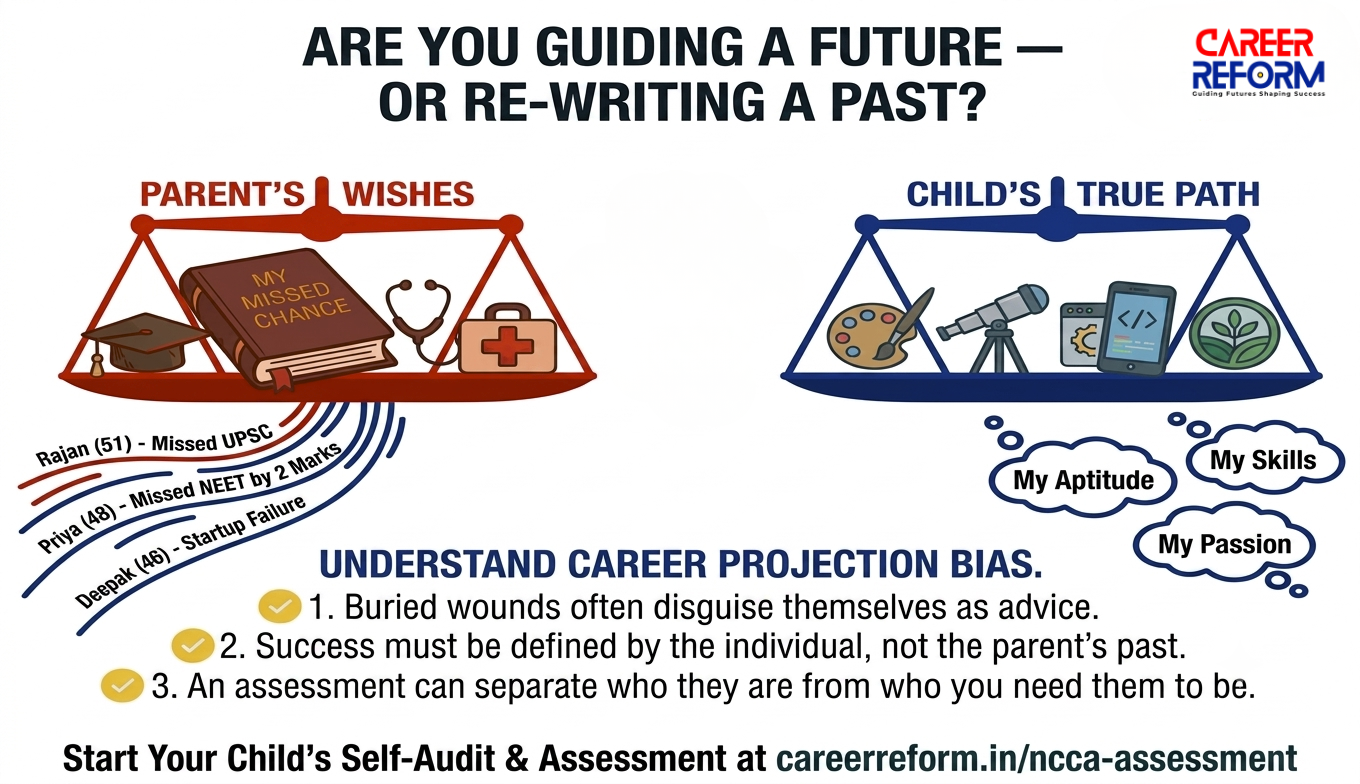
Rajan is 51. He spent three years of his youth preparing for the IAS exam. He didn’t clear it. He joined a PSU instead, built a decent life, and hasn’t spoken about those three years to anyone — except, quietly, endlessly, to his 17-year-old son.
Priya is 48. She was two marks short of the NEET cutoff the year she appeared. She became a pharmacist. A good one. But in her mind, it was a consolation prize. Her daughter is now in Class 11, and Priya reviews her Biology notes every evening with an intensity that belongs, if we’re being honest, to someone writing the exam herself.
Deepak is 46. His startup failed at the Series A stage. It cost him four years, some savings, and a great deal of pride. He tells his son — regularly, calmly, with the measured tone of experience — that stability matters. That passion is for people who can afford to fail. You should secure a job first, then follow your dreams.
Three parents. Three children. Three sets of career decisions are being made — with the child’s name on them, but the parent’s wound underneath.
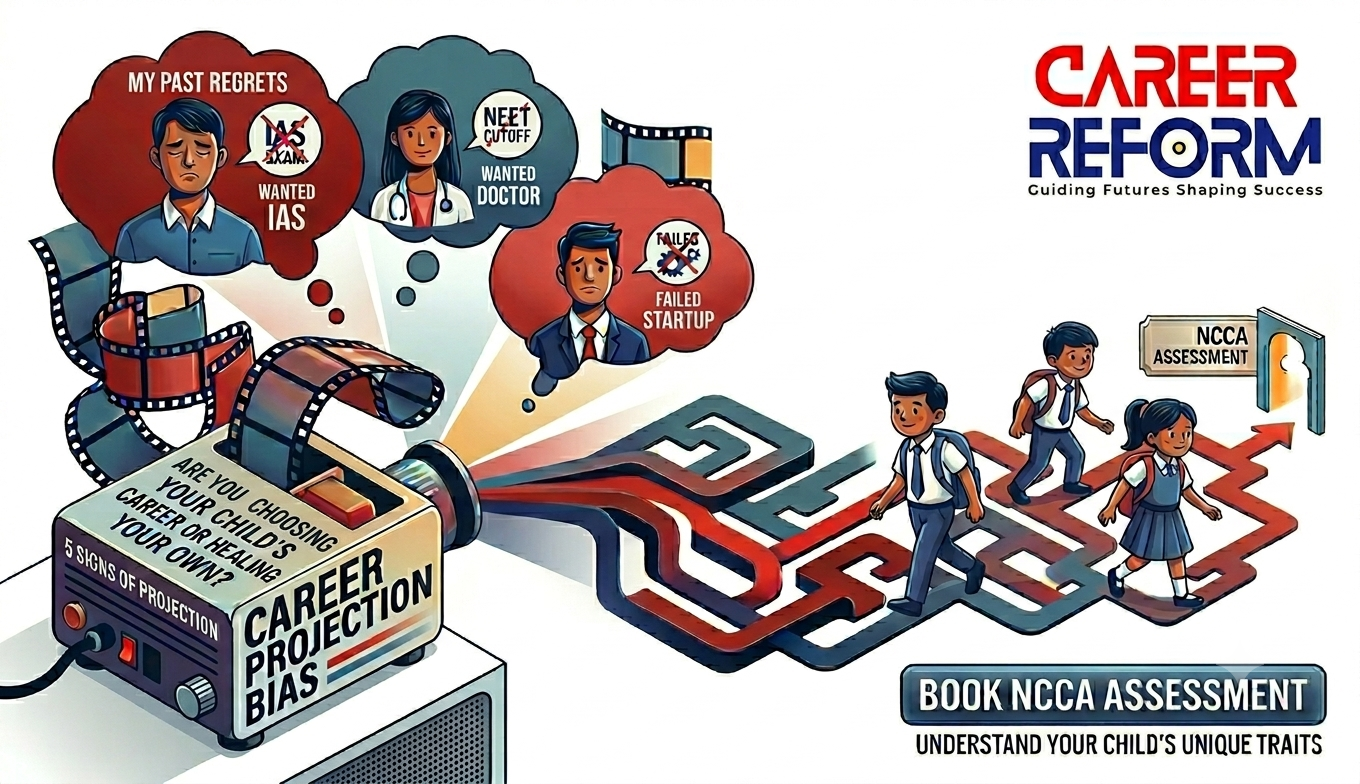
The Career You Wish You’d Had
There’s a concept that needs a name in Indian parenting conversations, so let’s give it one: Career Projection Bias.
It’s not malice. It’s not even conscious. It’s the deeply human tendency to look at our children’s future as an opportunity to correct the past — to replay the game we felt we lost, this time with a better ending.
Every parent who has ever said “I just want what’s best for my child” means it. Completely. But sometimes, buried just beneath that sentence, is another one: I want what I never got. Or: I want them to avoid what broke me. Or, most quietly: I want to finally be able to tell people that someone in our family made it.
This is not a character flaw. It is, in fact, a very human impulse. The problem is that it gets mistaken for guidance — by parents, and eventually by children, who learn to stop trusting their own instincts because every instinct gets corrected at the dinner table.
5 Signs You Might Be Projecting
Read these slowly. There’s no score at the end. There’s just what you notice.
- Your reaction to their “off-script” interest is disproportionate.
Your child mentions they want to study design, psychology, or marine biology. Notice what happens in your body before you say anything. Is it curiosity? Or is it a spike of something that feels like a threat? That spike — the one that makes you immediately list reasons it won’t work — often has less to do with the field and more to do with your own idea of what safety looks like. And your idea of safety was shaped by your own history, not theirs.
- You need to tell people what your child is studying.
Not because you’re proud of them — but because of how you feel in the silence between the question and your answer. If your child’s career choice makes you feel like you have something to prove in social situations, ask yourself: to whom? And about what? Because it’s rarely about them.
- You feel physically anxious around their results — more than they do.
There is a difference between caring and carrying. When a child’s exam results land harder on the parent than on the child, something has transferred. The child has, unconsciously, become the repository of unresolved ambition. Their 94 percent feels like your redemption. Their 78 percent feels like your failure. That’s a very heavy thing to put on a teenager’s shoulders without realising you’ve done it.
- You’ve already told them what they’ll study — before the assessment.
Not suggested. Told. “You’ll do engineering.” “Medicine is the only option we’re considering.” If the conversation about your child’s career has already concluded before you’ve actually heard from your child about their interests, aptitudes, or desires, you are not doing career counselling. You are doing something else.
- You use the word “practical” as a conversation-ender.
Practicality is genuinely important. But notice when you reach for it. If “be practical” arrives every time your child expresses something that excites them — and never when they express something that merely conforms — it may be less about pragmatism and more about discomfort with a future you didn’t have access to.
Why This Isn’t About Blame
Here is what’s true: the parents most likely to project are also the parents who care the most.
The IAS father who pushes his son toward UPSC is not a villain. He is a man who knows, from painful personal experience, what it felt like to almost make it. He genuinely believes he’s giving his child a map. He is — just, perhaps, a map to a destination only he needed to reach.
The mother who reviews Biology notes every evening is not living vicariously in some cinematic, detached sense. She is present, involved, and attentive. She is doing everything a good parent does — except stepping back far enough to ask whether the dream she’s tending is hers or her daughter’s.
The startup father is protecting his child from humiliation. Real humiliation, that he personally survived. His caution is not weakness — it’s scar tissue.
But children are not wound-healers. They are not second chances. They are, inconveniently, their own people — with their own cognitive profiles, their own risk tolerances, their own sense of meaning. And when we forget that, even with the best intentions, we create a particular kind of damage that is very hard to name and even harder to undo: a grown adult who is excellent at someone else’s life.
What the Child Carries
Picture a 26-year-old sitting in a performance review at a company he joined because it was “stable.” He is good at his job. His parents are proud. At family gatherings, his career is mentioned with relief. And somewhere in the back of his mind — quietly, persistently — is the thought he has never said out loud: I wanted to make films.
He won’t quit. The EMI is real. The family expectation is real. The years already invested are real. So he adapts. He gets better at suppressing the thought. He learns to call his original dream “impractical” — in his own inner voice, now, not just his father’s. And by 35, he will give the same advice to his own child, with the same measured tone of experience, and genuinely believe it is wisdom.
This is how projection compounds across generations. Not through cruelty. Through love that never stopped asking the right question.
A Self-Audit: 7 Questions Before the Next Career Conversation
Take these seriously. You don’t have to answer them out loud to anyone.
- What career did I want that I didn’t pursue — and why? Write it down. Be specific. Because what you write here is the lens through which you are likely evaluating your child’s choices.
- If my child chose a field I’d never heard of and became genuinely happy and financially stable, would I feel proud — or cheated of something? Both answers are honest. Neither is comfortable.
- When I imagine my child’s future, whose voice am I using to describe success? Yours? Your parents’? The colony uncle whose son is in the US?
- Have I ever asked my child what they find genuinely interesting — and then sat with the silence long enough for them to actually answer? Not the polished answer they’ve learned to give you. The real one.
- If my child’s career were not a reflection of me at all — not my parenting, not my family name, not my success or failure — what would I want for them? The gap between your answer to this question and your actual behaviour is where projection lives.
- Whose anxiety are they managing when they do well in the subjects I’ve chosen for them? This one stings. That’s intentional.
- What would I need to believe about myself for my child’s unconventional choice to feel acceptable — even exciting? Sometimes the question about our children is really a question about our own unfinished business.
What Your Child’s Assessment Can — and Cannot — Tell You
There is a reason the NCCA’s metacognitive reflection section cannot be completed by a parent.
It’s not a technical limitation. It’s a philosophical one.
When your child sits down to respond to questions about how they think, what they notice about their own mind, what kind of problems feel meaningful to them — that section cannot be auto-filled. It cannot be researched. The AI assistance is disabled. Copy-paste is blocked. It has to come from them.
That is, genuinely, the point.
Because the NCCA report is not measuring the child you hoped to raise. It’s measuring the child you actually have — their cognitive profile, their reasoning patterns, their metacognitive awareness, the shape of how their particular mind works. Not the one you wish you’d had the chance to build. Theirs.
And what parents often find, when they read that report alongside their child, is that it opens a conversation they didn’t know they were allowed to have. Not “here is what you should do” — but “here is who you actually are.” And from that foundation, real guidance becomes possible. Not a projection dressed as advice. Guidance.
Start your child’s NCCA assessment here→
One Last Thing
If you recognised yourself somewhere in this piece — in Rajan, or Priya, or Deepak — that recognition is not something to be ashamed of. It is, in fact, a sign of exactly the kind of self-awareness that makes for a genuinely good parent.
The parents who project without knowing it are not reading articles like this. You are. That matters.
The question is just what you do with the discomfort. Whether you let it pass, or whether you let it change the next conversation you have with your child about their future.
That conversation — the one where you listen more than you redirect, where you ask more than you tell, where you stay curious about who they actually are rather than who you need them to be — that might be the most important career intervention you ever make.
And it costs nothing. Except, perhaps, a little of the story you’ve been telling yourself.
The Neuro-Cognitive Career Architecture (NCCA) is a progressive, 60-item psychometric assessment for students in Grades 8–12, aligned with OECD, PISA, and WEF frameworks. It takes 45–60 minutes and measures six dimensions — Cognitive Ability, Interests, Personal Traits, 21st-Century Skills, Subject Competencies, and Metacognition — generating a 3-page psychometric report, a custom 6-month action plan, and your child’s Early Employability Index (EEI). The Metacognition section requires a minimum of 50 words written independently by the student; AI assistance and copy-pasting are strictly disabled.
To start the assessment, visit careerreform.in/ncca-assessment.
Sania Q