

Prague isn’t just one of the most beautiful capitals in Europe — it’s also fast becoming a top destination for international students. With centuries-old architecture, a low cost of living compared to Western Europe, and a growing number of English-taught degree programmes, the Czech capital offers a compelling mix of academic quality and everyday charm. If you’re considering an undergraduate degree abroad, here’s what you need to know about studying in Prague, plus direct links to the universities offering English-language programmes.
Why Prague?
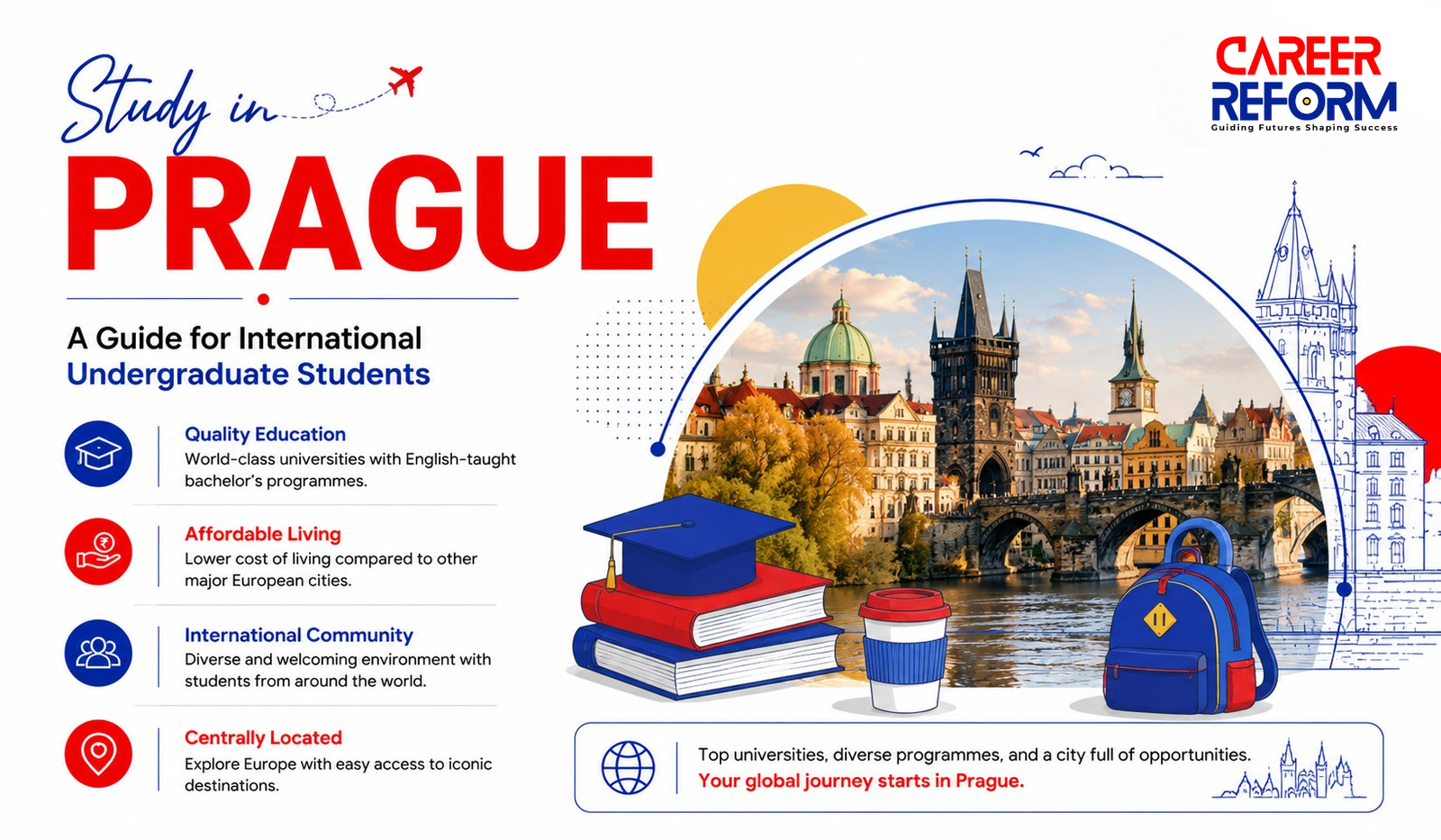
Prague combines a rich historical backdrop — think Gothic bridges, Baroque squares, and a skyline dotted with spires — with a modern, student-friendly city life. It’s centrally located in Europe, making weekend trips to Vienna, Berlin, or Budapest easy and affordable. The cost of living is notably lower than in cities like London, Paris, or Amsterdam, which makes it attractive for students managing a tight budget. Add to that a safe environment, reliable public transport, and a lively international student community, and it’s easy to see why Prague keeps climbing the list of preferred study destinations.
Universities Offering Undergraduate Programmes
Several public universities in Prague offer bachelor’s degree programmes taught in English, spanning fields from engineering and economics to fine arts and life sciences. Below are the main institutions, along with links to their official university pages and a sense of scale for each (based on the Study in Prague 2026/2027 consortium guide):
- Charles University — The oldest and most prestigious university in Central Europe, founded in 1348. It offers 28 English-taught bachelor’s programmes across fields from medicine and law to humanities and natural sciences, out of a student population of around 53,000, with roughly 23% international students and 1,350+ exchange partner destinations. University housing is available. Website: studycharles.cz | Contact: info@cuni.cz
- Czech Technical University in Prague (CTU) — A leading technical university known for engineering, informatics, and biomedical engineering, with 17 English-taught bachelor’s programmes among roughly 17,000 students (about 22% international). University housing is available. Website: studyatctu.com | Contact: study@cvut.cz
- Prague University of Economics and Business (VŠE) — Specializes in business, economics, and international relations, offering 5 English-taught bachelor’s programmes (including International Business and Economic Data Science) among around 14,000 students, with roughly 25% international students. University housing is available. Website: admissions.vse.cz | Contact: admissions@vse.cz
- Czech University of Life Sciences Prague (CZU) — Focuses on agriculture, environmental sciences, forestry, and related fields, with 10 English-taught bachelor’s programmes among about 19,000 students (roughly 25% international). University housing is available. Website: study.czu.cz | Contact: iro@czu.cz
- University of Chemistry and Technology, Prague (UCT Prague) — A specialized university for chemistry, food science, and material science, with 7 English-taught bachelor’s programmes among around 4,400 students (roughly 23% international). University housing is available. Website: study.vscht.cz | Contact: counsellors@vscht.cz
- Academy of Performing Arts in Prague (AMU) — For students pursuing film, theatre, music, and dance, with 3 English-taught bachelor’s programmes among about 1,500 students (roughly 13% international). No university housing available. Website: amu.cz/en | Contact: klara.banotova@amu.cz
- Academy of Fine Arts in Prague — A top choice for students interested in painting, sculpture, and other visual arts.
- Academy of Arts, Architecture and Design in Prague — Offers programmes in architecture, design, and applied arts, primarily at master’s level, among around 500 students (roughly 15% international). University housing is available. Website: umprum.cz/en | Contact: visualarts@umprum.cz
Tuition Fees by Programme (2026/2027)
Tuition for English-taught bachelor’s degrees varies widely by university and subject. Here’s a sample of representative annual tuition fees, drawn from the Study in Prague 2026/2027 guide:
| University | Sample Programme | Tuition (Standard) | Tuition (EU)* | Duration |
| Charles University | Liberal Arts and Humanities | ₹5,50,000 | — | 3 years |
| Charles University | Computer Science | ₹7,81,000 | ₹4,62,000 | 3 years |
| Charles University | General Medicine | ₹17,16,000–₹26,67,500 | — | 6 years (long-cycle) |
| CZU | Business Administration | ₹2,86,000 | ₹55,000 | 3 years |
| CZU | Informatics | ₹3,52,000 | ₹55,000 | 3 years |
| CTU | Mechanical Engineering | ₹4,84,000 | — | 3 years |
| CTU | Informatics | ₹5,72,000 | — | 3 years |
| VŠE | International Business (IBB) | ₹5,50,000 | — | 3 years |
| UCT Prague | Chemical Technology | ₹3,52,000 | — | 3 years |
| AMU | Photography | ₹9,68,000 | — | 3 years |
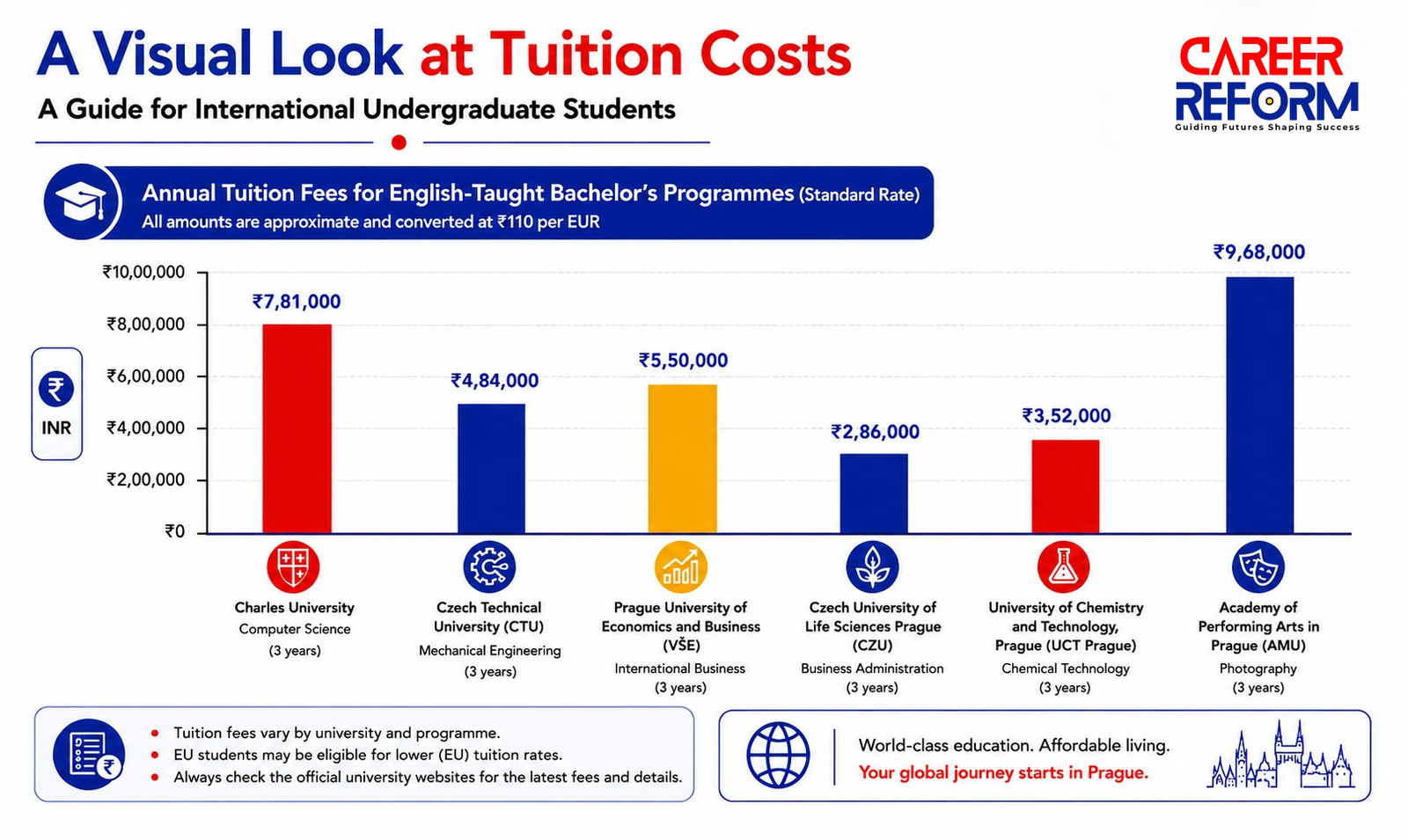 *EU-reduced rates apply only to select programmes and are also generally available to EEA and Ukrainian passport holders where noted. Tuition is charged per year and is subject to change based on currency conversion from Czech koruna. Figures shown in INR are approximate, converted at ≈₹110 per €1 (August 2026 rate) and will fluctuate with the exchange rate. For the complete list of programmes and fees, consult each university directly or the full Study in Prague programme guide.
The Admissions Process
Each university in Prague handles its own admissions independently, but the overall process tends to follow a similar path:
- Choose your programme and check its specific entry requirements — these vary not just by university but often by faculty within the same university.
- Submit an online application, usually along with a copy of your secondary school graduation certificate, a CV, and sometimes a motivation letter or portfolio (especially for art and design programmes).
- Prove your English proficiency — most programmes ask for an IELTS, TOEFL, or equivalent score, though some accept alternative proof such as prior education taught in English.
- Sit an entrance exam or interview, if required. Some technical and medical programmes include written or oral entrance exams; others rely purely on document review.
- Pay the admission fee, which is generally modest — often just a few hundred to a couple thousand CZK per faculty application.
- Get your foreign qualifications recognised. If your secondary education was completed outside the Czech Republic, it typically needs to go through a recognition (nostrification) process, which can take a few weeks and may involve certified translation.
Because requirements differ so much by faculty, it’s worth checking your target programme’s page directly rather than assuming one university’s process applies across the board. The Admission Requirements and Studies Recognition pages on Study in Prague are good starting points.
Application Timelines
Intake for undergraduate programmes at Prague’s public universities is almost always in the Fall semester, with only rare exceptions. Application windows vary meaningfully from one university to the next, so it’s worth checking the exact dates for your target institution:
| University | Application Period |
| Charles University | Start: Nov 1 · End: Feb 28 – Aug 31 |
| Czech University of Life Sciences Prague (CZU) | Start: Sept 15 · End: Jan 15 & Mar 31 |
| Czech Technical University in Prague (CTU) | Start: Sept 1 – Jan 1 · End: Mar 31 – Jun 30 |
| Prague University of Economics and Business (VŠE) | Start: Nov 1 · End: Feb 28 & Apr 30 |
| University of Chemistry and Technology, Prague (UCT) | Start: Dec 1 · End: Jan 31 |
| Academy of Performing Arts in Prague (AMU) | Start: Jan 1 · End: Mar 31 |
| Academy of Arts, Architecture and Design in Prague | Start: Mar 1 · End: May 15 |
A few things worth keeping in mind:
- Deadlines can be extended, and some universities and faculties continue accepting international applications even after their main deadline has passed — always check the current status on the programme website rather than assuming you’ve missed the cutoff.
- Some universities, like CZU and VŠE, run multiple deadlines within the same admissions cycle, so there may be more than one chance to apply within a given year.
- Because processing (admission decision, visa application, accommodation booking) can take months, it’s best to start researching programmes and requirements well ahead of the earliest deadline for your chosen university.
For the most accurate and current deadlines, always check the specific programme or faculty page rather than relying on general estimates, and keep an eye on Study in Prague’s Events and Deadlines calendar.
Scholarships and Financial Support
Czech public universities are already state-subsidised, so full-ride scholarships are less common than at some other destinations — but there’s still meaningful support available for international students, particularly at the bachelor’s and master’s level:
- Faculty-specific scholarships. Several faculties in the Study in Prague consortium run their own award schemes — for example, tuition-fee scholarships for standout Computer Science applicants, or development scholarships aimed at supporting students from abroad. Many of these can only be applied for after completing a first year or first semester of study, based on academic performance.
- The Professor Miroslav Vlček Scholarship. An annual award given by the Study in Prague consortium to an international student who has both excelled academically and helped promote the reputation and internationalisation of their university.
- Merit-based awards. Most faculties offer scholarships to students with strong academic results, awarded after at least one term or year of study rather than at the point of admission.
- Czech Government Scholarships. Run through the Ministry of Education, Youth and Sports, these are aimed primarily at students from select developing countries and cover degree or non-degree study.
- Studying in Czech instead of English. This isn’t a scholarship in the traditional sense, but it’s the single biggest way to cut costs — Czech-taught degree programmes at public universities are free of tuition for students of all nationalities, with only a small per-faculty administrative fee payable at application.
Because scholarship schemes are managed individually by each faculty or department, it’s best to check directly with your chosen programme once you’ve narrowed down your options. Study in Prague’s Scholarships and Fees page is a useful overview to start from.
Monthly Living Costs by University
Beyond tuition, it helps to budget for day-to-day living costs, which vary depending on where you study. The Study in Prague guide estimates an average of about ₹7,70,000 a year in living costs across the consortium (covering food, accommodation, public transport, miscellaneous expenses, and a phone package), with monthly costs by university breaking down roughly as follows:
| University | Cost per Month |
| Charles University | ₹11,000 – ₹55,000 |
| Czech University of Life Sciences Prague (CZU) | ₹18,700 – ₹57,200 |
| Czech Technical University in Prague (CTU) | ₹22,000 – ₹38,500 |
| Prague University of Economics and Business (VŠE) | ₹25,300 – ₹53,900 |
| University of Chemistry and Technology, Prague (UCT) | ₹19,250 – ₹33,550 |
| Academy of Arts, Architecture and Design in Prague | ₹28,600 |
Helpful Resources for Prospective Students
If you’re planning your application, the official Study in Prague portal is a good starting point. It has dedicated sections covering the study system, admission requirements, studies recognition, and scholarships and fees, along with an events and deadlines calendar to track application windows across universities.
For a closer look at specific degree programmes, several universities also publish downloadable brochures — for example, Charles University’s undergraduate programme guide and Czech Technical University’s overview of English-taught degrees are both available through the site’s brochure download page.
Frequently Asked Questions
Can I study for free in Prague? Yes — but only if you study in Czech. Czech-taught degree programmes at public universities in Prague are free of tuition for students of all nationalities, with just a small per-faculty administrative fee at application. English-taught bachelor’s programmes, by contrast, charge tuition ranging from roughly ₹1,10,000 to over ₹26,40,000 a year depending on the university and subject.
What are the minimum entry requirements for an undergraduate programme? Most programmes require a secondary school graduation certificate, proof of English proficiency (typically IELTS or TOEFL), and a completed online application. Some programmes — especially technical, medical, and art-based degrees — also require an entrance exam, interview, CV, motivation letter, or portfolio.
When should I apply to a Prague university? Applications typically open several months before the Fall intake, with deadlines ranging from late January (UCT Prague) to as late as August (Charles University). Because deadlines vary by university and admissions processing can take months, it’s best to start researching and preparing documents well ahead of your target university’s earliest deadline.
Are scholarships available for international undergraduate students? Yes, though full-ride scholarships are uncommon since public tuition is already state-subsidised. Support comes mainly through faculty-specific merit scholarships (often awarded after your first year or semester), the Study in Prague consortium’s Professor Miroslav Vlček Scholarship, and Czech Government Scholarships for students from select developing countries.
Do I need to speak Czech to study in Prague? No — not if you enrol in an English-taught programme, which is the case for most international undergraduates. Czech is only required for Czech-taught degrees, which are free but demand fluency from day one.
What documents does a foreign secondary school qualification need? If your secondary education was completed outside the Czech Republic, it generally needs to go through a recognition (nostrification) process before enrolment. This can take a few weeks and may require certified translation of your academic documents.
How much does it cost to live in Prague as a student? Living costs across the Study in Prague consortium average around ₹7,70,000 a year, though this varies by university — from roughly ₹11,000–₹55,000 a month at Charles University to ₹25,300–₹53,900 a month at the Prague University of Economics and Business, covering food, accommodation, transport, and other essentials.
Is university housing guaranteed for international students? Most Prague universities in the consortium — including Charles University, CTU, VŠE, CZU, UCT Prague, and the Academy of Arts, Architecture and Design — offer university housing. The Academy of Performing Arts in Prague (AMU) is the exception and does not provide university accommodation.
Final Thoughts
Studying in Prague as an undergraduate means access to affordable, high-quality education in a city that blends old-world charm with modern student life. Whether your interest lies in engineering, business, the arts, or life sciences, there’s likely a programme in Prague that fits — and with public universities generally more budget-friendly than private options elsewhere in Europe, it’s worth a serious look for anyone planning to study abroad.
Need help figuring out which programme, university, or country is the right fit for you? Visit careerreform.in for personalised guidance on your study-abroad journey.