

The students most likely to end up in the wrong career are not the ones who failed their boards. They are the ones who topped them.
Congratulations. Your child is a topper. The relatives have called. The WhatsApp groups have erupted. The coaching centre’s banner will carry their photograph. And now, somewhere in the next six weeks, you will make a decision about their stream, their college, and the trajectory of the next forty years — based almost entirely on the number printed on that marksheet.
This is the most dangerous moment in an Indian student’s life. The higher that number, the more dangerous it becomes.
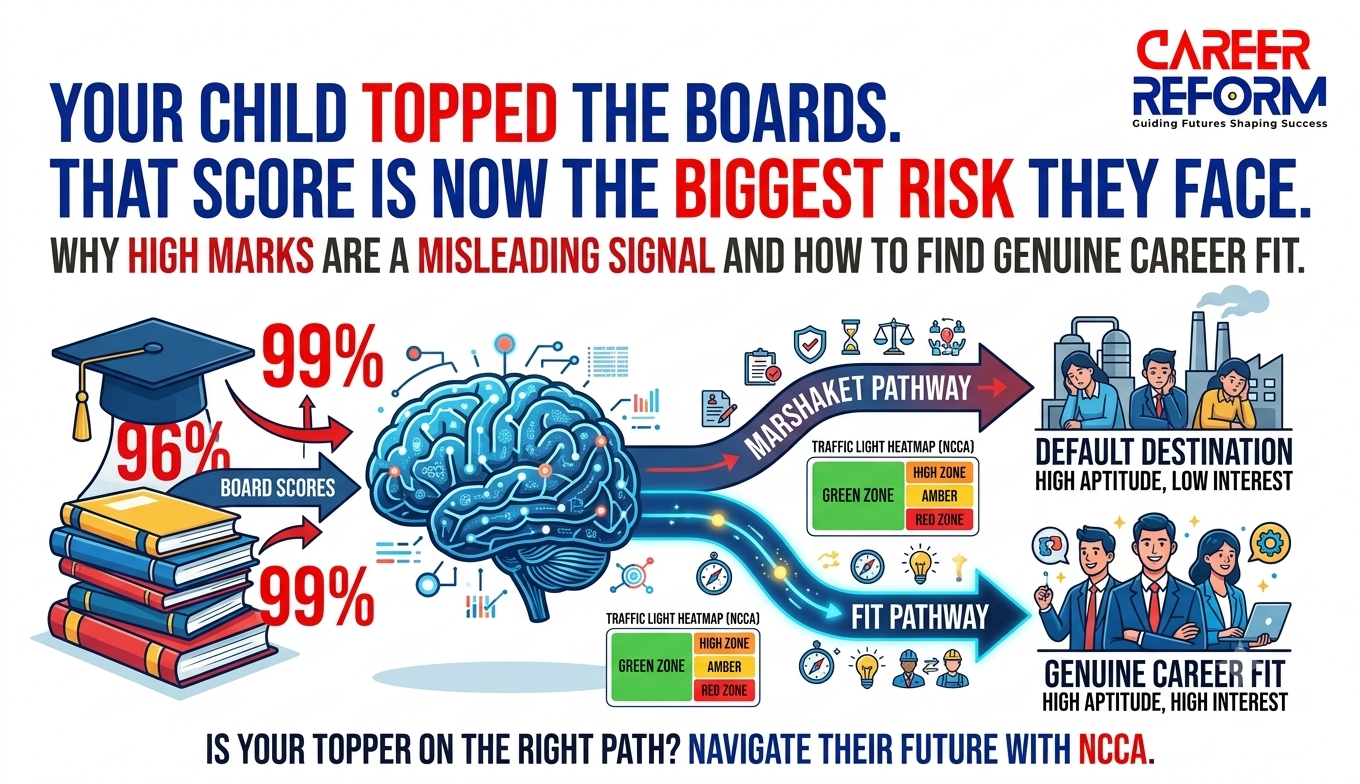
Here is what no premium counselling brand, no coaching institute, and no college admission consultant will tell you: Marks are not aptitude in disguise. They are discipline in disguise. And discipline, while admirable, is not a career map.
“High marks are the most misleading career signal in the Indian system. They measure compliance with curriculum, not fit with the profession.”
The Indian board examination system is among the most rigorous in the world at measuring one very specific skill: the ability to absorb structured content, reproduce it accurately under pressure, and do so across six to eight subjects simultaneously. Students who score 95% and above are extraordinary at this particular game. The problem is that this skill has an expiry date. Nothing that follows — not engineering, not medicine, not law, not finance — rewards the same skill in the same way. And yet we route students almost entirely on the basis of how well they played it.
CareerReform was built specifically because the existing career guidance ecosystem in India has a structural conflict of interest — coaching brands, admission consultants, and assessment platforms are all financially invested in specific outcomes for the students they advise. The Neuro-Cognitive Career Architecture — NCCA — was designed from the ground up to remove that conflict entirely from the assessment process. Every observation in this piece comes from that work — from sitting with students and families at exactly the moment this decision is being made and watching, repeatedly, how the system fails the very students it appears to serve.
The Decision That Actually Shapes Everything Begins at Class 10, Not Class 12
Most parents assume the critical career decision happens at Class 12 results. In reality, it begins two years earlier.
The stream selection decision after Class 10 — Science, Commerce, or Humanities — is made when a student is 15 years old, based on a board score, and with almost no structured understanding of aptitude or interest.
By the time Class 12 results arrive, the first wrong turn may already have been taken. A student guided into Science because their marks allowed it will spend two years preparing for an entrance exam in a field that may be entirely wrong for them, and their Class 12 score will simply reflect two years of effort pointed in the wrong direction.
If your child has just received Class 10 results, this piece is for you just as much as it is for parents of Class 12 students. The decision you are about to make is the same one, only two years earlier, with two additional years still available to course-correct.
A Pattern We See Repeatedly: The Topper Who Arrived at the Wrong Destination
Consider a student who scores 96% in Class 10 boards in a mid-sized Indian city. The school puts its name on a banner. Their parents, proud and naturally cautious, enrol them in JEE coaching within three weeks of the result.
The student was diligent, capable, and compliant. They cleared JEE Mains. They graduated from a reputable engineering college with a Computer Science degree and spent the next four years in software roles — performing well, receiving promotions, and feeling quietly hollow about all of it. By their late twenties, they are studying something else in the evenings and weekends. By their early thirties, they are attempting a full career pivot, at high financial and professional cost.
Students in this situation consistently describe the same feeling — that they were never bad at engineering, only uninterested in it, and that they never knew their interest was allowed to matter. That last part is the most important. Nobody told them. Not their school, not their parents, not the coaching centre that took their fees. The system was optimised entirely for capability and never once asked about curiosity. It is allowed to matter. It is, in fact, the only thing that matters over a forty-year career.
This is not a rare story. By our observation and by the broader data on Indian graduate outcomes, it is the most common result for a high-scoring student who never had their aptitude and genuine interests mapped separately from their marks.
Why Marks Cannot Tell You What You Actually Need to Know: The Aptitude–Interest Split
Career fit rests on two axes that board exams cannot measure.
Aptitude is the natural ease with which someone processes a certain kind of thinking — spatial reasoning, logical deduction, verbal abstraction, numerical pattern recognition, and interpersonal reading. It is not learned. It is the underlying cognitive wiring that makes certain kinds of work feel effortless and other kinds feel like sustained effort, regardless of how hard a person tries.
Interest is the domain that creates intrinsic motivation — where a person will voluntarily go deeper without being pushed, without a grade attached, without anyone watching.
These two axes are entirely independent of each other — and of board marks. A student can have high aptitude in an area with zero genuine interest in it. They can have a burning interest in an area where their aptitude is modest.
And in the most dangerous combination — which describes a significant fraction of Indian toppers — they can have high aptitude across everything. This makes them appear suited for any path, so they end up on the most prestigious path available rather than the right one.
Here is a concrete example. A student with high logical-mathematical aptitude and high interest in human behaviour is not an engineer waiting to happen. They are a potential psychologist, UX researcher, behavioural economist, or organisational consultant. Their marks would push them toward Computer Science. An honest fit map would point somewhere entirely different — toward a career where natural ability and genuine curiosity work together rather than run in parallel lanes that never meet.
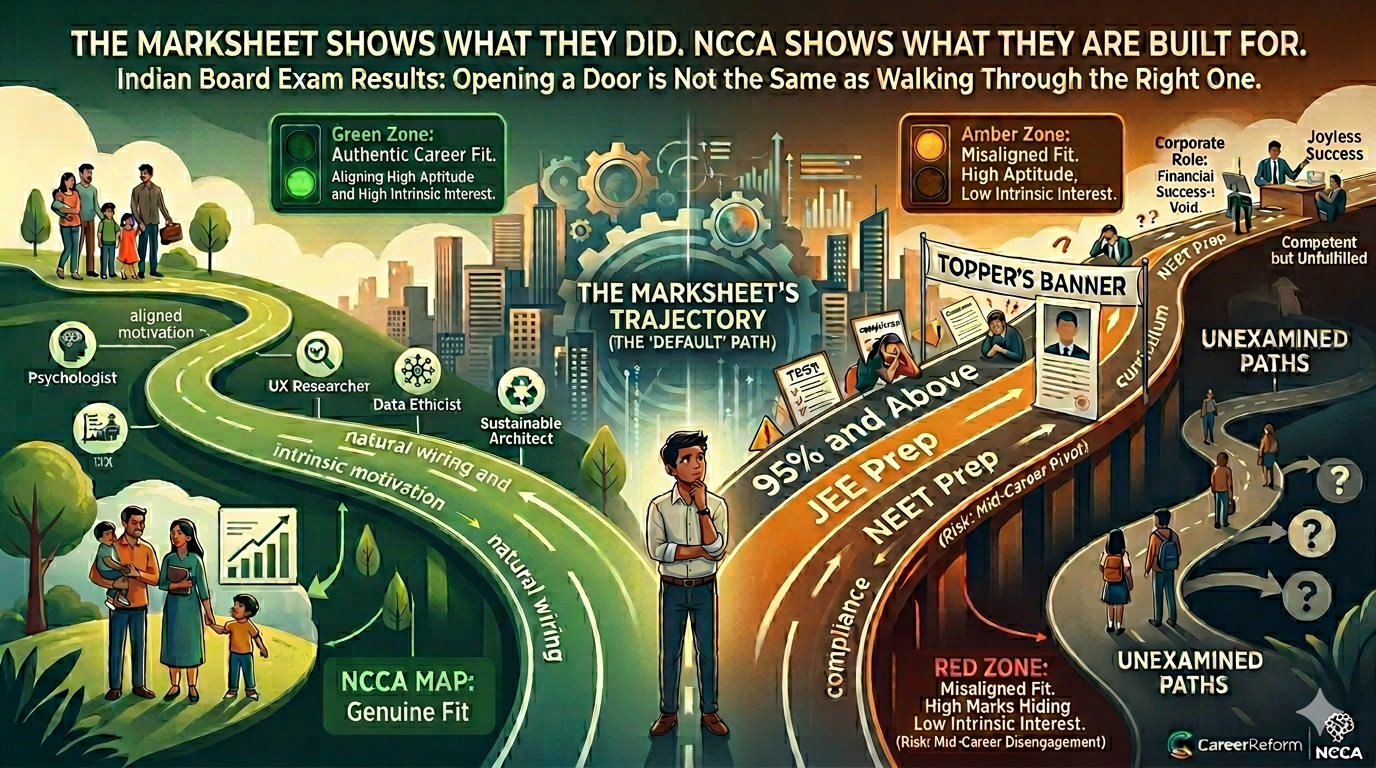
The marksheet shows you what your child did. It does not show you what they are built for.
Four Hidden Risks That Every Topper’s Parent Needs to Understand Before the Admission Rush Begins
Risk 1: Default-Pathway Capture — When the Score Decides the Stream
High scorers are routed into the best stream their marks allow — not the right stream, but the highest-ranked stream those marks make accessible. A student who scores 96% is pointed toward JEE prep before anyone asks whether they think in systems or in stories, whether they are energised by people or by problems, whether they want to build things or to understand them. The decision is made by the percentile, not the person.
Parents participate in this willingly because choosing a less prestigious path feels like wasting the score. But the score is about the past. The path is about the next four decades. These are not the same decision and must not be made using the same data.
Risk 2: Identity Fusion — When the Marksheet Becomes the Self
For a topper, the marksheet is not just a document — it is a self-concept. Twelve years of consistent academic validation build a fragile identity in which “I am good” and “I score high” become the same statement. Marks stop being a measure and start being a personality.
Then Year One of IIT or AIIMS arrives. The peer group is composed entirely of students who also topped their schools and built their identity around academic performance. Relative ranking collapses from top-of-class to middle-of-cohort, sometimes within the first semester. Without marks as their identity anchor, many high scorers experience genuine psychological crisis — anxiety, withdrawal, and sometimes clinical depression — at precisely the moment their technical education is most demanding. Student wellness data from IIT campuses has documented significantly elevated rates of anxiety, low self-worth, and disengagement among first-year students, a pattern that repeats consistently across institutions and batches.
The crisis is not academic. It is existential. Twelve years of validation taught these students that their worth is measured in percentages. When the percentage no longer places them at the top, they have no alternative measure of themselves to fall back on.
Risk 3: The Coaching-Industrial Complex — When Advice Is Not Actually Independent
Toppers are inventory. Premium coaching brands live on them. A student scoring 95% or above is simultaneously a prospect, a testimonial, a marketing asset, and a fee-payer.
The JEE and NEET coaching industry in India is a multi-billion-dollar industry, growing year on year. That scale does not exist because coaching centres are helping students find the right career. It exists because they are channelling high-scoring students toward the two or three pathways that generate the most revenue and the most visible proof-points for the next intake.
A counsellor affiliated with a JEE coaching brand has a direct financial interest in every student who enrols. This does not make such counsellors dishonest people. It makes them conflicted advisors — and conflicted advice, however well-intentioned, is not independent advice.
Before you accept any counselling recommendation this season, know what genuinely independent guidance looks like — and what it does not.
Independent guidance starts with your child. It asks about their thinking style, their voluntary interests, their energy patterns, and their long-term vision before it mentions a single stream, college, or entrance exam. It presents multiple paths — including unconventional ones — and explains the fit reasoning behind each. Conflicted guidance starts with the destination. It begins with JEE, NEET, or CA before it has asked a single question about who your child actually is. It presents options within a narrow band of pathways — always, coincidentally, the pathways the counsellor has a financial relationship with. It uses your child’s marks as the primary — sometimes the only — decision input.
The difference is not always obvious in the first meeting. Conflicted advisors are often genuinely enthusiastic, deeply knowledgeable, and completely sincere. The conflict is not in their character. It is in the structure of how they earn.
Ask yourself one question before you proceed: Does this person or organisation make more money depending on which path my child chooses? If the answer is yes, factor that into how you weigh their advice.
Risk 4: Late-Career Regret — The Quiet Crisis Nobody Talks About at 32
Look at any dataset of mid-career professionals seeking a switch in India. The overrepresentation of engineers is consistent and striking — not because engineering is a poor field, but because it absorbs so many students who were never engineers in the first place. They were toppers. The path of least resistance from a high science score led them to an entrance exam, the entrance exam led to a degree, and the degree led to a software or manufacturing role. A decade of competent, joyless work followed.
By 32, with a mortgage, a child, and ten years of domain-specific experience in a field they are not passionate about, the cost of switching is enormous — financially, professionally, and psychologically. The cost of staying, however, is a slow career diminishment that many never name aloud because the salary is acceptable and the résumé looks fine from the outside.
In every dataset we have reviewed — across graduate employability research, workforce mobility studies, and the career trajectories of our own assessment alumni — the pattern is consistent and striking. A large share of India’s most capable engineering graduates spend the second decade of their career entirely outside engineering. Not because they failed. Because they were never asked, at the moment it mattered most, whether engineering was actually where they wanted to go.
These are not failed students. These are some of India’s most capable and hard-working people. What failed them was not their effort — it was a selection system that asked only one question — how high did you score — when it needed to ask three.
Why the Smartest Students Are the Hardest to Help — and the Most Vulnerable to Getting This Wrong
There is a painful irony at the centre of all of this. The students who most need careful career mapping are the ones least likely to receive it, because their marks signal that they have already figured it out. Parents breathe easier. Teachers move on. Counsellors redirect their attention toward students who are visibly struggling. The topper is assumed to be fine.
They are not fine. They are overscheduled, under-examined, and being steered by a system that has no structural incentive to slow down and ask the right questions — because the right questions do not generate coaching fees, admission commissions, or ranking statistics.
“Every counselling brand celebrates toppers. None of them dares to suggest that the celebration is the problem.”
The right questions are not on any board exam paper.
Does your child’s mind move naturally through abstract logical sequences, or do they come alive with language and narrative? Do they seek people-problems or systems-problems when left entirely to their own devices? When they describe something they genuinely enjoyed learning — unprompted, outside school, with no grade attached — what kind of thinking did it involve? What did they choose to do during their last long holiday when no one set them a task and no marks were on the line?
These questions cannot be answered by marks. They require a properly designed aptitude and interest assessment, administered by someone with no financial stake in which path the student ultimately chooses.
Five Practical Things to Do Before You Book Any Coaching or Commit to Any Stream
These steps are useful regardless of which assessment you choose or which career direction you are considering. They cost nothing except time and an honest conversation.
- Ask your child what they do when no one is watching and no marks are involved.
The answer reveals more about genuine fit than any examination result. If they struggle to answer — if the honest answer is “I don’t know” — that itself is important information that deserves attention before any stream decision is made. - Look at their last three years of extracurricular choices and notice the pattern.
Not what they were pushed toward for a college application — what they chose voluntarily, returned to without prompting, or resisted stopping when time ran out. Sustained voluntary engagement is one of the most reliable early indicators of genuine interest. - Talk to professionals who are living the career you are considering — not people who sell admission into it.
Twenty minutes with a working architect, a practising psychologist, a journalist ten years into their career, or a UX designer is worth more than two hours with someone selling the degree that they hold. - Separate the question of college prestige from the question of career fit.
A prestigious institution in the wrong field produces a miserable, disengaged graduate. A good institution in the right field produces a motivated, curious one. Motivation compounds over four decades. Prestige does not. - Get an independent aptitude and interest assessment before committing to any stream.
Not one offered by a coaching brand with a financial stake in the outcome — an independent one, specifically designed to separate what your child has trained themselves to do from what they are naturally inclined toward, measuring both axes separately rather than inferring one from the other.
What the NCCA Traffic Light Heatmap Shows That a Marksheet Can Never Do
Most parents, when they hear “career assessment,” assume it is a more elaborate test that confirms what the marks already show — a sophisticated way of arriving at the same answer by a longer route. It should not work that way, and the NCCA is built on the understanding that it cannot.
In the NCCA framework, every student is mapped across both axes — aptitude and interest — measured independently of academic performance. The result is a Traffic Light Heatmap. And here is the part that consistently surprises parents when they see it for the first time:
Green does not mean high marks. Green means high aptitude and high interest aligned in the same direction at the same time.
🟢 Green Zone — High aptitude and high interest are both pointing the same way. This is a genuine career fit. Natural ability and intrinsic motivation work together. Pursue with confidence.
🟡 Amber Zone — High aptitude with low interest, or high interest with modest aptitude. Proceed with full awareness. The risk of eventual burnout, quiet disengagement, or a mid-career pivot is real and should inform the decision now rather than be discovered later.
🔴 Red Zone — Low aptitude and low interest in this direction. High marks may have hidden this entirely, because marks measure effort and compliance rather than underlying fit. Redirecting now costs a conversation and one Saturday morning. Redirecting at 32 costs a career.
Many toppers, when mapped honestly, find themselves in amber for the stream being pushed toward them — strong aptitude for engineering, low genuine interest in it, or clearly in green for something no one thought to ask about. The NCCA surfaces this before the admission decision is made, not a decade after it.
Honest Answers to the Questions Every Parent Is Already Thinking
“But what if my child actually wants to be an engineer?”
Then the NCCA will confirm it clearly, and you will proceed with confidence based on evidence rather than assumption. There is no argument here against engineering, medicine, law, or any other field. There is only an argument against choosing any field without first checking whether the fit is genuine. If it is, the assessment will show it — and you will know rather than hope.
“But won’t a lower-ranked stream limit their options?”
Only if career fit does not matter — and forty years of working evidence suggest it matters more than almost anything else. The risk of the wrong fit at a prestigious institution is substantially greater, over any meaningful time horizon, than the risk of the right fit at a less famous one.
“But we do not have time — admissions are only six weeks away.”
The NCCA takes one focused session. A career lasts forty years. The arithmetic is not complicated.
The Only Question That Matters Now
Your child worked for twelve years to earn that score. They sat through thousands of hours of classes, examinations, mock papers, and revisions. They did everything the system asked of them — and they did it exceptionally well. That deserves genuine, wholehearted celebration. But opening a door is not the same as walking through the right one.
The next decision — stream, college, career direction — is not a reward for past performance. It is a forecast about future fit. And forecasts require data that the marksheet was never designed to produce.
Your child’s marks tell you what they are capable of. They do not tell you what will sustain them at 24, challenge them meaningfully at 34, or still feel like theirs at 44.
The least you can do — the one thing the system will not do for them — is make sure the door that score opens is actually the right door. Not the highest-ranked one. Not the one that makes the best announcement in the school parents’ group. Not the one the coaching centre profits from. The right one.
If you know a parent whose child has just received their board results, share this piece. The conversation that starts is worth more than any coaching brochure they will receive this month.
“Your child’s marksheet shows what they did. NCCA shows what they’re built for.”
Take the Next Step — Book the NCCA Assessment Today
NCCA — Neuro – Cognitive Career Architecture
The NCCA is the only assessment in India designed specifically to separate marks from aptitude. It maps your child’s natural cognitive strengths and genuine domain interests independently, then shows you precisely where they align — and where they diverge.
No stream recommendation is made without both axes in view. No coaching brand receives a referral. No college partnership influences the result.
The assessment takes one session. The decision it informs lasts a lifetime.
→ Book the NCCA Assessment today.
The marksheet shows you what they did. CareerReform shows you what they are built for.