

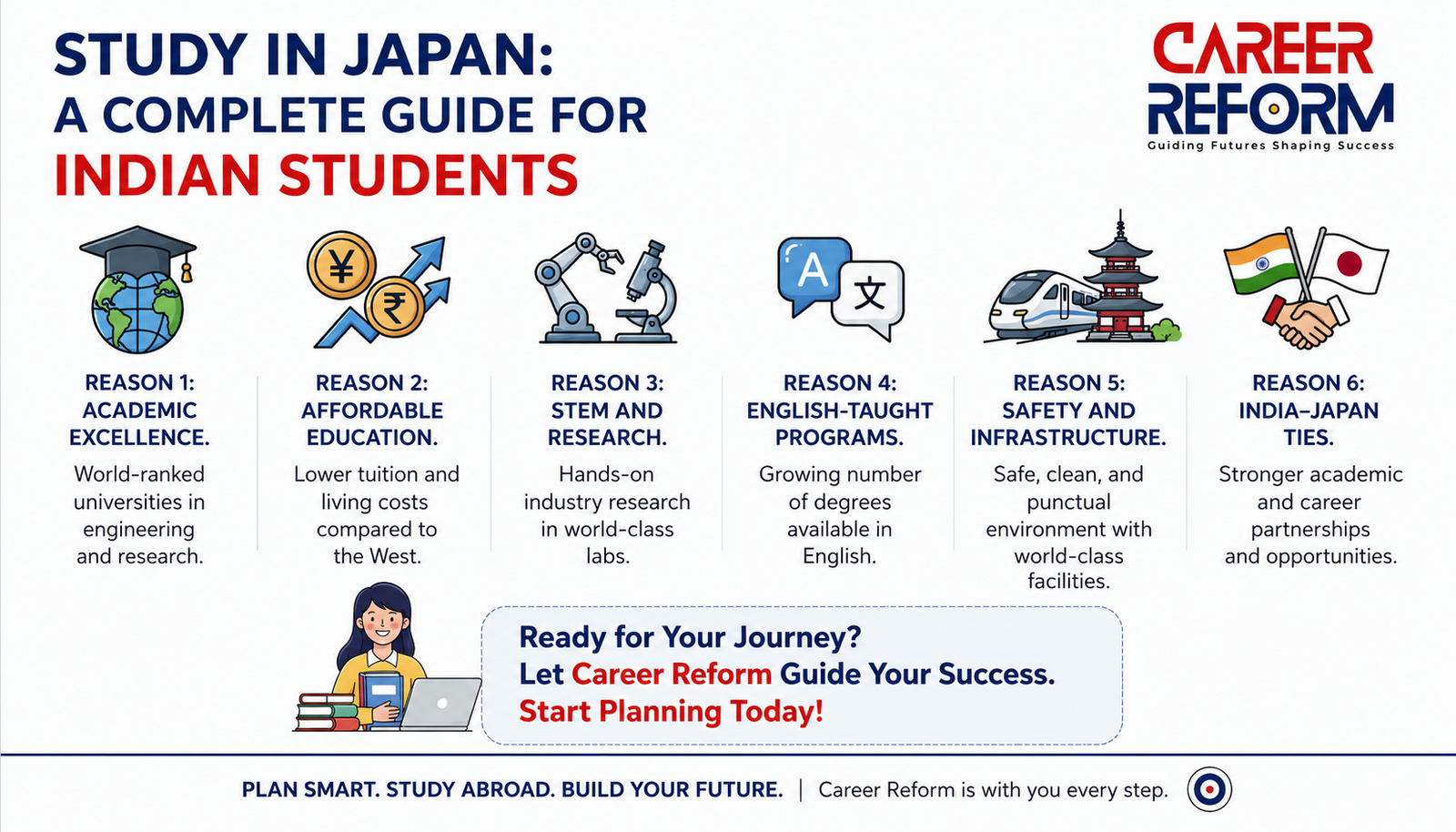
Japan has quietly become one of the most compelling study destinations in Asia for Indian students. It offers a rare combination: cutting-edge technology sitting alongside centuries-old tradition, world-ranked universities, government-funded scholarships, and a cost of living that undercuts most Western alternatives. As India and Japan continue to deepen their academic and strategic partnership, the path for Indian students to study, live, and eventually work in Japan has never been smoother.
This guide walks through everything a prospective student needs to know — from why Japan is worth considering, to the institutions, scholarships, and practical steps involved in getting there.
Why Japan Deserves a Spot on Your Shortlist
Japan’s appeal isn’t just about prestige — it’s about what the experience actually gives you.
A globally respected education system. Japanese universities consistently rank among Asia’s best, particularly in engineering, robotics, life sciences, and applied research. Degrees from institutions like the University of Tokyo or Kyoto University carry weight with employers across the world.
Genuinely affordable. Compared to the US, UK, Canada, or Australia, both tuition and living costs in Japan are markedly lower — even in Tokyo. For families weighing return on investment, this matters enormously.
A research-first culture. Japan is a global leader in robotics, automotive engineering, materials science, electronics, and sustainable technology. Students, especially at the postgraduate level, often work directly in labs alongside faculty on real, industry-linked research rather than purely theoretical coursework.
English-taught programmes are expanding fast. A decade ago, most degree programmes in Japan required fluency in Japanese. That’s changed dramatically. Universities now offer a growing number of bachelor’s, master’s, and doctoral programmes taught entirely in English — while still giving students the option to pick up conversational or professional Japanese alongside their studies, which significantly boosts employability later.
Exceptional safety and infrastructure. Japan is routinely ranked among the safest countries globally. Add to that its famously punctual public transport, clean cities, and low crime rate, and it becomes an easy place for international students — and their parents — to feel comfortable about.
Warming India–Japan ties. The two countries have been steadily building an education partnership. Following high-level diplomatic exchanges in 2026, both governments reaffirmed plans to expand Japanese language education in India and increase academic collaboration — a sign that the pipeline of opportunities for Indian students is only going to widen.
Understanding Japan’s Higher Education Landscape
Unlike some countries where “university” is the only real pathway, Japan offers several distinct routes depending on a student’s goals:
| Institution Type | What It’s Best For |
| Universities | Bachelor’s, master’s, and doctoral degrees |
| Graduate Schools | Standalone master’s and PhD research programmes |
| Junior Colleges | Two-year academic or vocational diplomas |
| Colleges of Technology (KOSEN) | Hands-on, practice-heavy engineering education |
| Specialised Training Colleges | Focused, career-oriented professional training |
| Japanese Language Institutes | Intensive language preparation before enrolling elsewhere |
| Short-Term Programmes | Semester exchanges and summer study-abroad options |
Students unsure of their exact path often start with a language institute or a short-term exchange before committing to a full degree — a low-risk way to experience Japanese academic life first.
For a complete, government-maintained overview of every pathway, visit the official Study in Japan portal.
Leading Universities to Explore
While there are dozens of strong institutions across the country, a few consistently stand out for international applicants:
- The University of Tokyo — Japan’s top-ranked and most internationally recognised university
- Kyoto University — renowned for research output and Nobel laureates among its alumni
- Osaka University — strong in medicine, engineering, and the sciences
- Tohoku University — a pioneer in accepting international and female students
- Hokkaido University — known for agriculture, environmental science, and a spacious campus
- Nagoya University — strong industry ties, particularly in automotive and materials research
- Kyushu University — growing reputation in engineering and international programmes
- Waseda University — one of Japan’s most prestigious private universities, strong in humanities and business
- Ritsumeikan University — known for its international relations and policy programmes
- Kyoto University of Advanced Science — a newer institution focused on applied sciences and engineering
Each of these offers a different mix of English-taught courses, scholarships, and research strengths, so it’s worth comparing specific departments rather than choosing on reputation alone.
Funding Your Education: Scholarships Worth Knowing
Cost is often the deciding factor for Indian families, and Japan makes a genuine effort to keep education accessible through several scholarship routes:
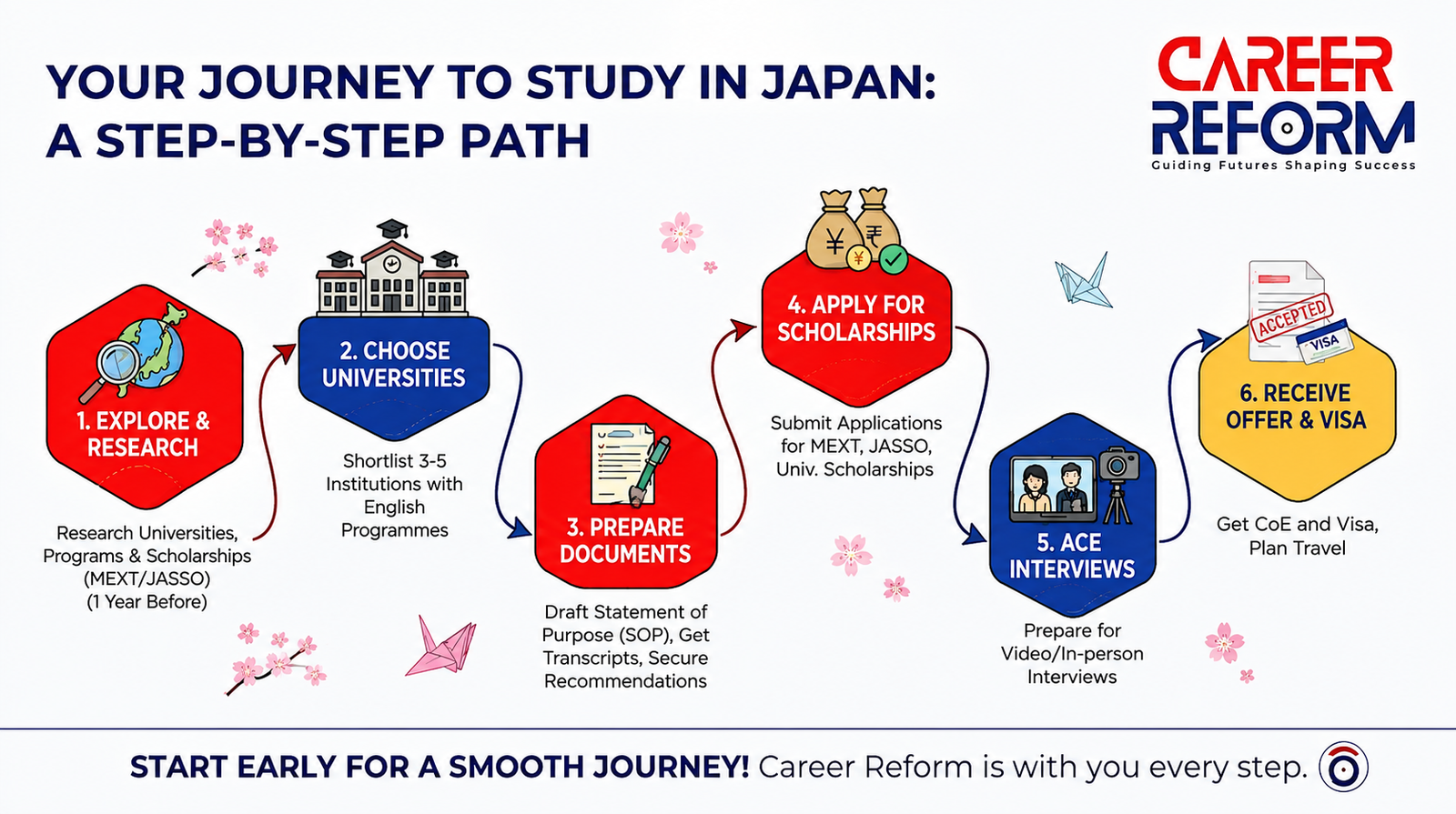
MEXT Scholarship (Japanese Government Scholarship) — The most prestigious option. It covers tuition fees in full, provides a monthly living stipend, and includes round-trip airfare for selected students. Competition is high, but so is the payoff.
JASSO Scholarships — Aimed at supporting self-funded international students already enrolled at recognised Japanese institutions, offering meaningful financial relief even if you’re paying your own way.
University-Specific Scholarships — Most universities run their own scholarship and tuition-waiver schemes based on academic merit, and many supplement these with support from local governments and private foundations.
It’s worth applying for multiple scholarships simultaneously, since eligibility criteria and deadlines vary widely between programmes.
Is Japan the Right Fit for You?
Japan tends to suit students who:
- Are drawn to STEM fields — engineering, robotics, AI, electronics, or computer science
- Want to study at research-intensive, lab-driven universities
- Are interested in business, design, architecture, or international relations
- Are looking for a rigorous education without US or UK-level costs
- Are genuinely open to learning a new language and adapting to a different culture
- Prioritise safety, order, and a high quality of daily life
- Hope to build a career in globally connected tech or manufacturing industries
If several of these resonate with you, Japan is worth serious consideration — not just as a backup option, but as a first choice.
 What This Journey Can Actually Look Like
The following is an illustrative, composite scenario — not the story of a specific individual — meant to show how these decisions typically play out.
When Meera’s school counsellor announced an opportunity to apply for the MEXT Scholarship to study in Japan, a ripple of quiet dismissal went through the room. A solid but unremarkable student by her own admission, Meera almost let the moment pass with everyone else.
But she stayed back after the session anyway. She asked what the eligibility criteria actually were — not what she assumed they were. That single question changed things. Her counsellor walked her through the requirements line by line, helped her shortlist two universities whose research genuinely matched her interests, and read her Statement of Purpose so many times that Meera lost count — pushing her, each round, to cut the generic lines and write about what she actually cared about.
The months that followed weren’t dramatic. There was no single breakthrough moment — just steady, unglamorous work: tightening her academic profile, reading up on prospective supervisors late at night, running through mock interview questions until the nervous stammer disappeared. Progress that was easy to miss day to day, and only visible in hindsight.
Then, one ordinary afternoon, the email arrived.
Meera had been awarded the MEXT Scholarship — tuition, stipend, and airfare covered in full.
Looking back, she’s clear about one thing: the scholarship wasn’t won in the interview, or even in the final draft of her essay. It was won the day she stayed back after the session instead of quietly walking out with everyone else.
Her story is proof that the gap between a passing announcement and a life-changing outcome is often smaller than it looks — and it usually closes the moment a willing student meets a counsellor who takes the time to guide them.
Getting Started
Studying in Japan rewards early planning. Application cycles, scholarship deadlines, and language requirements vary significantly by university and programme, so students should begin researching at least a year in advance. A good starting point is comparing English-taught programmes across two or three target universities, checking their specific scholarship offerings, and noting application deadlines well before they arrive.
Final Thoughts
Japan offers something increasingly rare in global higher education: genuine academic rigour, meaningful financial support, and a safe, well-run environment — all without the price tag typically attached to a Western degree. For Indian students willing to embrace a new language and culture alongside their studies, Japan isn’t just an alternative to the usual destinations. It’s a strong contender in its own right, and with India–Japan educational ties only growing stronger, the timing has rarely been better.
Ready to take the next step? Choosing the right university, scholarship, and application timeline can be overwhelming to navigate alone — and small mistakes in your MEXT or JASSO application can cost you a seat. At Career Reform, our counsellors help Indian students shortlist the right Japanese universities, build scholarship-ready applications, and stay on top of every deadline that matters.
Want to go deeper? Download our free Japan study e-book for a complete breakdown of universities, scholarships, and application timelines — or get in touch with Career Reform today and turn your Japan study plan into an offer letter.