

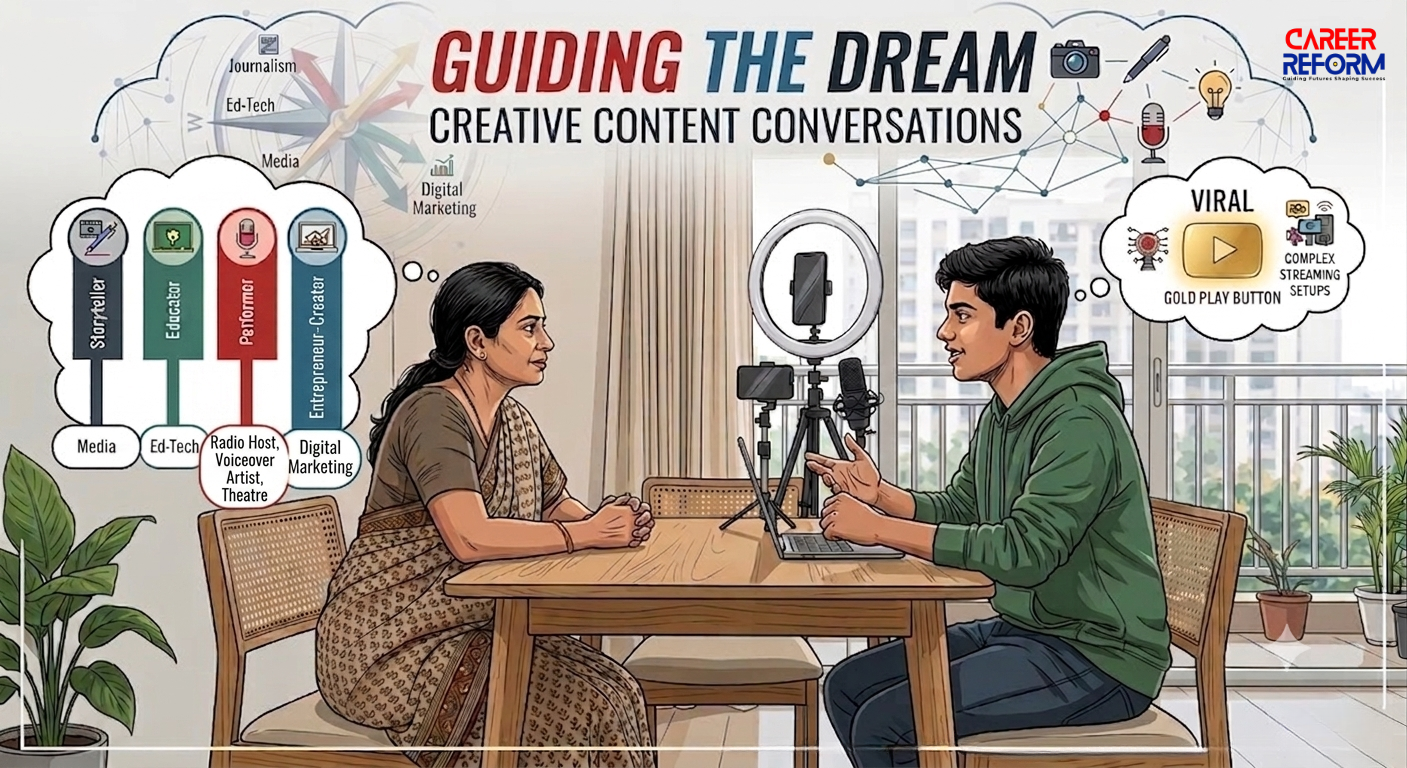
Your child sits across from you and says it. Maybe it’s YouTube. Maybe it’s Instagram Reels, a gaming stream on Twitch, or a podcast about cricket statistics that somehow already has 200 listeners. The exact platform changes. The look on their face doesn’t: half-terror, half-conviction.
And now you have about four seconds to respond in a way that neither crushes something real nor validates something catastrophic.
Most parents say one of two things. They say no — and spend the next three years watching their child lose interest in everything, including the studies they were supposed to protect. Or they say yes — and watch a promising teenager bet their future on a channel that peaks at 800 subscribers and a brand deal for a protein supplement nobody asked for.
There is a third option. It requires knowing something most parents don’t.
The Numbers Are Real. So Is the Graveyard.
India’s creator economy is not a fantasy. It is projected to cross ₹3,000 crore by 2026, and the trajectory has only accelerated. There are more than 50 million content creators in India. Several hundred thousand of them make a living. A few thousand make an excellent living. And a handful — the ones your child is mentally comparing themselves to — have built genuine media empires.
Here is the number nobody leads with: the overwhelming majority of people who try to build a creator career do not succeed — not on the timelines they imagine, not in the formats they start with, not by the metrics they originally set for themselves.
That’s not a reason to say no. It is a reason to think carefully.
The creator economy is brutally bottom-heavy. The top 1% capture a wildly disproportionate share of revenue, brand deals, and audience. The long tail of “almost made it” creators — people with 40,000 subscribers and ₹8,000/month in AdSense — is enormous. And those are the ones working hardest.
Here is what that means for you as a parent: the question is not “is the creator economy real?” It is. The question is not even “can my child succeed in it?” Some can. The only question worth asking is: what kind of creator ambition does my child actually have?
Because the answer to that question determines everything — the realistic ceiling, the realistic floor, and the career waiting on the other side if the channel never takes off.
The Four Archetypes of Creator Ambition
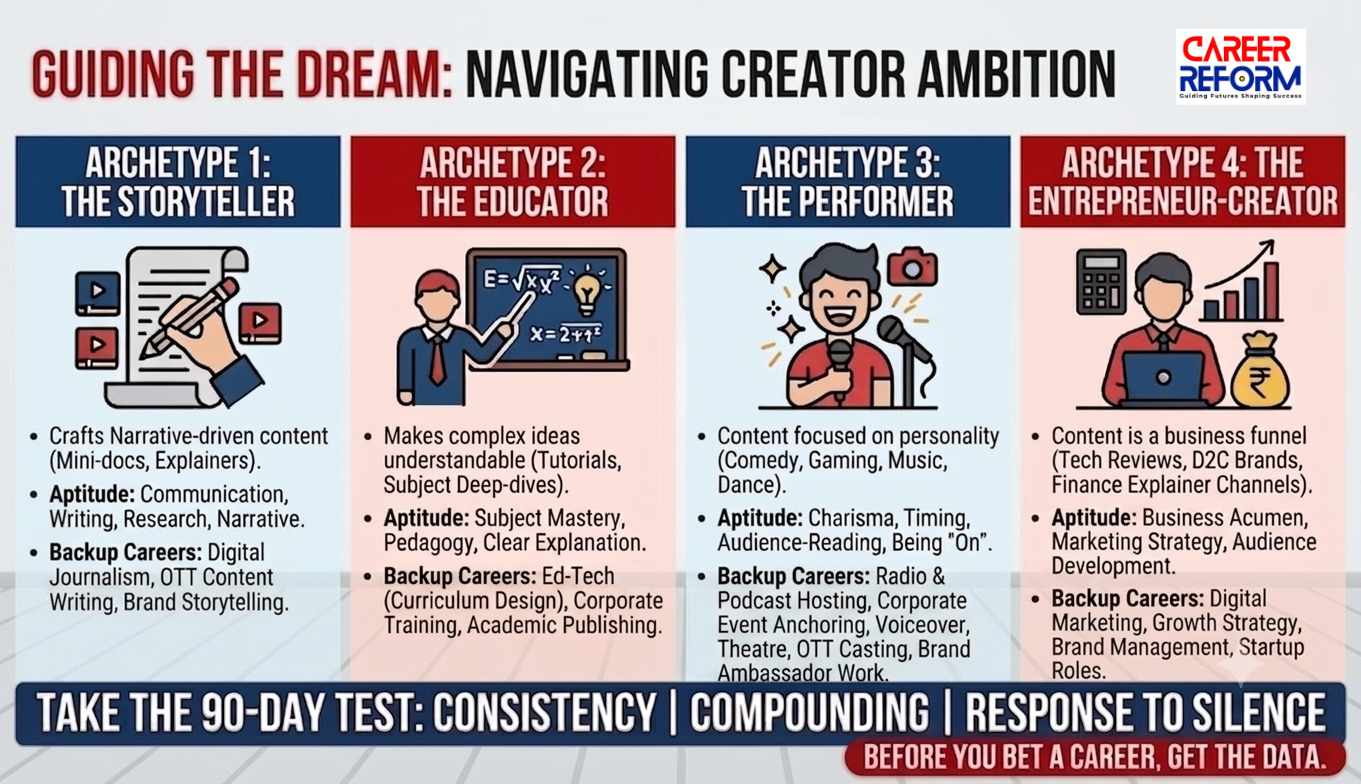
In every career counselling conversation we have about this topic, creator ambition takes many shapes. But underneath the surface, it almost always falls into one of four types. Parents who understand the difference make better decisions. Children who understand it make fewer catastrophic ones.
Here’s how to identify which one you’re dealing with.
Archetype 1: The Storyteller
Picture a teenager who spent three weekends editing a ten-minute video about why a certain Bollywood film was structurally brilliant — and is now re-editing it because the pacing in the second act bothers them. Nobody asked them to make it. Nobody is watching it yet. They made it because the argument in their head demanded to exist outside their head. That’s a Storyteller.
What they make: Narrative-driven content — mini-documentaries, essay videos, long-form explainers, commentary with a genuine point of view. Content that argues something rather than just entertaining.
The tell: They’re not just making videos, they’re writing them. They draft scripts. They rewatch their own content and find the pacing annoying. They reference Dhruv Rathee not because of his subscriber count, but because of how his arguments are structured. They care more about whether the thing they made is good than whether it performed.
The underlying aptitude: Communication, narrative construction, research, synthesis of complex information. This is, at its core, a journalism and media skill set — wearing a YouTube costume.
What if it doesn’t work? This archetype has the widest legitimate career floor of all four. A Storyteller has a natural path into digital journalism, OTT content writing, documentary production, brand storytelling, public policy communication, and ed-tech content strategy. And here’s the thing: even a “failed” YouTube channel — if the work was genuinely good — is a portfolio. It opens doors in ways a blank CV never does.
The skills are transferable almost one-to-one. A Storyteller who never goes viral is still a writer who knows how to hold an audience. That person is valuable, and they know it.
Archetype 2: The Educator
Think about the student in your child’s class who explains concepts to others before exams — not because they were asked to, but because watching someone misunderstand something they understand perfectly is physically uncomfortable. Now imagine that student with a camera. That’s an Educator.
What they make: Tutorials, explainers, subject deep-dives, the kind of content that makes a viewer comment: “I’ve had this explained to me six times, and it never clicked until now.” The subject could be JEE chemistry, Python programming, ancient Indian history, or personal finance — what matters is that they genuinely know it cold, and they’re frustrated that it isn’t being taught better.
The tell: Comments saying “this finally made sense” motivate them more than view counts do. They get irritated by bad explanations. They’ve already been tutoring classmates informally. They care about whether their viewer understood, not just whether their viewer watched.
The underlying aptitude: Subject mastery, pedagogical instinct, the ability to decompose a complex idea into something a stranger can follow. This is a teaching and training skill set — and it is more valuable than most parents realise.
What if it doesn’t work? Ed-tech in India is a market worth over ₹33,000 crore. The online learning content segment alone runs on exactly this kind of talent. Instructional design, curriculum development, corporate training, academic publishing — every one of these fields is actively looking for people who can explain difficult things clearly. The educator-creator who moves into ed-tech isn’t taking a backup plan. They’re taking a parallel career, often a better-paid one.
The honest assessment: This is the most underestimated archetype in every conversation we have with parents. “Teaching videos” sounds unglamorous. But the economics of educational content are more durable than entertainment — people pay for learning in ways they simply don’t pay for passive entertainment. An Educator-creator has a career whether or not the channel ever trends.
Archetype 3: The Performer
Here is the most important thing to understand about this archetype before anything else: it has the highest ceiling and the most brutal floor. The gap between a successful Performer-creator and an unsuccessful one is wider than in any other category. This is the archetype that most requires honest self-assessment — because enthusiasm and talent look identical until the camera is on.
What they make: Entertainment-first content — comedy, gaming streams, reaction videos, music, dance, anything where the personality is the product. The Performer isn’t conveying information or building a business. They are the content.
The tell: They are genuinely magnetic on camera in a way that is hard to fake — and they usually know it. They get energy from an audience, even a small one. Performing isn’t something they do for metrics; it’s something they do because not performing feels like suppression. Their early videos, even the rough ones, have something in them. You can feel it.
The underlying aptitude: Charisma, comic timing, audience-reading, the ability to be consistently “on” — a broadcasting and performing arts skill set that some people are born with and others simply aren’t.
What if it doesn’t work? The backup paths exist — radio and podcast hosting, brand ambassador work, corporate event anchoring, voiceover, theatre, OTT casting — but they require deliberate cultivation. A Performer-creator who treats their channel as a portfolio for the broader entertainment industry has real options. One who treats it purely as a route to viral fame has very few. The difference between those two is whether they take the craft seriously or just the audience.
The 90-day test (coming up below) matters most for this archetype. Performance talent reveals itself fast — and so does its absence.
Archetype 4: The Entrepreneur-Creator
This one is the most interesting to counsel, because it’s the least likely to look like a creative ambition from the outside. It often looks, to parents, like a child who has simply found a new way to avoid studying. It rarely is.
What they make: Content that is secretly a business. A tech review channel building toward affiliate revenue. A cooking channel that is actually a D2C brand in its first chapter. A finance explainer channel that is a funnel for a future advisory service. The content is real — but it’s also a distribution strategy, and they know it.
The tell: They’re already thinking about monetisation without being told to. They’ve researched brand deal rates. They know what CPM means. They’re far less interested in “going viral” than in building something that compounds over time. They may have already sold something small — merch, a PDF, a service. They talk about their channel the way a founder talks about their startup: in terms of audience, retention, and revenue, not views.
The underlying aptitude: Business acumen, marketing strategy, audience development, operational thinking. This is an entrepreneurship skill set with a personal brand layer on top.
What if it doesn’t work? These students were always going to end up in business or marketing. The channel is accelerating an education they would have received anyway — often better than a classroom could deliver. Digital marketing, growth strategy, brand management, and early-stage startup roles are a natural fit. Many of the most successful founders in India’s consumer internet space built a personal brand before they built a company.
The honest assessment: This archetype needs the least convincing, because these students already have a grounded sense of what they’re building. The risk isn’t failure — it’s distraction. Content creation can become an escape from the harder operational work of building something real. Watch for the channel that’s all strategy and no product.
The 90-Day Test (Before Anyone Bets a Career on This)
Stop. Before you make any decision — before you say yes, before you say no, before you sit your child down for a serious conversation about their future — do this instead.
Run an experiment.
Give your child 90 days. One piece of content per week, minimum — not “I’ll post when inspiration strikes,” but a committed, calendar-blocked output. No pressure on views or subscribers. No talk of quitting school or switching streams. Just 90 days of showing up and making things. At the end, you are looking for four things:
- Consistency without external accountability. Did they do it when no one was checking? Not when you reminded them, not when their friend was watching, not when they were in a good mood — just consistently, week after week, because the work pulled them? This is the single most reliable predictor of long-term creator success. The content industry has no teacher marking attendance, no parent asking if the assignment is done. The creators who last are the ones who don’t need to be reminded.
- Evidence of compounding. Did the work get better? Did the second video show something the first didn’t? Did the fifth show something the second couldn’t? Compounding in content creation is slow — painfully slow at the start — but it should be visible at the margin. A child who isn’t improving after 90 days of consistent effort is telling you something important.
- Response to silence. Most creators, in the first 90 days, post into near-silence. Three views. A comment from a cousin. Nothing. How did your child respond to making something and having the world not notice? Did they spiral? Quit quietly? Or did they shrug, study what didn’t work, and try differently next week? That response — not the subscriber count — tells you everything about whether this is a genuine vocation or a fantasy about the destination.
- What they built, not what they dreamed. The plan in their head is irrelevant. At the end of 90 days, there is either a real body of work or there isn’t. Even three months of consistent content tells you which archetype your child actually belongs to, whether the aptitude is there, and whether the ambition can survive contact with reality.
This test costs 90 days. The alternative — letting ambiguity fester for three years while JEE prep and YouTube pull in opposite directions, with no resolution and growing resentment on both sides — costs considerably more.
But How Do You Know Which Archetype You’re Dealing With?
Here is the honest answer: most students don’t know either. They know they want to create. They don’t always know why, or which archetype fits, or whether the drive is genuine or an escape from something harder. They can’t always tell you whether their aptitude matches their ambition — because they’ve never had anyone help them look at it clearly.
That’s where the NCCA assessment comes in.
The combination of Personality profiling, Cognitive Flexibility analysis, and Personal Traits mapping reads very differently for each of the four archetypes. A student who thinks they want to be a YouTuber but scores high on analytical depth and low on performance-drive is almost certainly a Storyteller who needs a different medium, not a different career. A student who scores high on audience-orientation and persuasion alongside strong business instincts isn’t a creator at all — they’re a future media founder. The difference matters enormously when you’re advising a 16-year-old on where to put the next three years of their life.
The data won’t decide for you. But it will replace a circular argument — “content creator vs. studies” — with an actual conversation: what does this child’s profile tell us about where they’re genuinely suited, and what’s the smartest path from here?
That’s a conversation worth having. And it’s a lot more useful than four seconds of instinct.
Before you let your child quit JEE prep for a YouTube channel — or before you dismiss a talent that deserves to be taken seriously — get the data.
The creator economy is real. So is the graveyard at the bottom of it. The difference between the two isn’t luck, and it isn’t passion. It’s knowing, with clarity, which kind of creator you actually are.
The NCCA report is where that clarity starts.
Sania Q