

Choosing an undergraduate program used to mean picking between a handful of familiar branches — Computer Science, Mechanical, Electrical, and a few others repeated across every engineering brochure in the country. That era is ending.
In 2026, India’s most selective institutions are no longer just expanding intake in existing branches — they are building entirely new degrees around the technologies and challenges that will define the next decade: artificial intelligence, quantum computing, cybersecurity, climate systems, and the deepening overlap between engineering and business.
Several IITs, IIMs, IISc, and IIITs have introduced new BTech and BS programs for this admission cycle, most reachable through JEE Main, JEE Advanced, or JoSAA counselling. (If you’re new to these acronyms: JoSAA, the Joint Seat Allocation Authority, and CSAB, the Central Seat Allocation Board, are the two official government bodies that allocate seats at IITs, NITs, IIITs, and other centrally funded institutes based on JEE ranks). These programs aren’t rebranding exercises. They reflect a real shift in how India’s top institutions think about the graduates that industry actually needs.
At Career Reform, we track these shifts so you don’t have to sift through dozens of scattered notifications yourself. Below is a close look at ten of this year’s most noteworthy new programs — what they teach, who they’re built for, and how to get in.
Before you dive in: This list is illustrative, not exhaustive, and it is not an endorsement of any institution or program. Admission criteria, intake numbers, fee structures, and eligibility norms are subject to change. Always verify details directly through official institute websites and JoSAA/CSAB notifications before making any decisions.
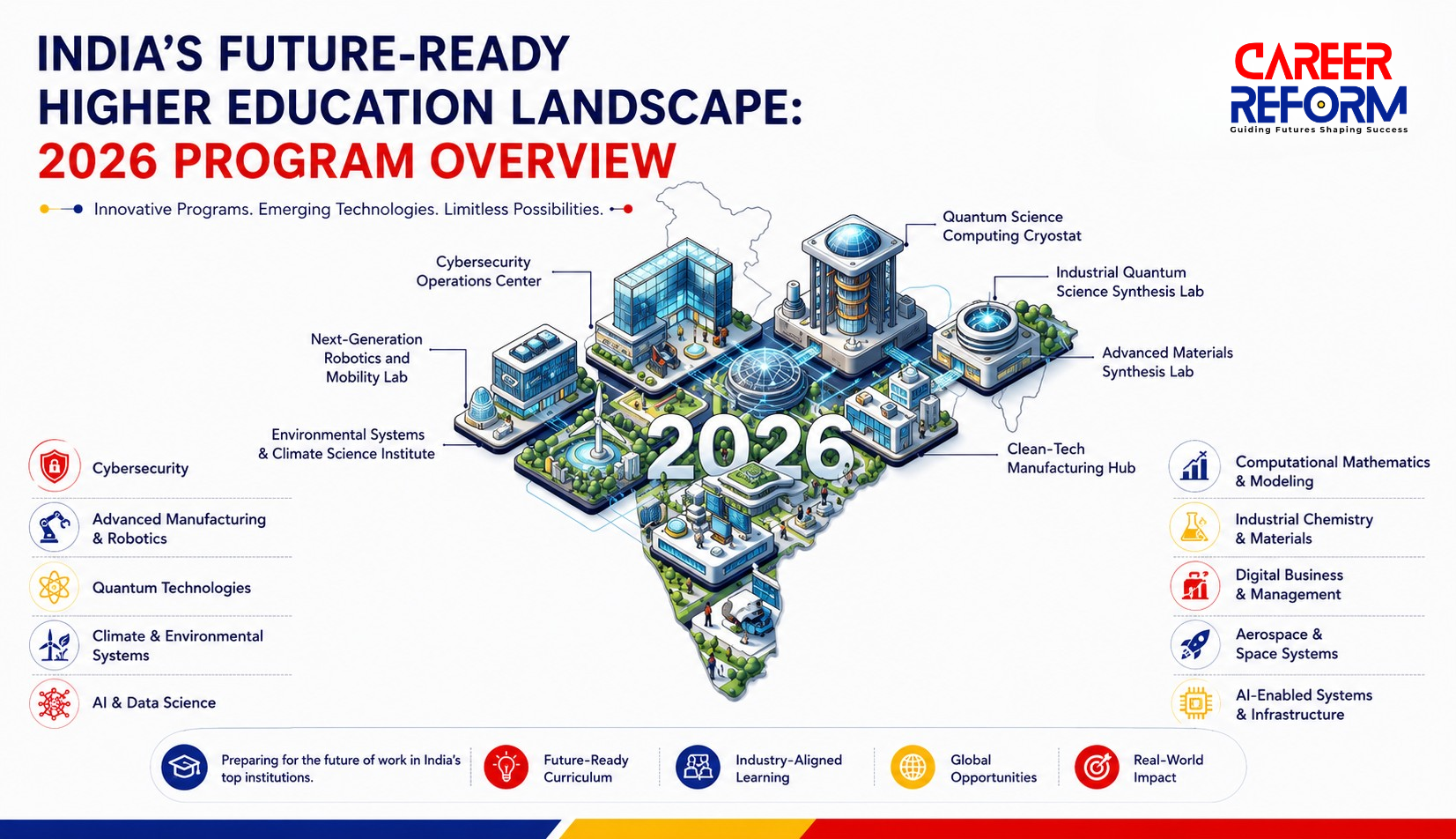
At a Glance: The 10 New Programs
| # | Institute | Program | Admission Route | Official Website |
| 1 | IIT Kanpur | Bachelor of Cybersecurity (B.Cyber) | JEE Main + portfolio + hackathon selection | iitk.ac.in |
| 2 | IIT Jammu | BTech in Unified Engineering | JEE Advanced (JoSAA) | iitjammu.ac.in |
| 3 | IIT Indore | Biomedical Engg. & Data Science / Environmental Economics & Sustainable Engg. / Applied & Industrial Chemistry | JEE Advanced | iiti.ac.in |
| 4 | IIT Jodhpur | BS in Mathematics & Computing | JEE Advanced (JoSAA) | iitj.ac.in |
| 5 | IIT Mandi | Quantum Science & Engineering + 2 more | JEE Advanced | iitmandi.ac.in |
| 6 | IIT Madras | BS in Mathematics | JEE Advanced / Olympiad Admission Mode | iitm.ac.in |
| 7 | IIM Lucknow | BSc in AI & Business Analytics | JEE Advanced | iiml.ac.in |
| 8 | IIM Mumbai | BS in Digital Science and Business Management | JEE Main + interview | “unverified — see note below,” |
| 9 | IISc Bengaluru | Aerospace Engg. / Mechanics & Computing / Materials Science & Engg. | JEE Advanced (JoSAA) | iisc.ac.in |
| 10 | IIIT Dharwad | BTech in AI & Computing | JEE Main (JoSAA) | iiitdwd.ac.in |
A note on IIM Mumbai: this institution does not appear among the 20 IIMs officially recognized under India’s IIM Act, so we are unable to confirm a verified institutional website for it. Any domain you may see circulating for “IIM Mumbai” should be treated as unconfirmed until checked directly against UGC/AICTE records or an official government notification.
For counselling schedules and seat-allotment updates across all JEE Advanced and JEE Main-linked programs above, the two central portals to bookmark are JoSAA and CSAB.
1. IIT Kanpur — Bachelor of Cybersecurity (B.Cyber)
IIT Kanpur has introduced a dedicated undergraduate degree in cybersecurity — among the first standalone UG programs of its kind at an IIT. Rather than folding security into a general Computer Science curriculum, this program builds its foundation around offensive and defensive security, cryptography, digital forensics, and system-level security engineering.
What sets it apart is its hands-on design: laboratory-based security training paired with a mandatory internship phase alongside government or security organizations. For a country facing a widening cyber-skills gap, this is a timely and targeted response.
Admission Route: JEE Main screening, followed by a cybersecurity portfolio review and an in-person, hackathon-based selection round at IIT Kanpur.
Who Should Consider This Program: Students with strong problem-solving instincts, an interest in ethical hacking or digital forensics, and a willingness to be evaluated through practical, competition-style assessments rather than marks alone. The mandatory government/security internship offers a rare, direct pathway into national cybersecurity roles that most CSE graduates only reach years into their careers.
2. IIT Jammu — BTech in Unified Engineering
This interdisciplinary program takes a systems-level approach to engineering education, weaving together artificial intelligence, robotics, energy systems, and intelligent mobility with sustainability principles.
Instead of the traditional single-branch model, Unified Engineering trains students to think across domains — a direct response to industry’s growing preference for engineers who can navigate complex, multi-layered problems rather than narrow technical silos.
Admission Route: JEE Advanced, via JoSAA counselling.
Who Should Consider This Program: Ideal for students who are genuinely undecided between mechanical, electrical, and computer-driven disciplines. Because the curriculum spans robotics, energy, and mobility rather than locking students into one branch, it suits those aiming for roles in electric vehicles, smart infrastructure, or clean-energy systems — sectors where cross-functional engineers are increasingly valued over narrow specialists.
3. IIT Indore — Three New Interdisciplinary Programs
IIT Indore has launched three new undergraduate programs as part of its 2026–27 intake expansion:
- Biomedical Engineering and Data Science
- Environmental Economics and Sustainable Engineering
- Applied and Industrial Chemistry
These programs sit under newly created academic verticals and signal the institute’s deliberate pivot toward healthcare technology, climate systems, and data-integrated chemical sciences.
Admission Route: JEE Advanced.
Who Should Consider This Program: The Biomedical Engineering and Data Science track suits students eyeing healthtech, medical devices, or diagnostic AI — a rapidly expanding intersection of hardware, software, and healthcare. Environmental Economics and Sustainable Engineering is well-suited to those drawn toward climate policy, ESG, or green infrastructure careers, while Applied and Industrial Chemistry fits students aiming for process industries, materials manufacturing, or chemical R&D roles that increasingly demand data literacy alongside core chemistry knowledge.
4. IIT Jodhpur — BS in Mathematics & Computing
Built for students who want to operate at the intersection of pure mathematics and computational systems, this program pairs rigorous theoretical grounding — analysis, algebra, probability, and optimization — with core computing disciplines like algorithms, machine learning, and data systems.
It’s a natural launchpad for careers in artificial intelligence, quantitative finance, and academic research, where mathematical depth is a genuine differentiator.
Admission Route: JEE Advanced, via JoSAA counselling.
Who Should Consider This Program: Best suited to students who enjoy rigorous, proof-based mathematics as much as programming. Graduates of this kind of program typically have a competitive edge for quantitative research roles, AI/ML research positions, and roles in quantitative finance — fields where employers specifically look for candidates who can move fluently between theory and implementation, rather than treating mathematics as a supporting subject to computer science.
5. IIT Mandi — Three New BTech Programs
IIT Mandi has introduced three programs targeting emerging technology domains, headlined by its Quantum Science and Engineering degree — one of India’s first dedicated undergraduate programs in quantum technologies, covering quantum computing, sensing, communication, and advanced materials.
The other two programs merge agriculture and chemical engineering with AI, IoT, and data analytics, reflecting a broader push toward AI-enabled sustainability and smarter industrial processes.
Admission Route: JEE Advanced.
Who Should Consider This Program: Quantum Science and Engineering is a frontier field with very few dedicated undergraduate pathways in India today, making it a genuine first-mover opportunity for students interested in advanced physics and computing research, national quantum missions, or future roles in quantum-secure communication. The agriculture and chemical engineering tracks, meanwhile, suit students interested in agri-tech, precision farming, or smart manufacturing — sectors where India has an acute and growing need for AI-literate engineers.
6. IIT Madras — BS in Mathematics
IIT Madras’s BS Mathematics program is designed as a flexible, research-oriented degree with strong theoretical foundations and industry-relevant electives. A standout feature is its dual BS-MS pathway, alongside specialization tracks in cryptography, financial engineering, actuarial science, and AI-enabled manufacturing.
Admission Route: JEE Advanced or the Olympiad Admission Mode (OAM).
Who Should Consider This Program: The dual BS-MS pathway is particularly valuable for students who want to move directly into research or a master’s-level specialization without a separate, competitive entrance process later. The Olympiad Admission Mode also opens a distinct route for students with strong Mathematics or Science Olympiad credentials, offering an alternative to the high-stakes, single-attempt nature of JEE Advanced.
7. IIM Lucknow — BSc in Artificial Intelligence & Business Analytics
This flagship four-year undergraduate program integrates AI, data science, and business analytics within a residential learning environment. Set within a strong innovation ecosystem, it’s designed to produce graduates fluent in both AI systems and strategic business decision-making.
Admission Route: JEE Advanced.
Who Should Consider This Program: A strong fit for students who want a management-oriented career built on technical fluency from day one, rather than acquiring it later through an MBA. This path suits those targeting roles in AI product management, business analytics, or strategy consulting — positions where employers increasingly expect candidates to be conversant in both data science and business decision-making, not just one or the other.
8. IIM Mumbai — BS in Digital Science and Business Management
This program blends digital technologies with business management, emphasizing data systems, computational thinking, and managerial decision-making frameworks — a direct response to the accelerating convergence of technology and business across industries.
Admission Route: JEE Main, followed by a personal interview.
Who Should Consider This Program: Suited to students aiming for digital transformation, product strategy, or technology-consulting roles, where a blended understanding of systems and business operations matters more than deep technical specialization alone. The JEE Main-plus-interview route also makes this a comparatively accessible entry point into the IIM ecosystem for students who may not clear the higher cutoffs of JEE Advanced-based programs.
9. IISc Bengaluru — Three New BTech Programs
IISc has expanded its undergraduate offerings with three new programs:
- Aerospace Engineering
- Mechanics and Computing
- Materials Science and Engineering
These programs carry IISc’s signature emphasis on research-led education, deep laboratory exposure, and rigorous scientific foundations — all backed by Bengaluru’s thriving innovation ecosystem.
Admission Route: JEE Advanced, via JoSAA counselling.
Who Should Consider This Program: IISc has traditionally been known for postgraduate and doctoral research rather than undergraduate teaching, so this expansion is significant for students who want early exposure to a research-intensive environment. Aerospace Engineering suits those aiming for the space and defense sectors; Materials Science fits students drawn to advanced manufacturing and nanotechnology; and Mechanics and Computing is well suited to those interested in computational modeling and simulation-driven engineering research.
10. IIIT Dharwad — BTech in AI & Computing
This program is structured around the complete AI lifecycle — from model development through deployment on high-performance computing infrastructure. It goes beyond conventional AI coursework by emphasizing systems-level understanding of the large-scale computing environments that power modern AI applications, aligning closely with industry needs in cloud computing and AI deployment.
Admission Route: JEE Main, via JoSAA counselling.
Who Should Consider This Program: Best suited to students who want to go beyond building AI models to understanding how those models are actually deployed and scaled in production — a skill set increasingly in demand as companies move from AI experimentation to full-scale implementation. It offers strong career alignment with MLOps, cloud infrastructure, and AI systems engineering roles — positions that remain in genuinely short supply across the industry today.
A Note on Completeness
This roundup captures only a sample of the new undergraduate programs emerging across India’s higher education system this year — not a definitive inventory. Numerous NITs, additional IITs and IIITs, central universities, and private institutions are also introducing programs in similar emerging domains.
Treat this article as a starting point for awareness, not a final reference. Details such as eligibility criteria, fee structures, intake numbers, and admission timelines change frequently and should always be verified directly through official sources before you make any decisions.
Frequently Asked Questions
1. Are these new programs harder to get into than traditional branches like CSE? Not necessarily harder, but often structured differently. Programs with portfolio reviews, hackathons, or interviews (like IIT Kanpur’s B.Cyber or IIM Mumbai’s Digital Science program) evaluate more than just rank, which can work in favor of students with strong practical skills or extracurricular achievement — but it also means preparation needs to go beyond exam scores alone.
2. Should I choose a new, niche program over an established branch like Computer Science? That depends on your goals. Established branches offer proven placement records and larger alumni networks. Newer, specialized programs offer first-mover advantage in emerging fields but come with less placement history to evaluate. If you’re confident about a specific niche — quantum computing or cybersecurity, for instance — a targeted program can be a strong bet. If you value flexibility and a longer track record, a traditional branch may still be the safer choice.
3. Do these programs guarantee better placement outcomes? No program can guarantee placement outcomes, and none of the institutes covered here have claimed to. What newer programs typically offer is closer alignment with emerging industry demand — which can translate into an advantage, but outcomes still depend on individual performance, market conditions at the time of graduation, and the strength of each institute’s industry partnerships.
4. Where can I find the most accurate, up-to-date admission details? Always go directly to the official JoSAA and CSAB portals, along with each institute’s own admissions webpage. Third-party articles, including this one, should be treated as a starting point for awareness — not a substitute for official notifications.
The Bottom Line
The 2026 undergraduate admissions cycle marks a structural shift toward interdisciplinary, technology-driven education in India. IITs and IISc are pushing into deep-tech engineering domains through JEE Advanced, while IIITs and IIMs are strengthening applied computing and business-technology programs through JEE Main and hybrid admission routes.
For prospective students, the takeaway is clear: the traditional boundaries between engineering, computing, and management are dissolving. The institutions best positioned to prepare graduates for the next decade are the ones building programs that reflect that reality — and increasingly, that means looking beyond the familiar CSE-or-Mechanical binary toward programs purpose-built for where the world of work is actually headed.
Our advice? Don’t just chase a brand name. Look closely at curriculum design, internship structures, and admission pathways — and make sure the program you choose is training you for the career you actually want, not just the one that sounds impressive on paper.
JoSAA and CSAB counselling schedules for these programs are still rolling out over the coming weeks. Bookmark this page and check back as official dates are confirmed — or better yet, revisit the official JoSAA and CSAB websites directly closer to the counselling window so you don’t miss a deadline.
For the latest updates on admission timelines and counselling schedules, always refer to the official JoSAA and CSAB websites, along with each institute’s admissions portal.
Who We Are
Career Reform covers admissions, careers, and higher-education trends in India, helping students and parents cut through scattered notifications to make informed decisions about where — and what — to study next.
For more clarity on these programs, admission timelines, and career-fit guidance, visit Career Reform — your go-to source for staying ahead of India’s fast-changing higher-education landscape.