

Every admissions season, the same story repeats itself in thousands of Indian households. A student with a flawless 99% aggregate, a spotless attendance record, and a trophy cabinet full of participation certificates opens a rejection email from a university they were “certain” they’d get into. The parents are stunned. The student is heartbroken. And the question everyone asks is the same: If a 99% isn’t enough, what exactly are they looking for?
Here’s the uncomfortable truth: at tier-1 global universities, a 99% is no longer a differentiator — it’s the baseline. When an admissions committee reviews ten thousand applications, and eight thousand of them report near-identical grades, the percentage stops telling a story. It becomes noise. What decides the outcome isn’t who scored the highest, but who looks like someone worth admitting into a specific university, a specific classroom, a specific cohort of thinkers and builders.
This is why so many “perfect” profiles are rejected — not despite their grades, but because their grades are the only thing on the page. Global admissions committees have quietly shifted the goalposts, and most students and parents in Grades 11 and 12 are still playing by the old rules.
The New Holistic Evaluation Matrix
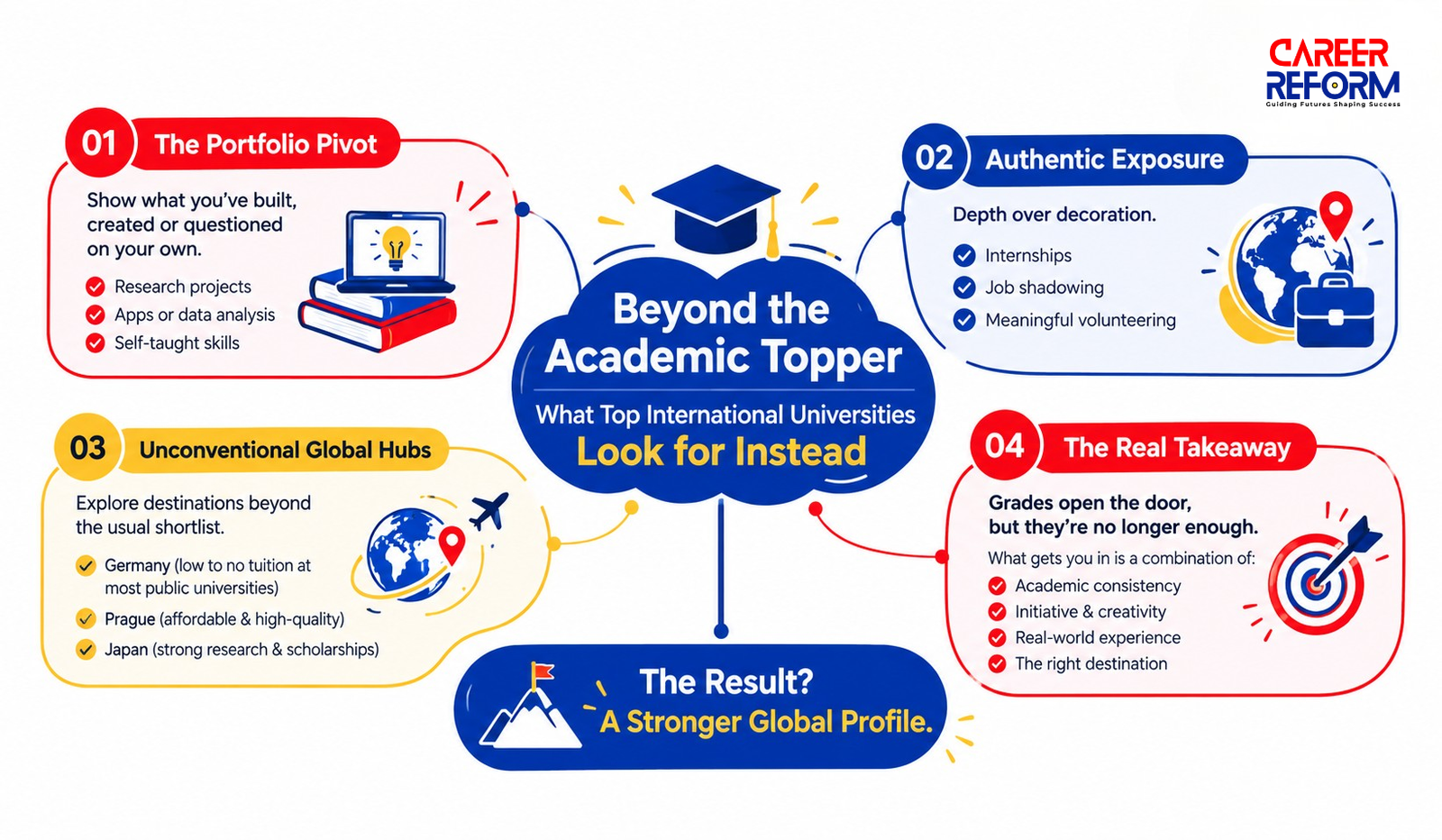
Top universities abroad now evaluate applicants against a broader matrix — one where academics are the entry ticket, not the main event. Three shifts matter most.
The Portfolio Pivot
Admissions officers are no longer asking “how well did this student perform on a set syllabus?” They’re asking “what has this student built, questioned, or created on their own?” This is the rise of the Superpower Portfolio — a body of self-directed work that proves initiative rather than compliance.
This could be an independent research paper on a niche economic model, a coded app that solves a small real-world problem, a published dataset analysis, or a self-taught skill turned into a tangible output. The specific subject matters far less than the evidence of ownership. A student who spent six months building and iterating on a project — with failures, pivots, and a final result — tells a far richer story than one more line reading “Topper, Class XII.”
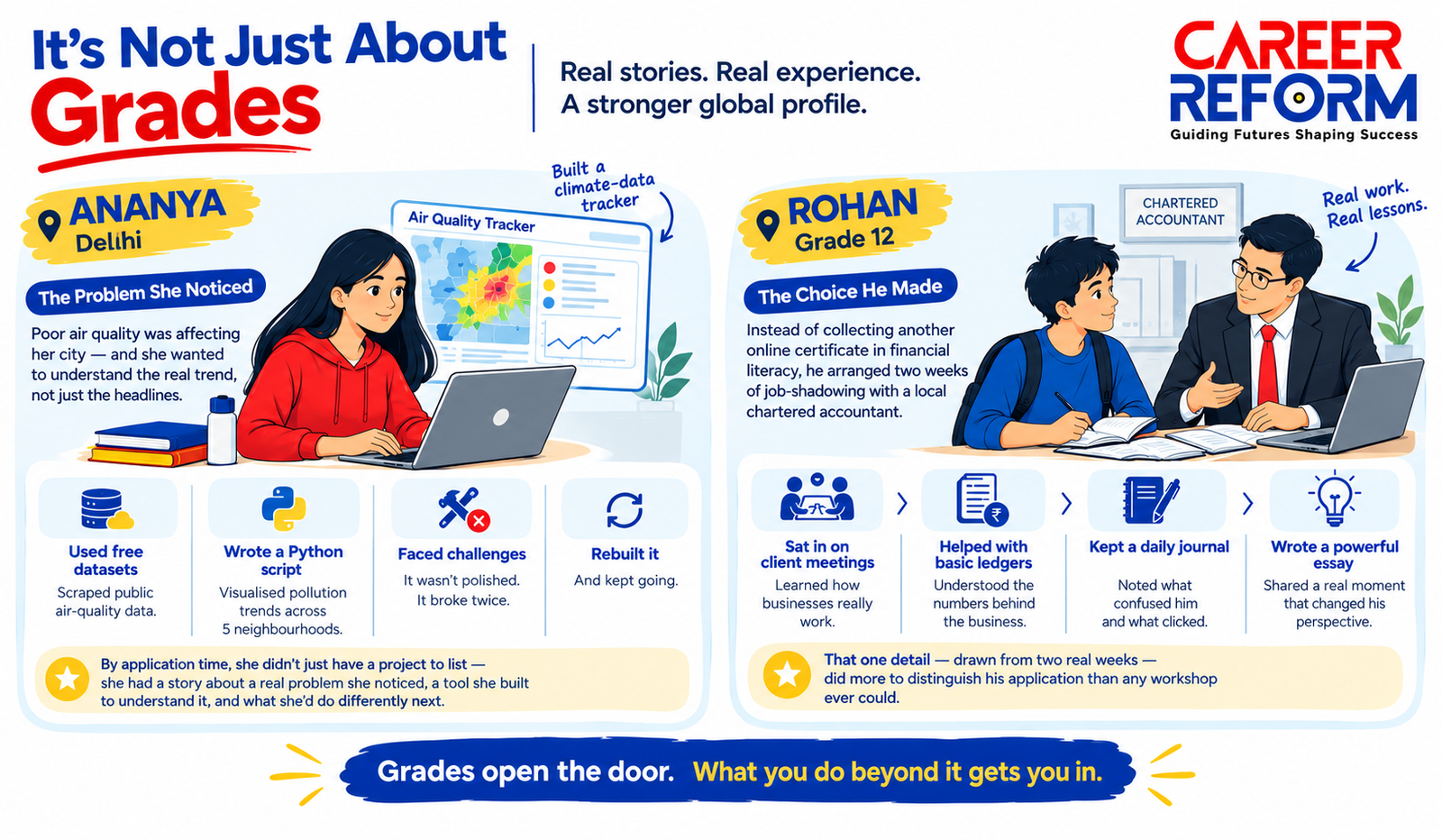
Consider a hypothetical applicant from Delhi — let’s call her Ananya — with a strong but unremarkable 96%. Instead of adding a twelfth certificate to her file, she spent a summer building a small climate-data tracker that scraped public air-quality readings for her city and visualized pollution trends across five neighbourhoods, using free datasets and a basic Python script. It wasn’t polished. It broke twice. She rebuilt it. By application time, she didn’t just have a project to list — she had a story about a real problem she noticed, a tool she built to understand it, and what she’d do differently next time. That narrative, not the grade on her transcript, is what an admissions officer remembers after reading two hundred applications in a single afternoon.
Authentic Exposure
The second shift is around real-world exposure, and it’s a subtle but important one: depth over decoration. Committees have grown skeptical of resumes padded with a dozen certificates from weekend webinars or one-day “leadership” workshops. These signal effort, not experience.
What stands out instead is documented, authentic exposure to real environments — a two-week micro-internship at a local startup, a genuine job-shadowing stint with a working professional, or a sustained volunteering role with measurable responsibility. The value isn’t in the logo on the certificate; it’s in the reflection a student can offer about what they learned, what surprised them, and how it changed their thinking. Quality of exposure now consistently outweighs quantity of certificates.
Take another hypothetical example — a Grade 12 student named Rohan, set on studying economics. Rather than collecting a sixth online certificate in “financial literacy,” he arranged two weeks of job-shadowing with a local chartered accountant during his winter break, sitting in on client meetings and helping organize basic ledgers. He kept a short daily journal of what confused him and what clicked. In his application essay, he didn’t just say he was “interested in finance” — he described a specific moment watching a small business owner struggle to read her own balance sheet, and how it reshaped what he wanted to study. That one detail, drawn from two real weeks rather than two dozen certificates, did more to distinguish his application than any workshop ever could.
Unconventional Global Hubs
The third shift is geographic. While the US, UK, and Canada remain popular defaults, savvy applicants and their families are increasingly looking toward emerging, high-value study destinations — Germany, where most public universities charge no tuition and only a modest semester fee, though the DAAD (German Academic Exchange Service) confirms that a few states and universities have begun introducing fees for non-EU students, so this is worth checking case by case; Prague, offering rigorous, English-taught programs at a fraction of Western European or US costs; and Japan, combining cutting-edge research opportunities with government-backed scholarships for international students.
These hubs often have less saturated applicant pools, strong post-study work pathways, and academic ecosystems that reward the exact kind of independent, project-based profile described above. For a family willing to think beyond the usual shortlist, this is where competition eases and opportunity widens.
By the numbers: For 2025–26, published tuition alone at private nonprofit universities in the US averages roughly $45,000 a year (approximately ₹43 lakh) — around $180,000 over four years (approximately ₹1.7 crore) — while total cost of attendance (including room, board, and other expenses) runs closer to $62,000–$65,000 a year, or roughly $250,000–$260,000 over a degree (approximately ₹2.4–2.5 crore), according to College Board’s Trends in College Pricing report (figures shown in USD). By contrast, most public universities in Germany charge only a semester contribution of approximately ₹11,000–₹44,000; a small number of states and universities charge more for select programs — Baden-Württemberg levies approximately ₹1.65 lakh per semester on non-EU students at its public universities (including Heidelberg and KIT), and the Technical University of Munich charges a separate, Master’s-programme-specific fee — as confirmed on DAAD’s official page on the costs of education and living in Germany (figures shown in EUR on the official site; the INR amounts above are our converted estimates). Combined with lower living costs in cities like Prague and strong graduate employability in Japan, an unconventional destination can deliver a comparable — or stronger — academic outcome at a fraction of the cost.
(Figures are national averages as of 2025–26 and vary significantly by institution, state, and program. INR conversions use approximate September 2026 exchange rates (₹94.7/USD, ₹109.7/EUR) and will shift with currency movements — always confirm current tuition, fee structures, and exchange rates directly with the university and your bank before planning.)
Families who want the full picture in one downloadable resource can grab the free Germany study e-book or the Japan study e-book — each covers everything above (university comparisons, eligibility, visas, and scholarships) in one place.
The Real Takeaway
None of this means grades don’t matter — they still open the door. But grades alone no longer decide who walks through it. The students getting offers from top-tier global universities are the ones who paired academic consistency with a portfolio of initiative, authentic real-world exposure, and a strategic, sometimes unconventional, choice of destination.
The challenge is that this kind of profile isn’t built in the final months before applications open. It’s built over one to two years of deliberate planning — choosing the right project at the right time, securing exposure that’s genuinely meaningful, and identifying destinations that align with a student’s strengths rather than just their rank list.
Frequently Asked Questions
How early should profile-building actually start? Ideally, by the start of Grade 11. This gives a student roughly 18–24 months to identify a genuine area of interest, complete one or two meaningful projects or exposure experiences, and refine their story before application deadlines arrive. Starting in Grade 12 isn’t impossible, but it compresses the timeline and often results in rushed, less authentic work.
Is a portfolio necessary for every major, or just STEM fields? Yes, in spirit — though what it looks like will differ by discipline. An aspiring engineer might build a coded project; an aspiring economics student might write an independent research paper or run a small data analysis; an aspiring humanities student might produce a body of writing, a podcast series, or a community initiative. The common thread is self-directed, sustained effort — not a specific format.
Do extracurricular certificates count for nothing, then? They still have value, but as supporting evidence rather than the centrepiece. A handful of relevant, well-chosen certificates paired with one strong, documented project is far more effective than a long list of unrelated ones.
Do unconventional destinations like Germany or Japan reduce the need for a strong portfolio? No. Emerging hubs often have less saturated applicant pools, but reputable universities there still evaluate applicants holistically. A weaker portfolio simply faces slightly less competition — it doesn’t become optional.
Is it too late to start building a profile in Grade 12? It’s tighter, but not too late. A focused, well-documented project completed over a few months — combined with a clear, honest narrative about what was learned — can still meaningfully strengthen an application. Starting earlier simply allows for more depth and less pressure.
Don’t Leave Your Global Admission Roadmap to the Last Minute
If your child is in Grade 11 or 12, the window to build a standout profile is narrower than it feels. The students who succeed aren’t the ones who start planning in Grade 12 — they’re the ones who mapped out their journey early, with guidance from someone who understands exactly what today’s admissions committees are looking for.
Map out your profile-building timeline with a dedicated advisor through the CareerReform Global Pathway Framework, and turn your child’s next two years into a strategic, well-documented journey toward the university that’s actually right for them — not just the one with the highest cutoff.
Ready to start? Book a one-on-one session with a CareerReform advisor and get a personalized profile-building roadmap mapped out for your child’s next two years.