

A missed MBBS seat is not a closed door. This guide maps the full spectrum of healthcare and life sciences careers available to Indian students, along with a ten-year roadmap for informed decision-making.
Each year, more than 22 lakh students register for NEET, most with a single ambition: a seat in medical college. Yet the arithmetic is unforgiving. India currently has just over one lakh MBBS seats, meaning the overwhelming majority of qualified aspirants will not secure one. For most families, the result is not celebration but disappointment.
This gap between aspiration and outcome has created a widespread but mistaken belief: that a career in healthcare begins and ends with MBBS. It does not. Healthcare is among the most expansive and fastest-evolving professional ecosystems in the world, and medicine is only one of many legitimate entry points into it.
This guide is intended to broaden that conversation — for parents seeking clarity, and for students who deserve to understand the full range of options available to them.
1. Reconsidering What “Healthcare” Means
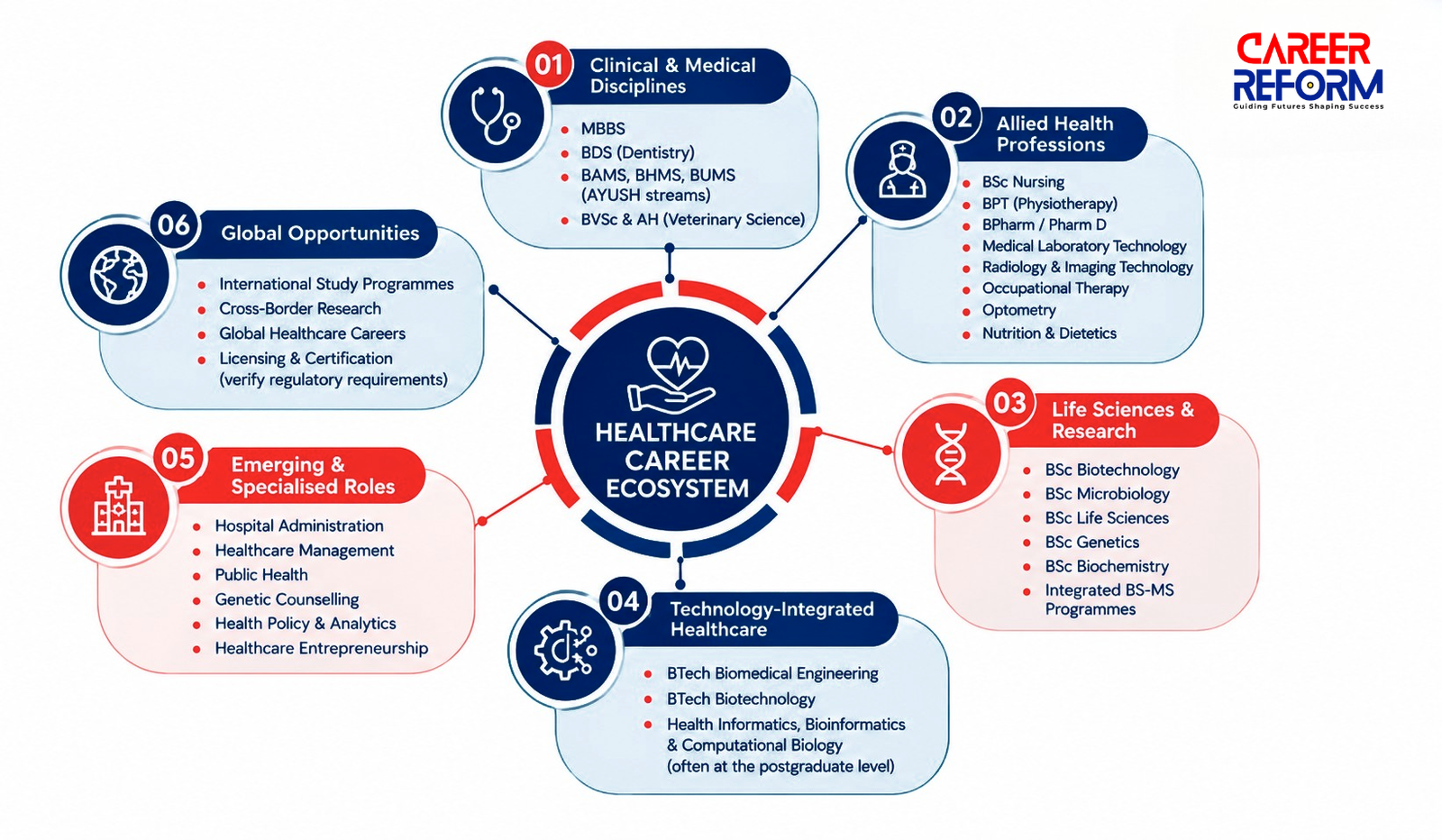
The instinct to equate healthcare with clinical practice is understandable, but increasingly outdated. Modern healthcare delivery depends on a coordinated network of professionals, including:
- Physicians and dentists
- Nurses and physiotherapists
- Pharmacists and laboratory scientists
- Biomedical engineers and health data analysts
- Genetic counsellors and public health specialists
- Hospital administrators and healthcare entrepreneurs
Several of these disciplines did not exist in their current form a decade ago, and many are expanding precisely because of advances in medical technology, an ageing population, and shifting patterns of disease. Framing the conversation around a single job title — “doctor” — overlooks the breadth of an ecosystem in which a student’s aptitude, rather than a single entrance exam, can determine their path.
2. Academic Pathways After Class 12
Indian students have several credible routes into healthcare and life sciences, shaped by subject choice, entrance examination performance and long-term interest.
Clinical and medical disciplines
- MBBS
- BDS (Dentistry)
- BAMS, BHMS, BUMS (the AYUSH streams)
- BVSc & AH (Veterinary Science)
These remain the most recognised entry points, each requiring NEET qualification and offering a defined path to licensed clinical practice.
Allied health professions
- BSc Nursing
- Bachelor of Physiotherapy (BPT)
- BPharm / Pharm D
- Medical Laboratory Technology
- Radiology and Imaging Technology
- Occupational Therapy
- Optometry
- Nutrition and Dietetics
These disciplines are experiencing sustained demand growth, in India and internationally, and typically involve their own state or institutional entrance processes rather than NEET alone.
Life sciences and research-oriented degrees
- BSc Biotechnology
- BSc Microbiology
- BSc Life Sciences
- BSc Genetics
- BSc Biochemistry
- Integrated BS-MS programmes
These prepare students for research careers in academia, pharmaceutical development and diagnostics.
Technology-integrated healthcare disciplines
- BTech Biomedical Engineering
- BTech Biotechnology
- Health Informatics, Bioinformatics and Computational Biology (often pursued at the postgraduate level)
These fields sit at the intersection of engineering and medicine, and are becoming increasingly relevant as healthcare digitises.
A note on eligibility: Entrance requirements vary considerably by institution and state. Families should verify current criteria directly with the relevant regulatory bodies before making commitments, as requirements are revised periodically.
3. Evaluating Domestic and International Options
Asking “which country offers the best healthcare education” is less useful than it first appears. A more productive line of inquiry examines the substance of a specific programme:
- Quality of clinical exposure
- Laboratory infrastructure
- Research opportunities
- Faculty credentials
- Recognition by relevant licensing authorities
This last point deserves particular emphasis. Regulated professions — medicine, dentistry, nursing and pharmacy chief among them — are governed by jurisdiction-specific licensing frameworks. A degree earned abroad does not automatically confer the right to practise in India, nor does an Indian degree guarantee recognition overseas. Families considering international education should confirm accreditation status with the National Medical Commission or the equivalent authority before enrolment, not after.
4. The Healthcare Sector Through 2035
Several structural trends are likely to shape the healthcare labour market over the coming decade:
- Demographic shifts. An ageing population and rising prevalence of lifestyle-related disease are expected to sustain long-term demand for healthcare services.
- Digital transformation. Telemedicine and digital health platforms continue to expand access, creating demand for professionals who can operate at the intersection of clinical knowledge and technology.
- Artificial intelligence in clinical settings. AI is increasingly embedded in diagnostics and drug discovery, though its deployment continues to depend on human clinical judgment and oversight.
- Preventive and mental health care. Both areas are receiving greater institutional and policy attention than in previous decades.
- Allied health specialisation. Demand for specialised allied health professionals is likely to grow alongside the broader expansion of the sector.
These trends do not imply uniform growth across every role, nor do they guarantee employment for any individual degree. They suggest, instead, that healthcare will remain a field in which technical competence and human judgment are jointly essential.
5. The Career Landscape in Practice
Clinical and patient-facing roles
Physicians, dentists, nurses, nurse practitioners, physiotherapists, occupational therapists, clinical dietitians, optometrists.
Laboratory and research careers
Biotechnologists, clinical research associates, microbiologists, genetic counsellors, pharmaceutical scientists, regulatory affairs specialists.
Technology and data-driven roles
Biomedical engineers, bioinformaticians, health data analysts, medical imaging specialists, digital health product managers.
Public health, policy and administration
Public health specialists, hospital administrators, health policy analysts, healthcare consultants, health-technology entrepreneurs.
Cross-disciplinary opportunities
The most significant growth may occur at the intersections — healthcare combined with artificial intelligence, law, finance, design, sports science and environmental policy. The professionals best positioned for the coming decade may not be those who treat patients directly, but those who understand a healthcare problem deeply enough to design better systems, policies, products or technologies around it.
6. The Capabilities That Will Matter
A common assumption among families is that strong performance in Biology is sufficient preparation for a healthcare career. It is necessary, but no longer sufficient. The skills likely to distinguish successful professionals over the next decade include:
- A solid foundation in biology and chemistry
- Data literacy
- Working familiarity with AI-enabled tools
- Research and analytical capability
- Clear communication
- Ethical judgment
- Collaborative competence
- The capacity for continuous learning
The last item may be the most critical. Healthcare technology and clinical protocols evolve faster than any four-year curriculum can anticipate; professionals who stop learning after graduation will find their knowledge dated within a few years.
7. A More Useful Question for Parents
Rather than asking “is there an alternative as prestigious as MBBS,” parents may find it more productive to ask what genuinely engages their child:
- Direct patient care
- Scientific inquiry in a laboratory setting
- Technology-driven problem solving
- Systems-level thinking about how care is delivered
The right path exists at the intersection of four factors: interest, aptitude, opportunity and preparation. A field’s growth prospects mean little if a student lacks genuine engagement with its core demands — mathematics, laboratory discipline, sustained study, or direct clinical responsibility, depending on the discipline in question.
8. Common Missteps Worth Avoiding
- Treating MBBS as the only legitimate outcome. This overlooks a wide range of equally rewarding clinical, research, technology and administrative careers.
- Taking a drop year reflexively. A repeat attempt at NEET can be right for some students, but should follow careful reflection rather than serve as a default response to disappointment.
- Overlooking institutional recognition. Verify that any institution and programme carries the appropriate approvals from national regulatory bodies before enrolment.
- Underweighting curriculum quality. Two programmes with similar names can differ substantially in laboratory access, clinical placements and faculty quality.
- Assuming credentials alone guarantee employment. Internships, research exposure, demonstrable projects and practical competence increasingly determine outcomes more than the degree title itself.
9. Building Toward This Decision Early
Career clarity in healthcare need not — and should not — wait until Class 12. Younger students can begin building relevant exposure through a straightforward progression:
- Explore — Develop a genuine understanding of the range of roles within a hospital or research setting.
- Experiment — Try small science, health-awareness or data projects.
- Question — Examine how technology is reshaping diagnosis and treatment.
- Build — Undertake volunteer work or shadowing opportunities where available, and document the experience.
- Reflect — Identify honestly which of these activities feel genuinely engaging rather than merely impressive.
By the time students reach Class 11 and 12, this early exploration typically sharpens into a more focused set of choices.
10. A Ten-Year Roadmap
| Stage | Focus |
| Grades 9–10 — Exploration | Foundational science, early exposure to healthcare settings, relevant academic competitions |
| Grades 11–12 — Preparation | Subject specialisation, entrance examination preparation, shadowing, early profile development |
| University Years 1–2 — Foundation | Core coursework, laboratory training, clinical exposure, research or professional clubs |
| University Years 3–4 — Specialisation | Focused study within a chosen discipline, internships, research projects, portfolio development |
| Early Career — Adaptation | Licensing where required, practical experience, digital and AI-tool fluency, postgraduate specialisation |
11. The CareerReform Outlook: Healthcare and Life Sciences
| Category | Details |
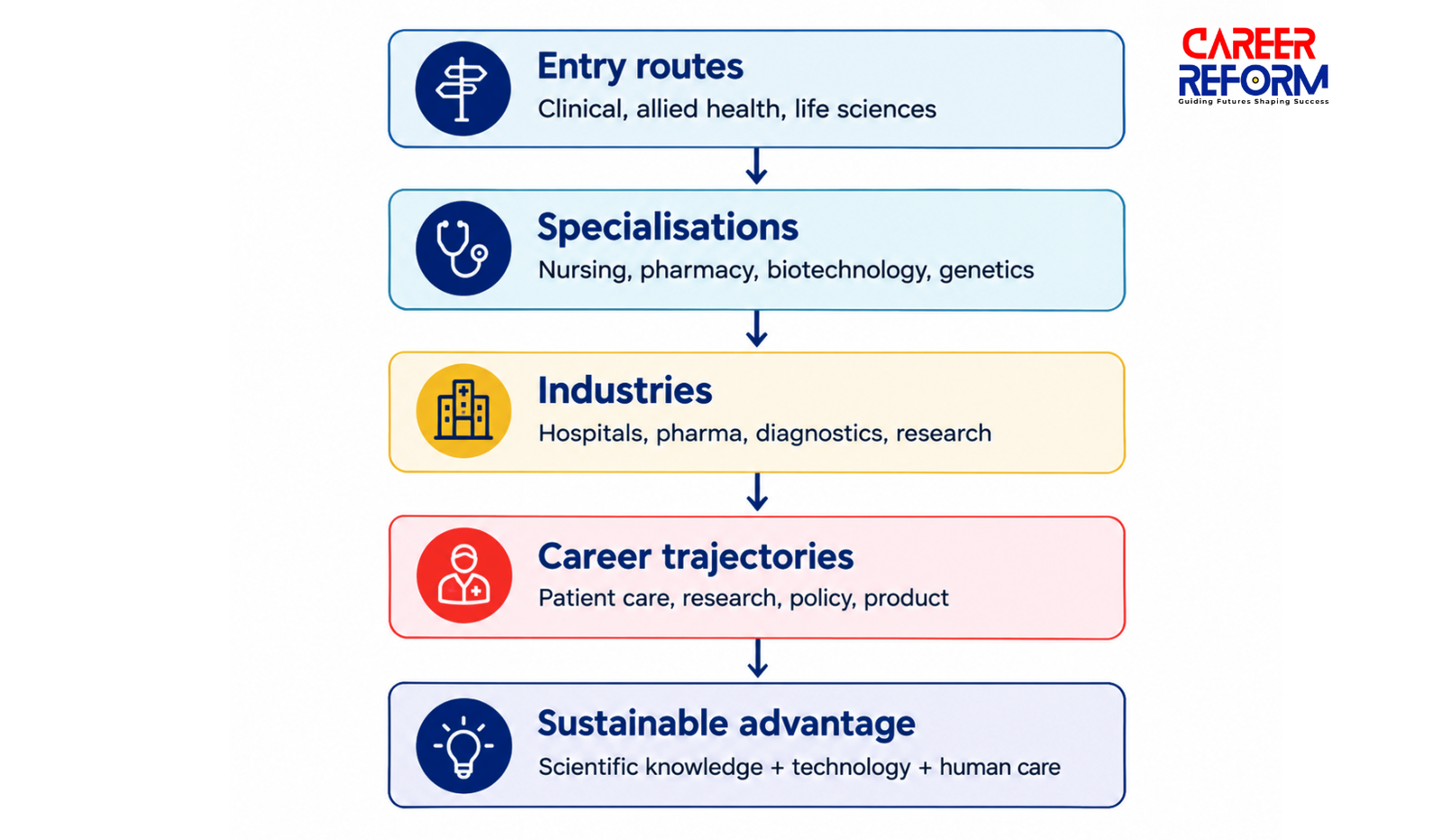
| Entry routes | Clinical · Allied Health · Life Sciences · Biomedical Engineering · Health Technology |
| Specialisations | Nursing · Physiotherapy · Pharmacy · Biotechnology · Genetics · Public Health · Health Informatics |
| Industries | Hospitals · Pharmaceuticals · Biotechnology · Diagnostics · Health-Technology · Research · Government · NGOs |
| Career trajectories | Patient Care · Research · Data · Product · Policy · Administration · Entrepreneurship |
| Sustainable advantage | Scientific knowledge + technological fluency + human judgment, applied together |
12. Reframing the Central Question
The question families most often ask — “what do we do if MBBS doesn’t work out” — treats a healthcare career as though it had only one door. A more useful question is this: how can a student contribute meaningfully to human health in a way that reflects their particular strengths?
The answer will differ for every student, but the underlying principle holds broadly: there is more than one credible, respected and future-ready path into this field. That path does not begin with a rank on an entrance examination. It begins with curiosity, deliberate preparation, and informed guidance — ideally sought well before Class 12 becomes the deadline by which every decision must be made.
Frequently Asked Questions
Is a BSc in Nursing a strong career choice in India?
Yes. Nursing is among the fastest-growing healthcare professions globally, with sustained demand in domestic and international markets, clearly defined licensing pathways, and opportunities for further specialisation in areas such as critical care or paediatric nursing.
Can a student pursue MBBS abroad after qualifying NEET?
Yes. Many Indian students pursue MBBS in countries such as Russia, Georgia, the Philippines and several Central Asian nations after clearing NEET, since NEET qualification remains a prerequisite for Indian students seeking to practise in India after a foreign degree. It is essential to confirm that the chosen institution is recognised by the National Medical Commission before enrolment, as this directly affects eligibility for the licensing examination required to practise in India.
What distinguishes BSc Biotechnology from BTech Biotechnology?
BSc Biotechnology is a science-oriented degree, typically three years, with an emphasis on laboratory and research skills. BTech Biotechnology is an engineering degree, typically four years, with a stronger orientation toward applied technology, bioprocessing and industrial application.
Is public health a credible alternative to clinical practice?
Yes, particularly for students drawn to population-level problem solving rather than direct patient interaction. Public health careers span epidemiology, health policy, government programmes and NGO work, and demand in this space continues to grow alongside increased attention to preventive care.
Verified Resources
- National Medical Commission — for confirming institutional recognition, curriculum standards and registration requirements.
- NEET Official Website (NTA) — for registration, syllabus and examination updates.
- Medical Counselling Committee — for seat allotment and counselling procedures.
Considering the Right Path for Your Child?
Book a personalised career counselling session with CareerReform to evaluate healthcare and life sciences pathways aligned with your child’s aptitude and interests.
Discover more student career guides at CareerReform.