

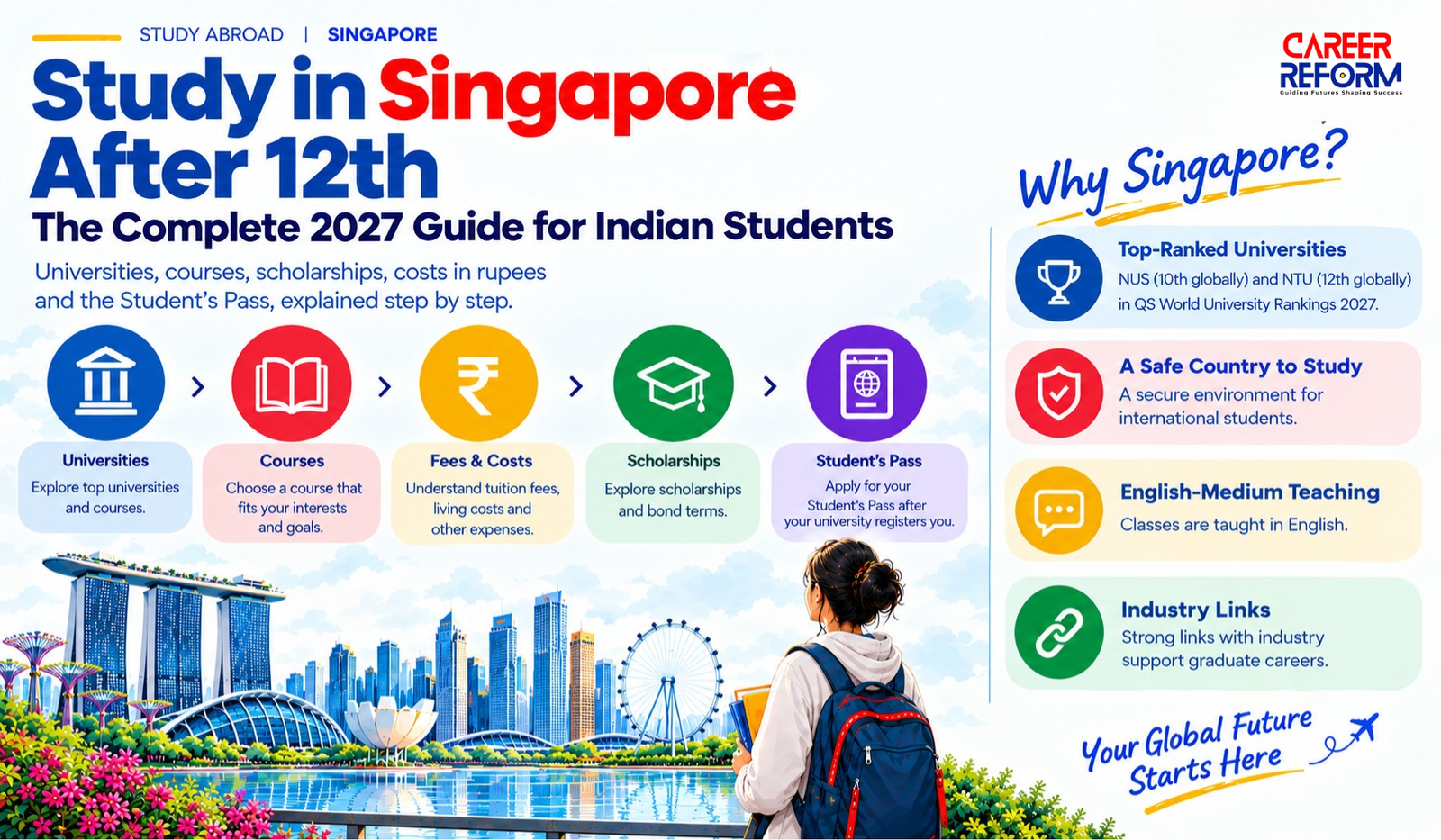
Singapore is a popular destination for Indian undergraduates. In the QS World University Rankings 2027, the National University of Singapore (NUS) ranked 10th in the world and first in Asia, while Nanyang Technological University (NTU) ranked 12th. Classes are taught in English, the country is safe and well connected to India, and strong industry links support graduate careers.
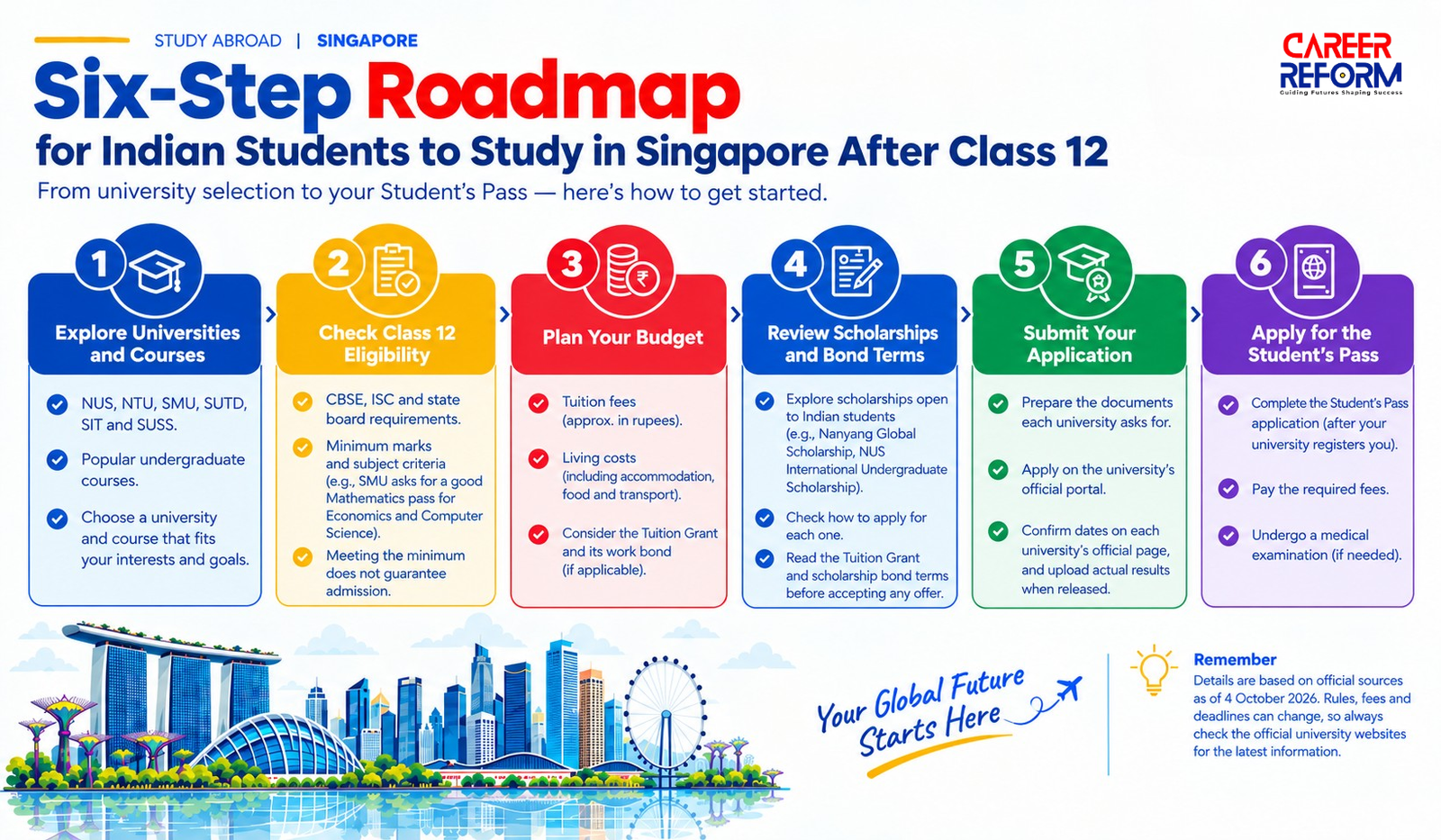
Part 1: Choose Your University and Course
In this part: the six Singapore universities and what each one teaches.
| University | Best Known For | Main Course Areas |
|---|---|---|
| NUS | Comprehensive research university | Computing and AI; a dozen engineering disciplines; sciences and data science; architecture; business and real estate; law, medicine, nursing, dentistry and pharmacy; music; arts and social sciences |
| NTU | Engineering, science and computing | Engineering (including Renaissance Engineering); computing and data science; science; business and accountancy; humanities, arts and social sciences; medicine; education |
| SMU | City-centre campus, business focus | Accountancy, business, economics, computing and information systems, law, social sciences, and the SMU-Duke-NUS Medicine Pathway |
| SUTD | Design-centred technology | Architecture and Sustainable Design; Computer Science and Design; Engineering Product Development; Engineering Systems and Design; Design and AI |
| SIT | Applied degrees with work-study | Engineering; Food, Chemical and Biotechnology; Infocomm Technology; Health and Social Sciences; Business, Communication and Design |
| SUSS | Applied social sciences | Human Development, business, humanities and behavioural sciences, law, science and technology, social work |
Full programme lists: NUS · NTU · SMU · SUTD
Good to know
- SIT: Most degrees include an eight- to 12-month work-study placement. International applicants are considered case by case for selected programmes only, and financial assistance for them is very limited. See SIT’s international qualifications page.
- Polytechnics award diplomas, not degrees.
- Private institutions must be EduTrust-certified to enrol international students, and no Student’s Pass is issued for a non-certified school.
In short: NUS and NTU offer the widest range of courses, while SMU, SUTD, SIT and SUSS suit specialized or applied degrees.
Part 2: Check Your Eligibility
In this part: the Class 12 requirements for NUS, NTU and SMU. Each university sets its own rules, and meeting the minimum does not guarantee admission.
NUS
- CBSE and ISC: A good pass in five subjects including English. No SAT, ACT, AP or English test is required.
- State and other boards: Good passes in five subjects including English, plus an SAT, ACT (with Writing) or AP score. No English test is required.
- Official pages: CBSE/ISC · State boards
NTU
- Marks: At least 90% in all subjects including English, excluding other languages and technical subjects.
- English test: Needed only if English was not your medium of study.
- JEE: JEE Main is not required, and NTU values a good JEE Advanced rank.
- Official page: NTU India Standard 12
SMU
- Marks: At least 90% in five subjects including English.
- Test score: One accepted standardized test is required. For non-Law programmes, the minimum is an SAT total of 1,350 (with at least 650 in evidence-based reading and writing), an ACT composite of 29, or an IELTS Academic overall score of 7.0. Law has higher minimums.
- Interview: Shortlisted applicants are interviewed, and shortlisted Law applicants first take a writing test.
- Official page: SMU international qualifications
SIT, SUTD and SUSS set their own requirements, so check each directly.
If your Class 12 results are pending
- You can usually apply while sitting your exams, but you must upload your actual results as soon as they are released.
- NTU asks for them within three days of release and decides on actual results only, with no provisional offers.
- At NUS, applicants with pending results cannot apply for Dentistry, Law, Medicine or Nursing, and CBSE and ISC applicants sitting Standard 12 in 2027 must submit their final results within three days of release.
- SMU accepts predicted Standard 12 results at application and asks for your actual results within three working days of release, according to its most recent published guidance.
- At NTU, applicants whose results arrive after 1 April cannot apply for Medicine or Renaissance Engineering.
In short: NUS asks less of CBSE and ISC students, state-board students need a standardized test score, and NTU expects at least 90%.
Part 3: Understand Tuition Fees and the Tuition Grant
In this part: what NUS charges, how the Tuition Grant works, and what it asks of you in return.
Fees depend on your programme and on whether you accept the government’s Tuition Grant. The table shows NUS’s annual fees for students admitted in 2026/27. Other universities publish their own fees, so check each one.
| NUS Programme Area | With Tuition Grant (per year) | Without Tuition Grant (per year) |
|---|---|---|
| Computing, Engineering | About ₹16.05 lakh | About ₹29.78 lakh |
| Humanities and Sciences | About ₹16.05 lakh | About ₹27.49 lakh |
| Business | About ₹16.65 lakh | About ₹25.05 lakh |
| Law | About ₹22.84 lakh | About ₹33.34 lakh |
| Medicine and Dentistry | About ₹63.4–65.9 lakh | About ₹1.43 crore |
Fees include GST and stay fixed for your entry cohort throughout your degree.
The Tuition Grant bond. The grant lowers your fees in exchange for a promise: you must work for a Singapore-based company for three years after graduation. Many scholarships build on this grant, and some add a longer commitment of their own, so read the terms before accepting any offer.
In short: For most NUS programmes, the Tuition Grant saves roughly ₹8 to ₹14 lakh a year, in return for three years of work in Singapore.
Part 4: Find the Right Scholarships
In this part: the scholarships Indian students can realistically explore, and how to apply.
The widely advertised ASEAN Undergraduate Scholarship is for ASEAN nationals only, so it does not apply to Indian citizens. These are the main options to explore instead:
| Scholarship | University | Open To | Key Condition |
|---|---|---|---|
| International Undergraduate Scholarship | NUS | All countries except Singapore | No bond; Tuition Grant required |
| Science & Technology Undergraduate Scholarship | NUS | Asian students (excluding Singapore citizens) | Selected computing, engineering and science programmes |
| ABS–Goh Keng Swee Scholarship | NUS | Asia Pacific economies (check eligibility) | Excludes Dentistry, Medicine and Music; Tuition Grant required |
| Nanyang Global Scholarship | NTU | All nationalities | No bond beyond the Tuition Grant’s three-year obligation |
| Science and Technology Undergraduate Scholarship | NTU | Asian applicants (excluding Singapore) | Check eligible programmes |
| Science & Technology Undergraduate Scholarship | SMU | Outstanding Asian citizens | Check terms |
| Design and Engineering Scholarship | SUTD | Asian students (excluding Singapore citizens) | Six-year bond |
| Rainmaker and Trailblazers (International) | SUTD | International students | Check terms |
How to apply
- NUS: Eligible students are considered through their admission application.
- NTU: Submit your admission application first, then a separate scholarship form.
- SMU: Apply for the scholarship with your admission application.
- SUTD: Apply at the same time as admission, by indicating your interest in your admission application.
The Nanyang Global Scholarship is NTU’s top undergraduate award. It covers subsidized tuition after the Tuition Grant, a living allowance of about ₹4.88 lakh a year, a one-off computer allowance of about ₹1.5 lakh, and an accommodation allowance of up to about ₹1.5 lakh a year for hostel residents. It also includes enrolment in NTU Honours College, and scholars must keep a GPA of at least 3.5 out of 5.0.
Official scholarship pages
- NUS: https://nus.edu.sg/oam/scholarships/scholarships-for-freshmen-international-students
- NTU (Nanyang Global): https://www.ntu.edu.sg/admissions/undergraduate/scholarships/scholarship-opportunities/detail/nanyang-scholarship
- SMU: https://admissions.smu.edu.sg/scholarships/prospective-students/international-students
- SUTD: https://www.sutd.edu.sg/admissions/undergraduate/scholarship/sutd-administered/
- SIT: https://singaporetech.edu.sg/undergrad/scholarships
- SUSS: https://www.suss.edu.sg/admissions/financial-matters/scholarships-sponsorships
SIT and SUSS also list scholarships, so check whether non-ASEAN applicants are eligible.
In short: Focus on the NUS International Undergraduate Scholarship, the Nanyang Global Scholarship and the Asian-student awards, and read every bond before accepting.
Part 5: Plan Your Living Costs
In this part: daily life costs, based on NUS’s estimates.
NUS advises international students to budget at least ₹14.6 lakh a year for living expenses. Monthly estimates:
- On-campus housing: ₹67,500 to ₹1,35,000
- Meals: ₹22,500 to ₹60,000
- Transport: ₹6,000 to ₹15,000
These estimates are a useful benchmark for any university, but your actual costs depend on your housing and lifestyle.
In short: Add at least ₹14.6 lakh of living costs to your tuition to get your true yearly budget.
Part 6: Follow the Application Steps
In this part: the order of steps from shortlisting to your visa. Application windows differ by university and change each year, so confirm every date on the official page rather than relying on past years.
- Shortlist two or three universities and the programmes you want.
- Check each university’s application window in the table below, and confirm it on the official page.
- Prepare the documents each university asks for. NTU, for example, asks for your Class 10 and Class 12 marksheets and your passport or ID number, plus an English test score if English was not your medium of study.
- Submit your application, and apply for scholarships as described in Part 4.
- Upload your actual results as soon as they are released, if they were pending when you applied.
- Accept your offer only after reading the Tuition Grant and scholarship bond terms.
- Apply for your Student’s Pass through ICA, as explained in Part 7.
Official application dates
| University | Application Window | Status |
|---|---|---|
| NUS | 16 December 2026 to 17 February 2027 | Published for 2027/28 (international qualifications except IB) |
| NTU | 15 October 2026 to 19 March 2027 | Published for 2027 |
| SMU | 17 November 2025 to 19 March 2026 | 2027 dates not yet published; latest dates shown |
| SIT | 8 January to 19 March 2026 | 2027 dates not yet published; latest dates shown |
| SUTD | 2 January to 2 March 2026 | 2027 dates not yet published; latest dates shown |
| SUSS | 19 November 2025 to 19 March 2026 | 2027 dates not yet published; latest dates shown |
For SMU, SIT, SUTD and SUSS, the dates shown belong to the 2026 intake and are for reference only. Confirm the 2027 dates on each official page before you plan.
In short: Follow the steps in order, and trust only the dates published on each university’s official site.
Part 7: Get Your Student’s Pass
In this part: the visa you need, when to apply, and what it costs.
All six universities require full-time international students to hold a Student’s Pass issued by the Immigration & Checkpoints Authority (ICA).
- When to apply: Once your university registers you, apply online at least two months, and no more than three months, before your course starts.
- Location: You do not need to be in Singapore while it is processed, and ICA advises applying before you arrive.
- Fees: An issuance fee of about ₹4,500 on approval, plus about ₹2,250 for a Multiple Journey Visa if applicable, in addition to the processing fee charged when you apply.
- Format: The pass is issued digitally. An approval letter does not extend your stay.
- Medical exam: Some universities require one. SIT, for example, requires admitted international students to pass its medical examination and complete the ICA medical report before a pass is issued.
Official ICA guidance: https://www.ica.gov.sg/reside/STP/apply/ihl
In short: Wait for your university to register you, then apply to ICA within the two-to-three-month window.
Part 8: Work During and After Your Degree
In this part: your part-time work rights and the work pass you need after graduating.
While studying. Full-time Student’s Pass holders may work during term without a work pass only if they meet specific conditions, including a limit of 16 hours a week. Exchange students may not work. See the Ministry of Manpower conditions.
After graduating. An Employment Pass requires both the qualifying salary and a pass in the points-based COMPASS. From 1 January 2027, the qualifying salary for new applications rises to about ₹4.5 lakh a month (about ₹4.95 lakh in financial services). Fixed monthly salaries of about ₹16.9 lakh or more are exempt from COMPASS. See the Ministry of Manpower eligibility page.
In short: You can work up to 16 hours a week during term, and after graduating, you will need an employer to sponsor a work pass such as the Employment Pass.
Explore More
- [https://careerreform.in/study-in-ireland-2026-the-complete-guide-for-indian-undergraduate-applicants/]
- [https://careerreform.in/study-in-australia-a-complete-guide-for-undergraduate-students-2026/]
- [https://careerreform.in/study-in-germany-top-universities-eligibility-visa-scholarships-for-indian-students/]
📘 Free E-Book: The Indian Student’s Guide to Studying in Singapore
University checklists, scholarship tips and visa guidance in one download. Get the free e-book
Ready to Start Your Singapore Journey?
Your degree starts with one well-planned application. For personalized career guidance and mentoring as you plan your study path, visit careerreform.in.