

You gave your child complete freedom to choose their career — so why are they more stuck than ever? The surprising psychology behind decision paralysis, and what Indian parents can do instead.
Meera remembers the exact moment she decided to raise her son differently. He was eleven, and she was helping him fill out a school form that asked, “What do you want to be when you grow up?” She remembered her own version of that form at his age—doctor or engineer, tick one—and how it felt less like a question than an order. So she took the pen from his hand and said, “Write whatever you want, beta. Anything. This is your life, not mine.” He wrote “astronaut,” and she framed the moment in her memory as the day she broke the cycle.
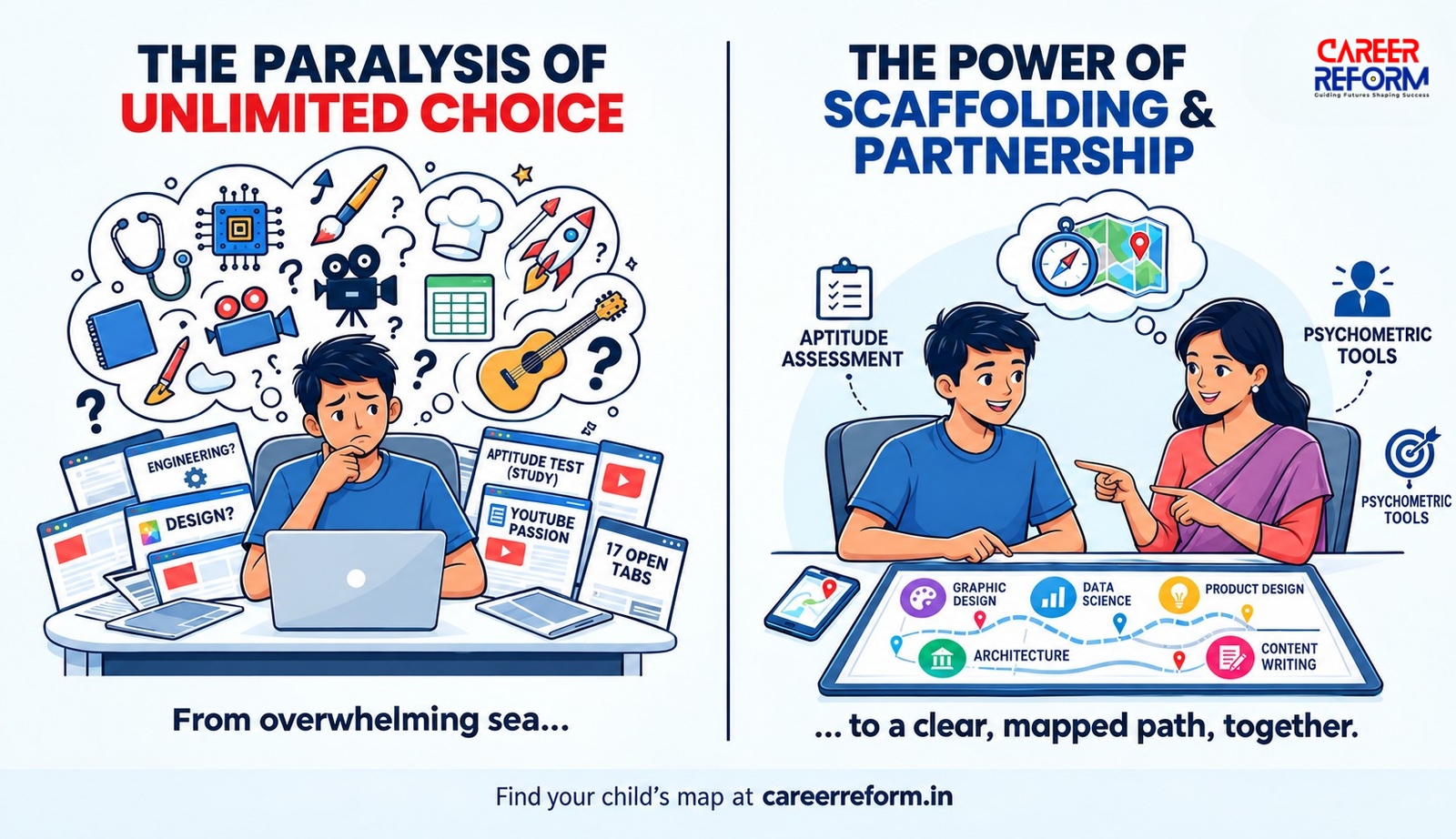
Five years later, that same boy — Arjun, now sixteen — is at his desk at eleven at night. Seventeen browser tabs are open: an engineering college’s admissions page, a design portfolio site, a YouTube video titled “How I Found My Passion at 19,” and an aptitude quiz he started and abandoned twenty minutes in, stuck on question fourteen. He has been “figuring it out” for three months. Tonight, like most nights, he will close the laptop, having chosen nothing, and lie awake doing the maths on how many of his classmates already know.
Downstairs, at a family dinner a few days later, Meera says it again, this time to her sister-in-law, with the same quiet pride she felt five years ago: “We’ve never pushed him into anything. He can be whatever he wants.”
She has no idea that upstairs, in that same house, her son has started to dread the word “want.” It doesn’t feel like an open door to him anymore. It feels like a test he’s failing, alone, with no one allowed to help — because helping was never supposed to be necessary. She gave him freedom. So why, he wonders, does he feel worse than the friend whose father told him: engineering, full stop, no discussion?
This is not a story about a controlling parent and a rebellious teenager. It’s almost the opposite. It’s a story about a generous parent, a genuinely open door — and a child standing frozen in front of it, mistaking his own paralysis for personal failure. If this sounds familiar, you haven’t done anything wrong. You’ve walked, with the best intentions, into a psychological trap that almost no one warns parents about.
Why “Do Anything You Want” Feels Like a Gift — and Lands Like a Weight
Meera’s generation largely grew up inside a narrow, prescribed path: engineering, medicine, or “figure it out yourself” with no further guidance. So when it became her turn to parent, she consciously reached for the opposite extreme. No pressure. No script. Just: it’s your life, your choice.
From where she stands, this feels like love. It feels like respect. It feels, quite reasonably, like good parenting — and in many ways, it is.
But Arjun isn’t standing where she’s standing. From his side, an unstructured “anything” doesn’t feel like an open field — it feels like an open sea, with no coordinates and no shore in sight. When there is no direction at all, a sixteen-year-old isn’t choosing between meaningful options. He’s staring into an undifferentiated blank, trying to invent a compass from scratch, with no practice ever having done so and no one beside him while he tries.
The Science: More Options, More Regret, Less Action
Psychologists have long studied what happens when choice expands without support. The core finding, often called the paradox of choice, is counterintuitive: past a certain point, more options don’t make decisions easier — they make them harder. Faced with many open-ended alternatives and no criteria for narrowing them, people tend to delay choosing, feel more anxious about choosing wrong, and feel less satisfied even after they finally do choose.
Arjun’s seventeen open tabs are that finding, made visible. He isn’t comparing five real, well-understood paths. He’s drowning in an undifferentiated field of dozens, with no framework for ruling any of them out — so question fourteen on the aptitude quiz, which asks him to weigh “creative work” against “stable income,” simply becomes the point where he closes the laptop instead.
A career “decision” at sixteen is not like picking a flavour of ice cream. It’s open-ended, high-stakes, and irreversible-feeling, with no rehearsal and no clear metric for “right.” Hand that decision to a teenager with zero scaffolding, and you haven’t given them freedom — you’ve handed them the hardest version of a hard problem, and then left the room.
The Hidden Message Your Child Is Actually Receiving
Here is the part that rarely gets said out loud: “do anything you want” doesn’t only describe options. It also assigns responsibility. What Arjun hears, underneath his mother’s genuine generosity, is something closer to: this decision, and everything that goes wrong with it, is entirely mine to carry — and if I get it wrong, I can’t even say she made me do it.
That’s not liberation. It’s isolation, dressed up as trust. A child who is quietly afraid of disappointing himself, of “wasting” the freedom he’s been handed, of picking the “wrong” future with no one to share the weight of the thinking — will very often do the only thing that feels safe. Nothing. His paralysis is not laziness, and it isn’t a character flaw. It’s a rational response to an unreasonable amount of unstructured weight, placed on shoulders that have never had to carry it before.
Freedom Is Not the Same as Abandonment
There’s a crucial difference between two things that get confused constantly:
- Choosing for your child — telling them what to become.
- Thinking alongside your child — helping them build the muscle to choose well.
Meera, trying hard not to do the first, quietly skipped the second entirely. She removed the map because she didn’t want to draw it for him — but Arjun was never asking her to draw it for him. He needed someone to sit beside him while he learned to draw it himself.
Freedom without scaffolding isn’t trust. It’s delegation of a task no one has ever taught the child how to do.
What Scaffolding Actually Looks Like
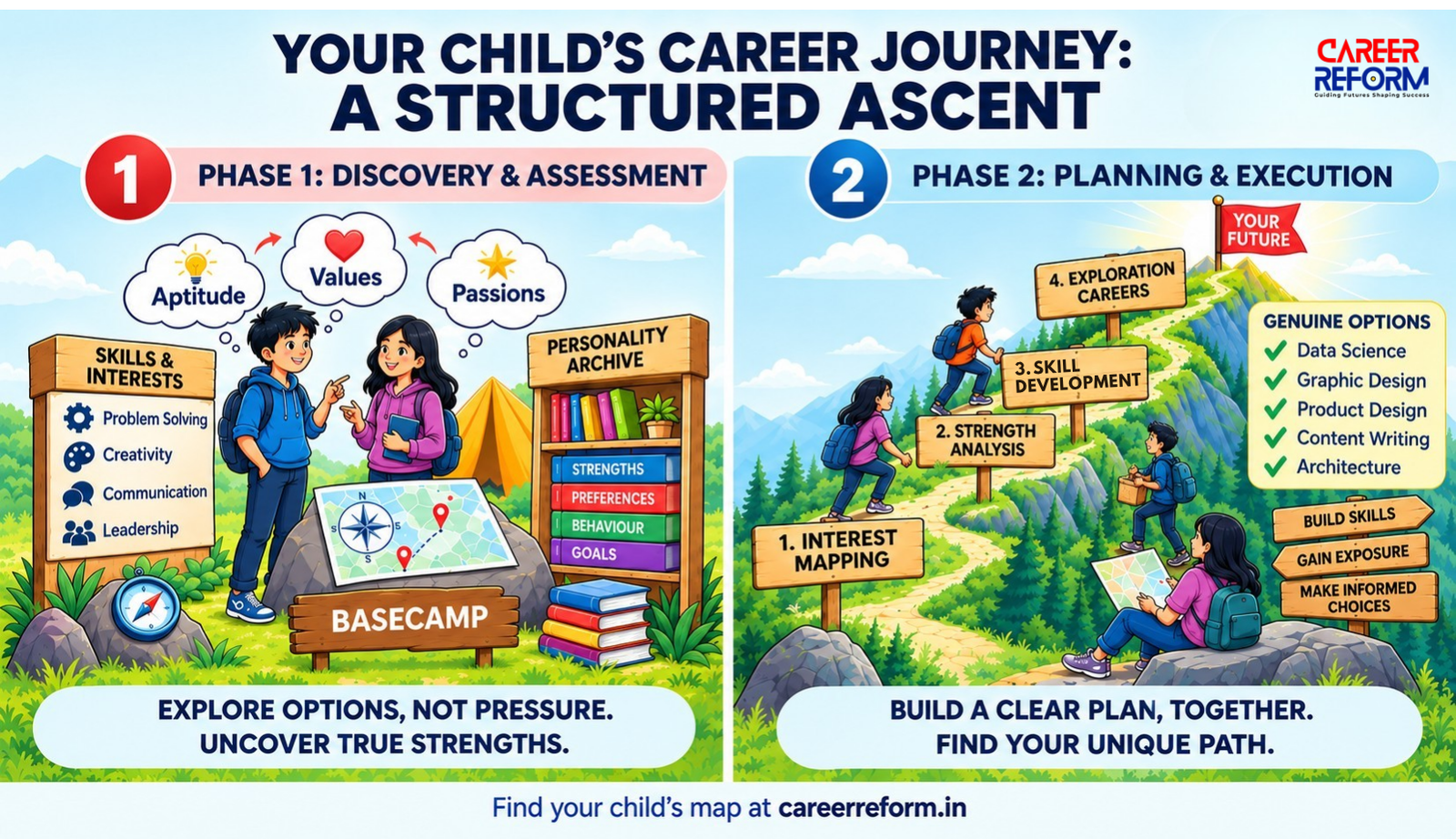
Scaffolding isn’t control, and it isn’t a return to “engineering or medicine, tick one.” It’s structure a child can eventually take over on their own. In practice, it looks like:
- Narrowing the field, not the future. Instead of “anything,” help sort the universe of options into a shortlist of five or six that genuinely fit their interests, strengths, and circumstances. Seventeen tabs become three real conversations.
- Sharing your reasoning, not your verdict. Instead of “I think you should do X,” try “Here’s how I’d think about this, here’s what I’d weigh, here’s what I honestly don’t know either.” Model the thinking process, not the conclusion.
- Making the decision reversible in spirit, even when it isn’t fully in practice. Much of the fear behind paralysis comes from treating a first step as a life sentence. Naming, out loud, that paths can bend — that changing course later is normal and survivable — lowers the stakes enough to actually move.
-
Permitting to not know yet — with a plan to find out. “You don’t have to know today, but let’s find three real answers by next month” is very different from either “you must decide now” or “take all the time you need,” which quietly means the same thing as no help at all.
A Short Script for “Let’s Figure This Out Together”
One evening, Meera finally noticed the laptop light still on at eleven at night and sat down next to Arjun instead of calling out from the hallway. This is close to what she said:
“I realize I’ve been saying ‘it’s totally your choice’ — and I still mean that. But I think I left you to figure this out completely on your own, and that’s a lot for anyone, let alone at sixteen. I don’t want to tell you what to do. I want to think it through with you. Can we sit down this weekend, list out what you actually enjoy and what you’re good at, and narrow this down together — not to one answer, but to a few real options we can actually explore?”
Arjun didn’t answer right away. But he closed three of the seventeen tabs. It was the first thing he’d closed in three months.
Notice what this conversation does: it keeps the freedom fully intact, removes none of Arjun’s agency, and adds the one thing that had been missing all along — a partner in the thinking, not a director of the outcome.
The Real Takeaway
Arjun never needed more freedom. He already had all of it. He didn’t need more control either — that would have undone the very trust Meera had spent five years building. What he needed, the whole time, was a thinking partner: someone to help narrow an infinite field into a workable one, to model reasoning instead of dictating outcomes, and to make the first step feel like a step rather than a sentence.
If this story sounds like the one playing out in your own house, the fix isn’t to take the freedom back. It’s to add the structure that was always meant to come with it — aptitude assessments, psychometric tools, and a framework for narrowing an impossible field into a real, workable choice. Not to choose for your child. Not to take over. Just to finally give both of you the map that “do anything you want” never came with.
That’s exactly what we help build at careerreform.in — sit down with your child, take a proper aptitude assessment together, and turn “anything” into a real, workable shortlist.