

Germany is one of the most accessible study destinations in the world. Its public universities charge little to no tuition, even for international students, and its degrees carry strong global recognition — especially in engineering, sciences, and the humanities. This guide covers the top universities offering English-taught bachelor’s programmes, who’s eligible, what it costs, how the visa process works, and where to find funding.
📘 Want the full breakdown in one place? Career Reform’s free Studying in Germany e-book covers everything below — university comparisons, eligibility, visa checklists, and scholarships — in a single downloadable guide. View the flipbook here.
Top Universities for English-Taught Bachelor’s Degrees
| University | QS Rank 2026 | Location | Popular English Programmes |
|---|---|---|---|
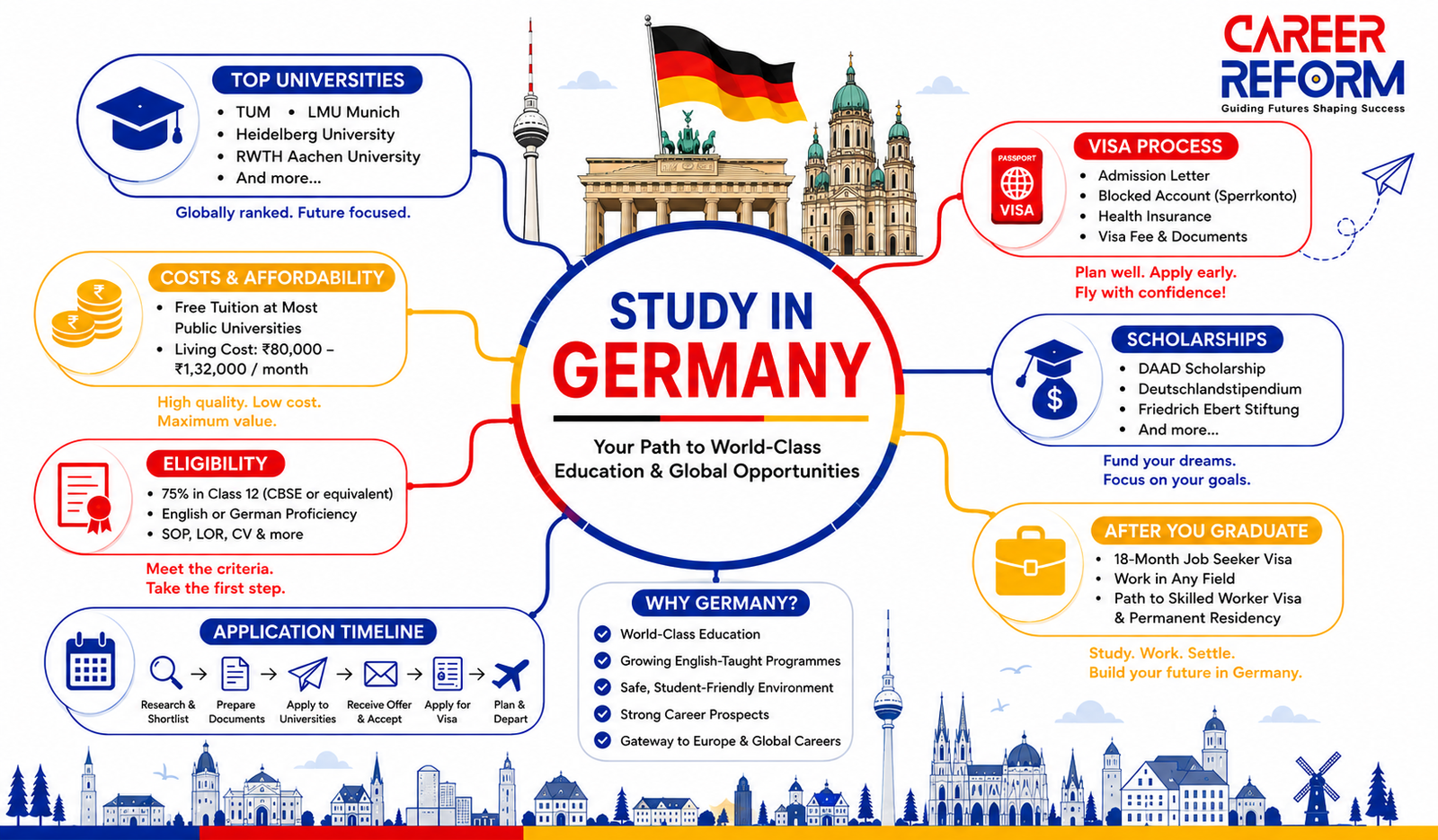
| Technical University of Munich (TUM) | 22 | Munich | Engineering, Computer Science |
| LMU Munich | 58 | Munich | Natural Sciences, Medicine |
| Heidelberg University | 80 | Heidelberg | Life Sciences, Humanities |
| Freie Universität Berlin | 88 | Berlin | Political Science, Philosophy |
| Karlsruhe Institute of Technology (KIT) | 98 | Karlsruhe | Engineering, Physics |
| RWTH Aachen University | 105 | Aachen | Mechanical Engineering, IT |
| Humboldt University of Berlin | 130 | Berlin | Arts, Humanities, Social Sciences |
QS World University Rankings 2026. Note: While these universities offer select English-taught bachelor’s programmes, most bachelor’s degrees at German public universities are still taught in German. Always confirm the language of instruction on the specific programme page before applying.
Tuition and Living Costs (2026/27)
| University | Tuition (Annual) | Living Cost (Monthly) |
|---|---|---|
| TUM | ₹0 tuition + ₹15,840 semester fee | ₹88,000 – ₹1,32,000 |
| LMU Munich | ₹0 tuition + ₹15,840 semester fee | ₹88,000 – ₹1,10,000 |
| Heidelberg University | ~₹1.65 lakh/semester tuition + ₹18,810 fee | ₹93,500 – ₹1,32,000 |
| Freie Universität Berlin | ₹0 tuition + ₹34,210 semester fee | ₹88,000 – ₹1,32,000 |
| KIT | ~₹1.65 lakh/semester tuition + ₹16,940 fee | ₹82,500 – ₹1,21,000 |
| RWTH Aachen | ₹0 tuition + ₹33,000 semester fee | ₹88,000 – ₹1,32,000 |
| Humboldt University of Berlin | ₹0 tuition + ₹34,650 semester fee | ₹99,000 – ₹1,32,000 |
Important correction for Indian applicants: Heidelberg and KIT are both located in the state of Baden-Württemberg, which has charged non-EU/EEA students a tuition fee of €1,500 (~₹1.65 lakh) per semester for bachelor’s and consecutive master’s programmes since 2017 — this applies on top of the standard semester fee. The remaining five universities in this list charge no tuition, only the semester contribution. (Verified directly against Heidelberg’s and KIT’s own official fee pages.)
Figures are approximate, converted at ~₹110 per €1 (August 2026 rate). Confirm current fees directly with each university before applying.
Eligibility Criteria for Indian Students
Without German language proficiency:
- Class 12 completion (CBSE or equivalent) with at least 75% marks; students scoring 60–74% can qualify via a one-year Studienkolleg (foundation course).
- English proficiency: IELTS 6.0–6.5 overall, or TOEFL 80–90 (internet-based).
- Some universities accept SAT/ACT scores or JEE, depending on the course.
- Supporting documents: Statement of Purpose (SOP), Letters of Recommendation (LOR), CV, and passport copy.
With German language proficiency:
- Same Class 12 academic requirement as above.
- German proficiency: TestDaF Level 4–5 (all sections), DSH Level 2 or higher, or Goethe-Zertifikat B2/C1 depending on the course.
- Some programmes require an additional university entrance exam.
Application Timeline
| Stage | Timeframe Before Intake | Typical Months (for Winter intake) |
|---|---|---|
| Research and shortlisting | 12–18 months | April – September (previous year) |
| Prepare documentation | 9–12 months | July – October (previous year) |
| Language proficiency tests | 8–10 months | August – November (previous year) |
| Application submission | 6–9 months | October – December (previous year) |
| Offer and acceptance | 3–4 months | March – June |
| Apply for visa | 3–6 months | March – June |
| Accommodation and final prep | 1–3 months | July – September |
| Course begins (Winter intake) | — | September – October |
Visa Requirements for Indian Students
Indian students need a National Visa (D-Visa) to study in Germany. Requirements include:
- Completed visa application form (from the German consulate/embassy website)
- Valid passport (at least six months beyond intended stay)
- University admission letter
- Proof of financial resources: a blocked account (Sperrkonto) showing sufficient funds for the year — currently €11,904 (~₹13.1 lakh), released as €992/month, and unchanged since September 2024. Confirm with your consulate before applying, as this is revised periodically
- Health insurance coverage
- Proof of language proficiency (IELTS/TOEFL for English-taught courses; DSH/TestDaF for German-taught ones)
- Visa fee: ~€75 (~₹8,250), subject to change
- Proof of accommodation
- Academic documents (Class 10 and 12 certificates, passport photos, SOP, and CV)
Visa processing typically takes 6–12 weeks, so apply well in advance. Full details are available on the German Federal Foreign Office website.
Scholarships for Indian Students
| Scholarship | Available For | Eligibility | Benefit |
|---|---|---|---|
| DAAD Scholarship (Undergraduate) | Bachelor’s, Master’s, PhD | Indian students with excellent academic records | ~₹94,700/month |
| Deutschlandstipendium | Bachelor’s, Master’s, PhD | Open to international students at a German university | ₹33,000/month |
| Friedrich Ebert Stiftung (FES) | Bachelor’s, Master’s, PhD | Strong academic record plus social/political engagement; conversational German expected | ~₹1,09,000/month + health insurance and a family allowance |
Heinrich Böll Foundation is not open to incoming Indian undergraduates. It’s included in many “top scholarships for Germany” lists. The source material for this blog listed it as available at the undergraduate level. Still, the foundation’s own eligibility page states that bachelor’s-level funding is restricted to German students and students who completed secondary school in Germany (Bildungsinländer) — an Indian student applying from India for a bachelor’s degree does not qualify. It remains open to international Master’s and PhD applicants, so keep it in mind for later, not for your undergraduate application.
University- and course-specific scholarships are also worth checking directly on each institution’s website. Scholarship deadlines and combinability rules vary, so confirm details on the official scholarship page before applying.
After You Graduate
Germany allows international graduates to stay for up to 18 months on a job-seeker visa, during which they can work in any field while searching for a role that matches their qualifications. From there, most move on to a Skilled Worker visa or the EU Blue Card, with permanent residency possible in as little as 21 months for those with B1-level German — a major reason Germany has become a strong long-term career destination, not just a study one.
Helpful Resources
- DAAD — official scholarships and programme search
- Uni-Assist — centralised application portal for many German universities
- German Federal Foreign Office — visa requirements and documentation
- Career Reform’s Studying in Germany e-book — the full guide in one downloadable resource.
Final Thoughts
Germany offers a rare combination of low cost, strong academics, and real post-study career prospects — but the details matter: which state your university is in, whether your programme is taught in English or German, and how early you start your APS and visa paperwork can all change your outcome significantly.
Need help figuring out which programme, university, or scholarship is the right fit for you? Visit careerreform.in for personalised guidance on your study-abroad journey.