

Most Indian parents will spend ₹8,000 on school books this year. Most will spend 40 hours researching coaching centres. Very few will spend 40 minutes having the five conversations that may shape their child’s career satisfaction for the next 40 years. Here are those conversations — with the exact words to use.
I have spent much of my career in rooms where these conversations either happen or they do not. In Ahmedabad drawing rooms thick with expectation, at Chennai dining tables where a Grade 10 result can shift the entire mood of a household, and in family WhatsApp groups where a neighbour’s son getting into IIT makes fifty parents simultaneously question whether they have done enough.
What that career taught me — as a counsellor, a scientist, and a parent — is this: the parents who guide their children most effectively are not the ones who know the most about engineering colleges or NEET cut-offs. They are the ones who ask better questions.
These are those questions.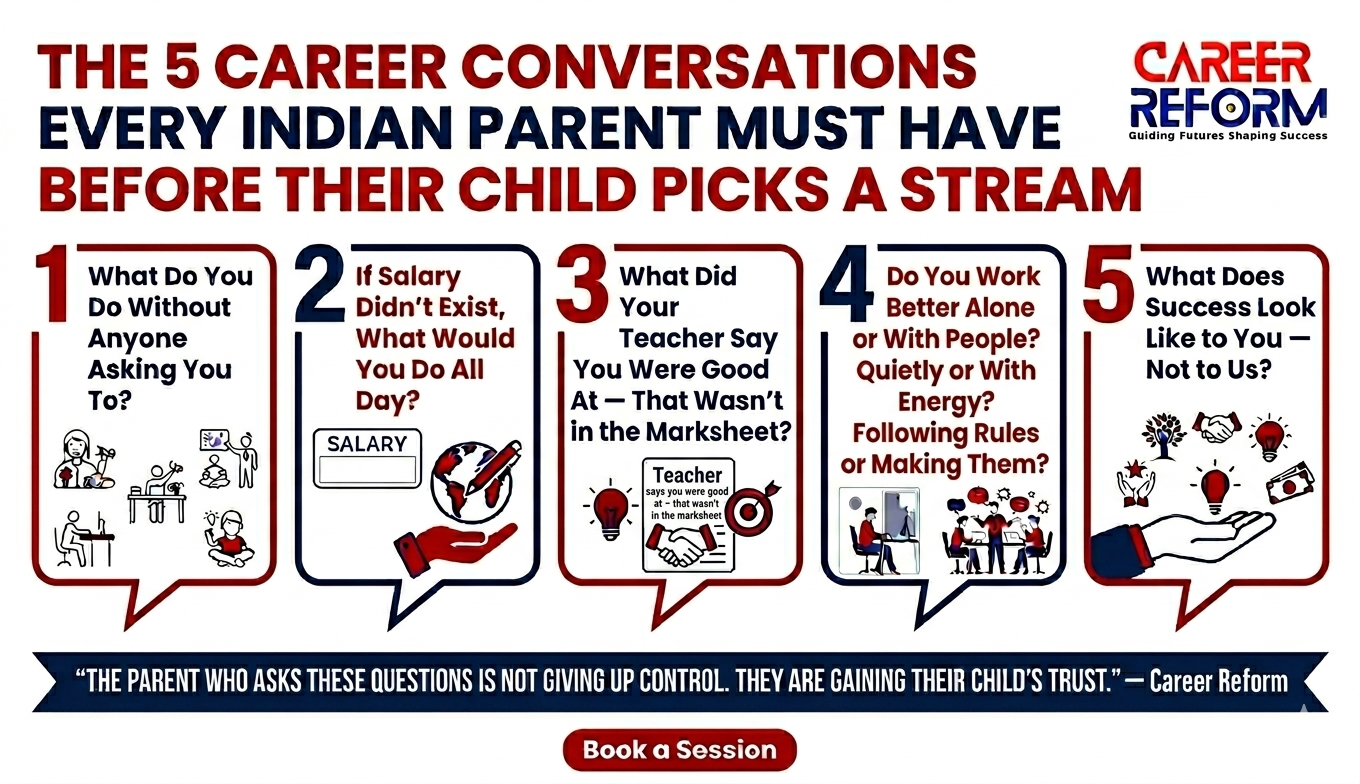
Conversation 1: “What Do You Do Without Anyone Asking You To?”
Why This Conversation Matters
Most of what we know about our children is what they do because we asked — study, attend tuition, come for dinner. Natural behaviour is different. It is what a child does when there is no grade attached and the only motivation is their own quiet curiosity. It is the single most reliable signal of professional fit available to a parent.
The child who spends Saturday afternoons dismantling broken electronics reveals a disposition. The one who reorganises her bookshelf by subject without being told shows you how her mind works. The one who explains cricket statistics to a younger cousin with a teacher’s patience is demonstrating something no report card will ever capture.
These are not hobbies. They are clues. And they are hiding in plain sight.
The Question
Choose a relaxed evening — not the night before an exam. Sit somewhere comfortable. Then ask:
“When you have free time and nobody is watching, what do you end up doing? Not what you think you should do — what do you actually do?”
Ask it once, then wait. Resist the urge to fill the silence.
What to Listen For
Listen for verbs, not nouns. “I like science” tells you very little. “I keep building things out of whatever I can find” tells you a great deal. The verbs — building, explaining, organising, creating, analysing, writing, designing — are the raw material of career direction. Collect them without judgement.
If your child says “I just watch YouTube,” ask one follow-up: “What kind? And what do you do after?” Curiosity is often sitting just beneath the surface answer. Your job is not to evaluate — it is to excavate.
How to Respond
Child: “I just mess around with my guitar. I don’t really do much else.”
Parent: “Tell me more. Do you follow songs someone taught you, or do you figure them out yourself?”
Child: “I figure them out by ear. Sometimes I change the chords around — make my own version.”
Parent: “So you are composing. That takes a specific kind of ear and creativity. What else do you find yourself doing when no one has given you anything to do?”
Notice what this parent did not do: panic, redirect toward studies, or say “that’s nice, but.” They stayed curious — and kept the conversation alive.
What Not to Say
- “That is just a time pass. It is not going to get you anywhere.”
- “You should be using that time to study.”
- “Your cousin in Hyderabad has been learning Python on weekends.”
These responses do not merely end the conversation. They teach your child that honesty with you carries a cost — and once a child learns that, you will not get the truth easily again.
Conversation 2: “If Salary Didn’t Exist, What Would You Do All Day?”
Why This Conversation Matters
Indian families have a remarkable capacity to compress all career thinking into one question: will it pay? This is not shallow — it comes from real sacrifice and real love. But when salary is the only filter, the outcome is frequently someone who is financially comfortable and quietly dissatisfied. I have sat across from hundreds of such adults in their thirties, tracing their unhappiness back to a conversation that never happened when they were seventeen.
This question reveals what your child truly values and separates those values from what they may have been taught to prioritise. Those are not always the same thing.
The Question
A relaxed Sunday morning works well. Keep the tone exploratory — not interrogative.
“Imagine money was never going to be a problem — you would always have enough. What would you spend your days doing? There is no wrong answer. I truly want to know.”
What to Listen For
Resist calculating employability while your child is still speaking. “I would travel and write” is a data point. “I would cook for people all day” is a data point. “I would play video games” deserves one follow-up — do they mean playing them, designing them, or building communities around them? The surface answer is rarely the complete one.
Children who go quiet or say “I don’t know” are often signalling that they have already learnt their real interests are unacceptable. That silence deserves patience, not pressure. It is one of the most important moments in this conversation — and most parents rush past it.
How to Respond
Child: “I would probably make videos — reviewing or explaining things.”
Parent: “What kind of things would you want to explain?”
Child: “Tech stuff, maybe. Or travel.”
Parent: “Content creation and communication are serious professional fields. I am not mapping out a career plan right now — I just want to understand what draws you before we think about where it leads.”
What Not to Say
- “That is not practical.”
- “Do you know how many people fail in that field?”
- “Your Mama spent twenty years in a stable government job. That is what real security looks like.”
An impractical-sounding answer is not a career plan. It is a data point. Dismissing it does not make those values disappear — it only ensures they are no longer shared with you.
Conversation 3: “What Did Your Teachers Say You Were Good At — That Wasn’t in the Marksheet?”
Why This Conversation Matters
Examinations measure accuracy, retention, and speed under pressure — valuable skills, but not the only ones that determine professional success. Curiosity, communication, leadership, creative thinking — these rarely appear on a report card. Teachers, however, observe them every day. And sometimes, in a passing comment or a quiet one-on-one moment, they say something a child carries for years without knowing what to do with it.
This conversation retrieves that feedback. It reminds your child — and you — that they are more than their marks.
The Question
“Think about all the teachers you have had. Did any of them ever say something about you as a person or thinker — not about your marks? Something like ‘you have a real gift for this’ or ‘you should pursue this further’?”
What to Listen For
Watch for moments your child mentions and then immediately minimises. “My English teacher said I write really well, but I didn’t think much of it.” “My art teacher once said I have a good eye, but that’s not a career.” A teacher who singles out one student from hundreds has usually noticed something worth paying attention to. These throwaway lines often contain the clearest career signal in the conversation.
How to Respond
Child: “My history teacher used to say I ask really good questions. Once he told the whole class that I think differently from most people.”
Parent: “What kind of questions were you asking?”
Child: “I always wanted to know why things happened — not just the events, but the reasons behind them.”
Parent: “Analytical thinking — the need to understand causation, not just fact — is enormously valuable in law, research, journalism, and policy. I never knew your teacher noticed that in you.”
“I never knew” signals to your child that you are still learning who they are. That you are not finished forming your picture of them. That signal builds more trust than most parents realise.
What Not to Say
- “Why didn’t your teacher put that in your report if it was so important?”
- “That is a nice compliment, but it does not pay the bills.”
- “Every child gets told something nice by a teacher — it does not mean anything.”
These dismissals teach your child to stop bringing you the softer, less obvious signals — which are often the most honest ones.
Conversation 4: “Do You Work Better Alone or With People? Quietly or With Energy? Following Rules or Making Them?”
Why This Conversation Matters
Two students, both academically strong, both interested in medicine. One will thrive in a busy government hospital in Kolkata — energised by patients, colleagues, and organised chaos. The other will be quietly miserable in exactly that environment, and will flourish instead in a Hyderabad research lab, working alone on a single problem for months.
Same field. Opposite lives.
Stream selection is not only a decision about what your child will do. It is a decision about the environment in which they will spend the majority of their working life. A person can be brilliant and deeply unhappy simply because they are in the wrong kind of room every day. This conversation maps their natural temperament to the environments where they will belong — not merely cope.
The Question
This works best as three gentle questions, asked over the course of a conversation rather than fired one after another:
- “When you have a project — do you prefer working through it alone, or with others?”
- “Do you work better in quiet, structured environments, or ones with energy and variety?”
- “Do you prefer following a clear process, or deciding the approach yourself?”
What to Listen For
There are no wrong answers. An introvert who likes structure may be well-suited to actuarial science, law, or accounting. An extrovert who thrives on variety and autonomy may be drawn toward entrepreneurship, journalism, or marketing. What you are building is a personality map — not a prescription, but a frame for understanding which environments will energise your child and which will slowly drain them.
How to Respond
Child: “I prefer working alone. Group projects stress me out — I end up doing everything myself anyway.”
Parent: “Is that because you like things done a specific way, or because you simply work faster alone?”
Child: “Both. I have very particular ideas about how things should be done.”
Parent: “High personal standards and a preference for independent work are genuine strengths — in design, writing, research, finance, and coding. Let us think about which of those interests you.”
What Not to Say
- “You need to learn to work in teams. That is how the real world operates.”
- “Being an introvert is going to hold you back.”
- “Why can you not be more like your sister? She gets along with everyone.”
Temperament is not a flaw to be corrected. It is a starting point to be understood.
Conversation 5: “What Does Success Look Like to You — Not to Us?”
Why This Conversation Matters
This is the most important conversation on this list — and the one most Indian parents avoid. Not because they do not care, but because they are afraid of what the answer might be.
Here is what I have observed: parents who ask this question and listen without agenda end up with children who trust them with every significant decision that follows. Parents who skip it spend the next decade having the same argument in different forms — louder each time, with more at stake.
Success is deeply personal. To your child’s grandfather, it may mean a government post with a pension. To a cousin in Bengaluru, it may mean a startup exit. To your child — your specific, irreplaceable child — it may mean something none of these models prepared you to expect. This conversation finds out what that is before the stream is chosen and the coaching fees are paid.
The Question
Choose a quiet, uncharged moment. Not the week of results. Not after a difficult conversation about marks. Then ask:
“Not what we expect, not what looks impressive to the family — what does a genuinely good life look like to you? What would make you feel, at forty, that the path you chose was the right one?”
Then listen. Not to evaluate. Simply to understand.
What to Listen For
The most important information is often what lies beneath the answer. “I want to earn a lot of money” frequently means “I want to feel secure — I don’t want to worry the way I have seen people around me worry.” “I want to do something creative” means “I need to feel alive in my work.” “I want to help people” could point to medicine, teaching, social enterprise, or policy — and knowing what kind of helping energises them will tell you which.
Also notice what your child does not mention. If prestige or family approval feature nowhere in their answer, that is significant. It tells you something important about what they will and will not sustain motivation for over the long years of a career.
What to Do When the Answer Surprises You
It will. At some point, it will.
Child: “I think I want to work in the environment sector — climate, conservation, something like that.”
Parent (internal reaction): What will the family say? Is there a career in that? We have already been looking at engineering colleges.
Parent (actual response): “Tell me more. What draws you toward that?”
That pause — between the internal reaction and the spoken response — is where the relationship either deepens or closes. It is one of the most important pauses in a parent’s life, and it lasts only a second or two.
The practical conversation about earnings and pathways can come later. It will be far more productive once your child knows their answer was received with respect rather than concern. React with doubt first, and you may secure compliance. You will not secure trust — and without trust, every conversation that follows becomes a negotiation rather than a partnership.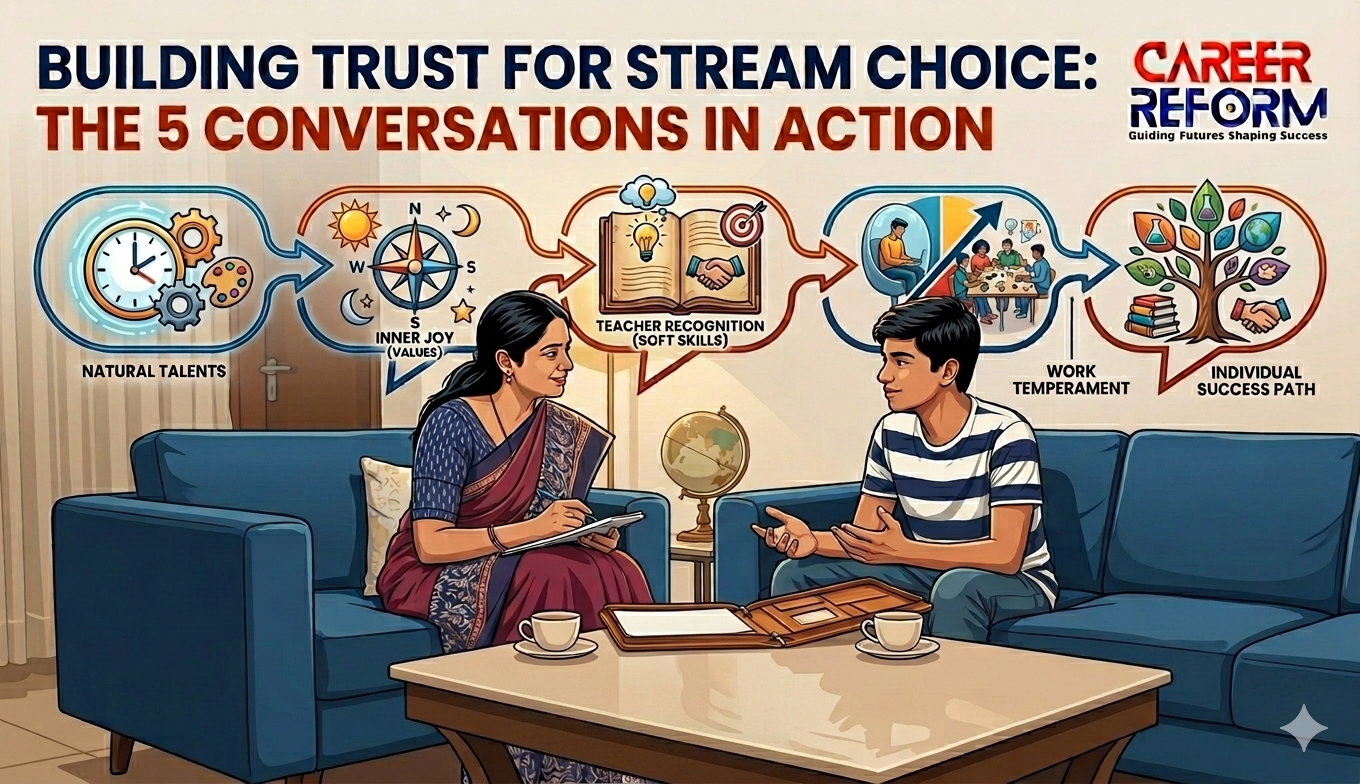
A Final Word
You are not reading this because you want to control your child’s future. You are reading it because you love them — and because love, when it is paying attention, asks questions rather than gives answers.
These five conversations will not hand you a neat answer — career decisions at seventeen rarely resolve neatly. But they will give you something more durable: a child who knows that when the JEE pressure becomes unbearable, or the chosen stream begins to feel wrong, or the family WhatsApp group starts circulating someone else’s achievement — they can come to you with the truth.
Because you asked. Because you listened. Because you made space for their answer, even when it was not the one you had hoped for.
The parent who asks these questions is not giving up control. They are gaining their child’s trust. And that trust, across the long arc of a career and a life, is worth more than any stream selection made without it.
If you would like support in having these conversations, we are here.
These conversations are often the starting point of effective career planning. At Career Reform, we work with students in Grades 8 to 12 and their parents to explore career pathways through structured assessments, guided conversations, and evidence-based counselling. If you would like deeper insights into your child’s strengths, interests, personality, and career options, you can book a career counselling session with Dr. Chetna Sabharwal to gain clarity and confidence in the decisions ahead.
“The parent who asks these questions is not giving up control. They are gaining their child’s trust.” — Career Reform
Sania Q