

Beyond the Textbook: Where Can a School Subject Take You?
Ask a Grade 11 student what Mathematics leads to, and the answers are usually predictable: engineering, accountancy or teaching. These are rewarding careers, but they represent only a small part of what Mathematics makes possible.
Mathematics is the language behind artificial intelligence, financial markets, medical research, climate models and online security. Whenever you use a navigation app, make a digital payment or receive a streaming recommendation, mathematics is working quietly in the background.
This guide explains what Mathematics involves, where it is used, what you can study, where you can study it and how to prepare while you are still in school.
Admission details last checked: November 2026.
1. The Subject: What You Actually Learn
School Mathematics builds a toolkit that becomes more powerful each year:
- Algebra and functions: describing relationships between quantities.
- Calculus: understanding change, rates and optimisation.
- Trigonometry and geometry: working with shape, space and measurement.
- Probability and statistics: making sense of uncertainty and data.
- Vectors, matrices and coordinate geometry: representing and transforming information.
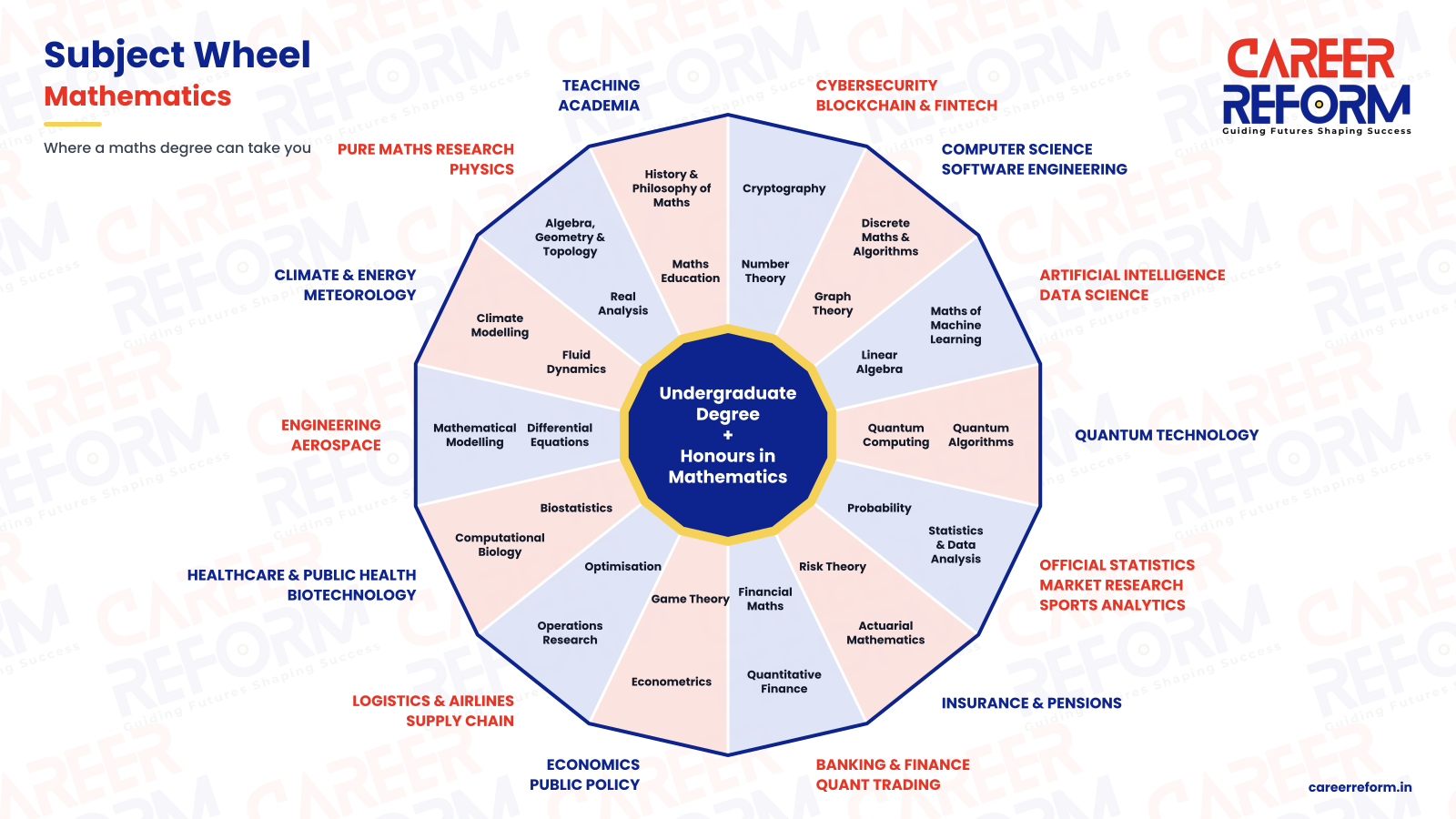
Beyond these topics, Mathematics teaches you to reason logically, recognise patterns and build arguments step by step. At university level, it expands into linear algebra, real analysis, number theory, differential equations, graph theory and mathematical modelling.
2. The Connection: How Mathematics Works in the Real World
Mathematics rarely announces itself, yet it sits beneath much of modern life:
- Artificial intelligence is built on linear algebra, calculus and probability.
- Online security relies on number theory and cryptography to protect passwords, banking and messages.
- Insurance and pensions use probability models to estimate risk.
- Healthcare uses statistics to test whether a new drug or vaccine is safe and effective.
- Logistics and airlines use optimisation to plan routes, schedules and supply chains.
- Weather and climate forecasting depend on mathematical models of complex systems.
Mathematics is less a subject you complete and more a tool you can apply to almost any field.
3. Academic Pathways: What to Study After Grade 12
There are many routes beyond a standard engineering degree.
Undergraduate options
- BSc or BSc (Hons) in Mathematics or Statistics
- BMath (Hons) and BStat (Hons) at the Indian Statistical Institute (ISI)
- BS (Hons) in Mathematics, Mathematics and Computer Science, or Mathematics and Physics at Chennai Mathematical Institute (CMI), a four-year programme with a three-year BSc exit option
- Integrated BS-MS programmes at the Indian Institutes of Science Education and Research (IISERs)
- BS (Research) at the Indian Institute of Science (IISc), Bengaluru
- BTech in Mathematics and Computing at selected IITs and NITs, such as IIT Delhi and NIT Warangal
- BSc programmes in Data Science, Applied Mathematics or Actuarial Science
- BSc or BA in Economics with a strong quantitative component
Postgraduate options
- MSc in Mathematics, Statistics or Applied Mathematics
- MSc in Data Science or Machine Learning
- MSc in Financial Mathematics or Quantitative Finance
- MSc in Operations Research
- MSc in Cryptography or Information Security
- MSc in Econometrics
- PhD programmes in pure and applied mathematics
Professional qualifications
- Actuarial qualifications offered by the Institute of Actuaries of India (IAI) and the Institute and Faculty of Actuaries (UK)
4. Career Pathways: Traditional, Unconventional and Emerging
Traditional careers
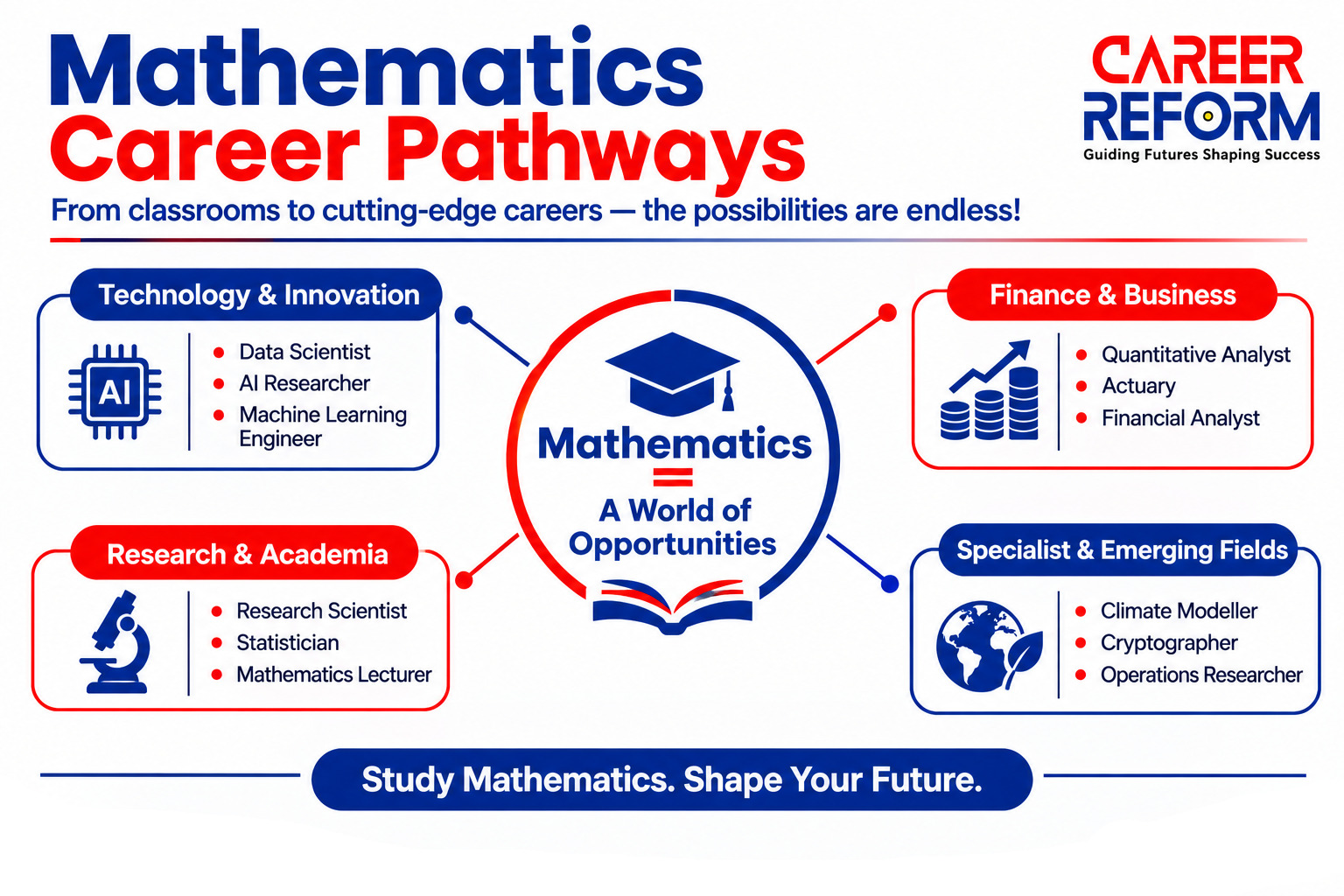
- Mathematics teacher or lecturer
- Statistician in government or research organisations
- Banking and financial services analyst
- Researcher in universities and national institutes
Unconventional careers
- Actuary: assesses financial risk for insurers and pension funds.
- Quantitative analyst: builds models for pricing, trading and risk management.
- Cryptographer: designs systems that keep digital information secure.
- Operations researcher: solves optimisation problems in transport, manufacturing and retail.
- Biostatistician: analyses clinical trial and public health data.
- Econometrician: applies statistical methods to economic questions and policy.
- Sports analyst: uses data to improve performance, strategy and player selection.
Emerging careers
- Data scientist and machine learning engineer
- AI researcher
- Quantum algorithm developer
- Climate and sustainability modeller
- Computational biologist
- Fintech and blockchain specialist
5. Global Opportunities: Where to Study
India
- Indian Statistical Institute (ISI)
- Chennai Mathematical Institute (CMI)
- Indian Institutes of Science Education and Research (IISERs)
- Indian Institute of Science (IISc), Bengaluru
- IITs and NITs, through Mathematics and Computing programmes, with seats allocated through JoSAA
- Central and other leading universities offering BSc programmes, many through CUET-UG
United Kingdom
Cambridge, Oxford, Imperial College London, Warwick, University College London and the London School of Economics are well known for Mathematics, Statistics and related subjects.
United States
MIT, Stanford, Princeton, Carnegie Mellon and many liberal arts colleges offer strong programmes in mathematics and applied mathematics, often with flexible degree structures.
Canada
The University of Waterloo is widely recognised for Mathematics, Computer Science and Actuarial Science.
Europe, Asia and Australia
ETH Zurich, the National University of Singapore, the University of Melbourne and the University of Sydney are respected options. Some public universities in Europe also charge relatively low tuition fees, although policies differ by country and student category.
Admission routes vary. Common Indian routes include CUET-UG, JEE Main and JEE Advanced, the ISI and CMI entrance examinations, and the IISER Aptitude Test (IAT). IIT seats are allocated on JEE Advanced ranks and NIT seats on JEE Main ranks, both through JoSAA counselling.
For the UK, Oxford now uses the Test of Mathematics for University Admission (TMUA) in place of the old Mathematics Admissions Test (MAT). Cambridge, Imperial, Warwick and several other universities use the TMUA, STEP or both, depending on the course.
For the US, testing policies are changing. MIT and Stanford currently require SAT or ACT scores, Princeton is test-optional for now but has announced a return to required testing, and Carnegie Mellon’s policy varies by college.
Entrance tests, eligibility criteria and deadlines change from year to year, so always confirm them on each institution’s official website.
6. Skills Required: Aptitudes and Complementary Subjects
Core skills
- Logical and analytical reasoning
- Comfort with abstraction and patterns
- Persistence when problems are difficult
- Clear communication of complex ideas
- Attention to accuracy and detail
Complementary subjects
- Computer Science: essential for data science, AI and computing careers.
- Physics: useful for modelling and applied mathematics. See our guide to Physics careers.
- Economics: valuable for finance, policy and econometrics.
- Biology: helpful for biostatistics and computational biology.
Technical skills worth building early
- Python or R for data analysis
- Spreadsheet skills
- Basic statistics and data visualisation
You do not need to be the fastest at calculation. The strongest mathematicians are often those who are patient, curious and willing to think deeply.
7. Future Outlook: Emerging Industries and Opportunities
Demand for mathematical thinking is growing wherever data and decisions meet:
- Artificial intelligence and machine learning: every major AI system rests on mathematical foundations.
- Data science and analytics: organisations in every sector need people who can interpret data.
- Cybersecurity and cryptography: as digital activity grows, so does the need for secure systems.
- Quantum technology: new algorithms and error-correction methods call for strong mathematical talent.
- Fintech and risk management: digital finance depends on quantitative models.
- Climate and energy modelling: forecasting and planning require advanced simulation.
- Healthcare analytics: personalised medicine and diagnostics rely on statistical and computational methods.
Technologies will keep changing, but the ability to reason with numbers and models will remain valuable.
8. Student Action Plan: Preparing in Grades 9–12
Grades 9–10
- Build solid fundamentals in algebra, geometry and arithmetic, because gaps here become obstacles later.
- Try puzzles, logic games and problem-solving challenges.
- Start noticing how mathematics is used in everyday life and in different professions.
Grade 11
- Choose a subject combination that keeps your options open, such as Mathematics with Physics, Computer Science or Economics.
- Start learning Python through free online courses.
- Take part in Mathematics Olympiads or similar competitions.
Grade 12
- Research degree options and entrance examinations early.
- Prepare for the entrance examinations that match your interests, such as CUET-UG, JEE, the ISI and CMI entrance tests, or the IISER Aptitude Test.
- Build a small portfolio, such as a data analysis project or a short research essay.
Throughout school
- Read books on the history and applications of mathematics.
- Speak with professionals such as actuaries, data scientists and researchers.
- Consult a career counsellor to match your strengths with the right degree and country.
Final Thoughts
Mathematics is not a narrow subject that leads only to engineering or accountancy. It is a gateway to technology, finance, healthcare, security, research and the future of artificial intelligence.
A student who enjoys Mathematics should not feel confined to a traditional path. The better question is not “What is Mathematics usually used for?” but “What could Mathematics make possible for me?”
Solve for Your Future
Every good problem has a solution, and so does the question of what to study next.
Your Interests + Your Strengths + The Right Guidance = A Career Path That Fits You
You already have the first two. At CareerReform, we help with the third. Our counsellors help you explore degrees, compare universities across countries and plan your next steps with confidence. Download a free Mathematics Career Guide Here.
Book a counselling session with CareerReform today, and let’s work out your best-fit path together.