

One Subject, A Thousand Possibilities: Connecting Academics to Careers
When students think about careers connected to Economics, banking, Chartered Accountancy (CA) and finance-related professions often come to mind. But Economics offers far more possibilities.
It explores how individuals, businesses and governments make decisions when resources are limited. From rising prices and unemployment to international trade, technology and climate change, Economics helps us understand the world around us.
If you enjoy Economics but don’t see yourself working in banking or accountancy, here are 12 alternative career paths worth exploring.
Admission information last reviewed: November 2026. University requirements, eligibility criteria and examination patterns may change. Always check the latest official notifications before applying.
Why Does Economics Open So Many Career Opportunities?
Economics is more than the study of money and markets. It develops three important skills:
- Analytical reasoning: Identifying problems, recognising patterns and evaluating possible solutions.
- Quantitative skills: Understanding numbers, statistics, data and mathematical models.
- Communication: Explaining complex ideas and presenting evidence-based arguments.
These skills are valuable across government, technology, research, consulting, finance, media and sustainability.
What Do You Actually Learn in Economics?
At school, Economics introduces students to how individuals, businesses and governments make decisions. Depending on the school board and curriculum, students may study areas such as:
- Microeconomics: Demand, supply, production and market structures.
- Macroeconomics: Inflation, unemployment, national income and government budgets.
- Indian Economic Development: India’s economic growth, reforms and development challenges.
- Statistics for Economics: Collecting, analysing and interpreting data.
At university, students explore these subjects in greater depth through areas such as econometrics, mathematical economics, development economics, public economics and international trade.
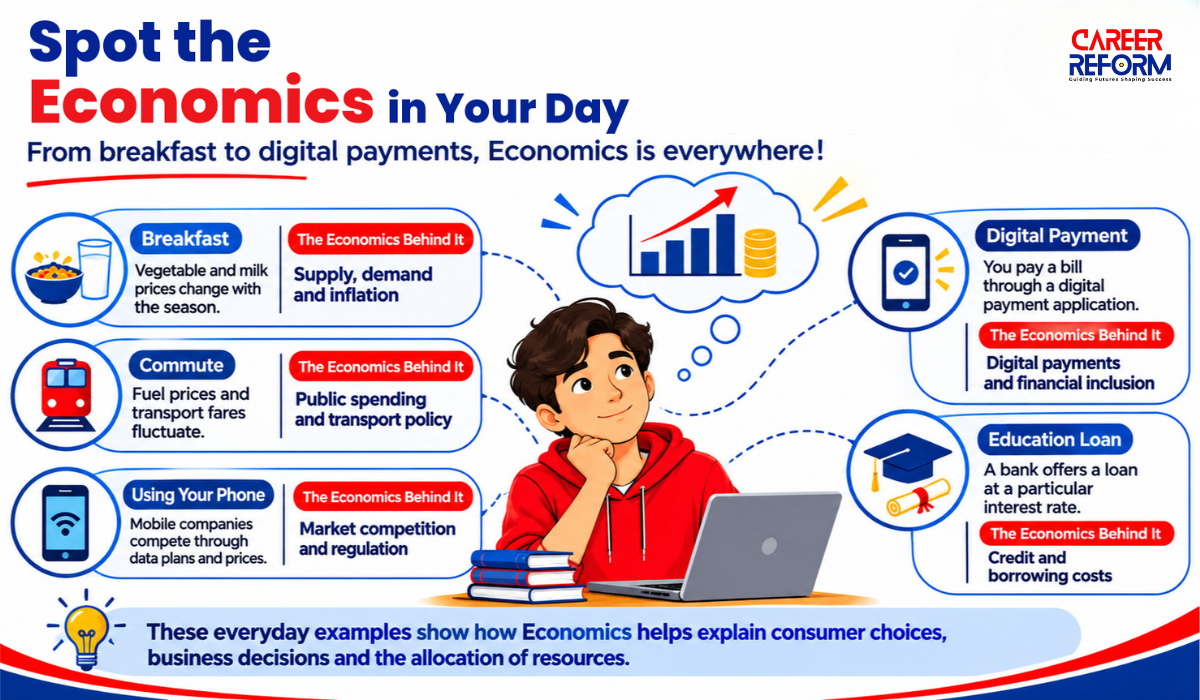
The Connection: Economics in One Ordinary Day
Economics influences decisions throughout an ordinary day. Consider how it appears in the life of a student:
Career Pathways: 12 Careers to Explore
An Economics degree can lead to opportunities across traditional industries and specialised fields involving technology, research and sustainability.
1. Economist (Research and Policy)
Economists study inflation, unemployment, economic growth, taxation and international trade. They use economic theories and statistical methods to understand challenges and advise policymakers and businesses.
Where can you work?
- Reserve Bank of India (RBI)
- NITI Aayog
- Government ministries and research institutions
- International organisations
What should you study?
A bachelor’s degree in Economics provides a strong foundation. Many specialist research positions require a master’s degree, while advanced research and academic roles often require a PhD.
2. Public Policy Analyst
Public policy analysts evaluate government programmes and policies to determine whether they achieve their intended objectives. Their work may involve education, healthcare, taxation and employment.
Where can you work?
- Government departments
- Public policy think tanks
- Consulting firms
- Non-profit organisations
What should you study?
A degree in Economics, Political Science or a related subject can provide a foundation. A master’s in Public Policy or Economics can offer further specialisation.
3. Development Economist
Development economists examine poverty, education, healthcare, employment and economic inequality. They research whether development programmes are improving people’s lives.
The 2019 Nobel Memorial Prize in Economic Sciences was awarded to Abhijit Banerjee, Esther Duflo and Michael Kremer for their experimental approach to alleviating global poverty.
Separately, Banerjee, Duflo and Sendhil Mullainathan founded the Poverty Action Lab at MIT in 2003. It is now known as the Abdul Latif Jameel Poverty Action Lab (J-PAL).
Where can you work?
- World Bank
- United Nations agencies
- J-PAL International research organisations
What should you study?
A bachelor’s degree in Economics followed by a master’s degree in Development Economics, Economics or Public Policy can be a suitable route. Research-focused positions may require a PhD.
4. Behavioural Economist
Behavioural economists combine Economics with Psychology to understand how people make decisions. They explore why individuals sometimes make choices that differ from what traditional economic models predict.
Their research is used in public policy, marketing, product design and financial planning.
Where can you work?
- Behavioural research organisations
- Government policy teams
- Financial institutions
- Technology and consulting companies
What should you study?
A degree in Economics, Psychology or a related subject can provide a foundation. Postgraduate study in Behavioural Economics or a related discipline can help develop specialised knowledge.
5. Data Scientist or Data Analyst
Economics develops an understanding of patterns, numbers and relationships between different factors. These abilities provide a useful foundation for data-related careers.
Data analysts interpret information to help organisations make decisions, while data scientists use advanced statistical and computational techniques to identify patterns and build predictive models.
Where can you work?
- Technology and e-commerce companies
- Healthcare organisations
- Financial institutions
- Consulting firms
What should you study?
Economics combined with Mathematics, Statistics or Data Science can be useful. Develop practical skills in Excel, Python or R, SQL and data visualisation. Data science positions generally require additional training in programming, statistics and computational methods.
6. Quantitative Analyst
Quantitative analysts, commonly called quants, use Mathematics, Statistics and programming to solve complex financial problems. They develop models for investment strategies, financial risk assessment and market analysis.
Where can you work?
- Investment banks
- Hedge funds
- Asset management companies
- Financial technology firms
What should you study?
A strong background in Economics, Mathematics, Statistics or Computer Science is useful. Many specialised positions prefer postgraduate qualifications and advanced quantitative skills.
7. Actuary
Actuaries use Mathematics, Statistics and financial theory to evaluate financial risks and uncertainties.
Insurance companies, for example, employ actuaries to estimate the likelihood of claims, calculate premiums and assess future financial obligations.
Where can you work?
- Insurance companies
- Pension organisations
- Consulting firms
- Financial services companies
What should you study?
Students can pursue a degree in Actuarial Science, Mathematics, Statistics, Economics or a related field. Professional qualification generally requires passing examinations conducted by the Institute of Actuaries of India or another recognised actuarial body.
8. Indian Economic Service (IES) Officer
The Indian Economic Service offers an opportunity to contribute to economic research and policymaking within the Government of India.
IES officers undertake economic analysis and prepare reports on areas such as public finance, development, trade and economic planning.
Where can you work?
- Ministry of Finance
- Government ministries and departments
- Economic policy divisions
What should you study?
A postgraduate degree in Economics, Applied Economics, Business Economics or Econometrics from a recognised university is required. Recruitment takes place through the competitive examination conducted by the Union Public Service Commission (UPSC).
Check the official UPSC website for the latest notification, eligibility conditions and examination details.
9. Economic or Management Consultant
Consultants help organisations understand business challenges and make informed strategic decisions. An Economics background is useful when analysing pricing, market demand, competition and business performance.
Where can you work?
- Management consulting firms
- Economic consulting firms
- Corporate strategy departments
- Financial advisory companies
What should you study?
A degree in Economics, Business or Finance can provide a foundation. A master’s in Economics, Management or an MBA may be useful for certain roles. Analytical thinking and communication skills are particularly important.
10. Economic Journalist
Economic journalists explain complex financial and economic developments to the general public. They report on subjects such as government budgets, inflation, employment, international trade and financial markets.
Where can you work?
- Newspapers and business magazines
- Television news organisations
- Digital media platforms
- Financial news publications
What should you study?
A degree in Economics combined with journalism or communication training can be a useful route. A postgraduate journalism qualification can help develop reporting and storytelling skills. A strong writing portfolio is also valuable.
11. Environmental and Climate Economist
Environmental and climate economists examine the economic impact of environmental changes and evaluate policies designed to address them.
Their work may involve assessing natural resources, contributing to carbon-market design and evaluating clean-energy policies.
Where can you work?
- Environmental research institutions
- International organisations
- Government sustainability departments
- Renewable energy companies
What should you study?
A degree in Economics followed by specialisation in Environmental Economics, Climate Economics or Public Policy can be useful. Knowledge of environmental science and data analysis can provide an additional advantage.
12. Academic or Researcher
Students who enjoy economic theories, research and teaching may consider an academic career.
Economics researchers investigate subjects such as poverty, financial markets, international trade and public policy. Academics also teach university students and contribute to research.
Where can you work?
- Universities and colleges
- Economic research institutions
- Government research organisations International research centres
What should you study?
A master’s degree in Economics is generally an important step towards research and university teaching. A PhD is commonly expected for independent academic research and long-term academic progression.
In India, Assistant Professor appointments generally require a relevant master’s degree with at least 55% marks (or an equivalent grade, subject to applicable relaxations) and qualification in UGC-NET or an accredited State Eligibility Test (SET/SLET). Certain PhD qualifications and other provisions may provide exemptions under applicable UGC regulations. Check the latest eligibility rules for the relevant institution and position.
Academic Pathways: What Should You Study After Grade 12?
If you are considering Economics as a career, understanding the available academic pathways can help you plan your next steps.
1. Undergraduate Degree (Usually 3–4 Years)
A BA or BSc in Economics is one of the most direct routes into the subject.
Universities worth exploring in India include:
Some universities offer Economics as a specialised degree, while others include it within liberal arts programmes.
Admission routes in India:
- CUET-UG: Used by many central universities, including the University of Delhi.
- University-specific admissions: Private universities such as Ashoka and Krea conduct their own admission processes, which may include assessments, essays and interviews.
2. Postgraduate Degree (Usually 1–2 Years)
After completing an undergraduate degree, students can pursue a master’s qualification to develop specialised knowledge.
Possible programmes include:
- MA Economics
- MSc Economics
- MSc Quantitative Economics
- Master’s in Public Policy
- MSc Data Science or Finance
Well-known Indian institutions offering relevant postgraduate opportunities include the Delhi School of Economics, Indian Statistical Institute (ISI) and Indira Gandhi Institute of Development Research (IGIDR).
Admission procedures and eligibility requirements vary between institutions.
3. Doctorate (Several Years)
Students interested in advanced research, university teaching or specialised economic research can pursue a PhD in Economics or a related discipline.
A doctorate involves conducting original research, analysing evidence and contributing new knowledge to the field.
Do You Need Mathematics in Grade 12?
Not every Economics programme has the same Mathematics requirement. However, Mathematics can strengthen your preparation and keep more academic options open.
For example, the University of Delhi’s 2026 admission requirements for BA (Hons.) Economics required applicants to appear in Mathematics in CUET-UG.
If you are choosing your Grade 11 subjects, consider Mathematics alongside Economics wherever it is available and appropriate for your strengths and goals. Always check the eligibility requirements of your shortlisted universities.
Global Opportunities: Where Can You Study Economics?
Economics is taught at leading universities worldwide. Studying abroad can provide exposure to different economic systems, research approaches and international perspectives.
Here are some universities worth exploring:
| Destination | Well-known universities for Economics |
|---|---|
| United Kingdom | London School of Economics, University of Oxford, University of Cambridge, University of Warwick |
| United States | Massachusetts Institute of Technology (MIT), University of Chicago, Stanford University, Yale University |
| Canada | University of Toronto, University of British Columbia, McGill University |
| Europe | Toulouse School of Economics (France), Bocconi University (Italy), Erasmus University Rotterdam (Netherlands) |
| Asia-Pacific | National University of Singapore, Australian National University |
These are examples, not a ranking. Compare course structures, entry requirements, tuition fees, research opportunities and career outcomes before making a decision.
Skills That Can Strengthen Your Economics Profile
You don’t need to master everything before starting, but developing these four skills can help:
- Statistics and data analysis: Understand percentages, probability, correlation and economic trends.
- Spreadsheets and programming: Learn Excel or Google Sheets, then explore Python or R.
- Writing and presentation: Practise explaining complex issues clearly.
- Current affairs: Follow economic news, government budgets, international trade and public policy.
Complementary Subjects: What Else Can You Study Alongside Economics?
Combining Economics with other subjects can help you explore specialised career opportunities.
| Subject | How it strengthens Economics |
|---|---|
| Mathematics and Statistics | Mathematical modelling, optimisation and data analysis |
| Computer Science or Data Science | Programming and data handling |
| Political Science | Government institutions and public policy |
| Psychology | Decision-making and behavioural economics |
| Geography or Environmental Studies | Climate and resource economics |
| English and Communication | Research writing and presentation |
The right combination depends on your interests and the career direction you want to explore.
Future Outlook: Emerging Industries and Opportunities
Economics continues to evolve alongside technology, environmental changes and global developments.
Here are six areas where economic knowledge is increasingly relevant.
- AI and Data-Driven Policy: Evaluating how technology and policies affect society.
- Climate Economics: Understanding carbon pricing, renewable energy and climate risks.
- Digital Economy: Studying online platforms, digital payments and market competition.
- Health Economics: Examining healthcare costs, accessibility and resource allocation.
- Sustainable Finance: Evaluating investments through environmental and social considerations.
- Impact Evaluation: Using research to measure whether social and economic programmes achieve their objectives.
The growth of these fields will depend on technological developments, government policies and market conditions. Students who combine Economics with data skills, research abilities and interdisciplinary knowledge can prepare themselves for a wider range of opportunities.
Student Action Plan: Preparing for Economics Careers in Grades 9–12
You don’t have to wait until university to explore Economics. Small steps during school can help you discover your interests.
Grades 9–10: Build Your Foundation
- Strengthen Mathematics, especially algebra, percentages and statistics.
- Read business and economic news.
- Observe everyday economic activities, such as price changes and household budgeting.
Grade 11: Explore Your Interests
- Choose your subject combination carefully.
- Learn Excel or Google Sheets.
- Try introductory courses in Economics or Data Analysis.
- Participate in debating and current-affairs clubs.
Grade 12: Prepare for University
- Shortlist Economics programmes in India and abroad.
- Compare eligibility, entrance examinations, fees and deadlines.
- Prepare for CUET-UG or university-specific admission assessments, where applicable.
- Build a small research or data-analysis project.
- Explore scholarships if considering studying abroad.
Throughout School: Speak with professionals, attend workshops, follow reliable economic research and consult a career counsellor to understand how your interests and strengths align with different pathways. Remember, career exploration is about discovering possibilities, not deciding your entire future at an early age.
The Bottom Line: Economics Is More Than Banking and Accountancy
Economics can take you far beyond banking, Chartered Accountancy and an MBA in Finance.
You could analyse data, shape public policy, research poverty, report economic developments or contribute to climate solutions. The important question is not simply: Which careers are usually associated with Economics?
It is:
What problems interest you, and how would you like to help solve them? Your answer can guide the subjects, skills and qualifications worth exploring.
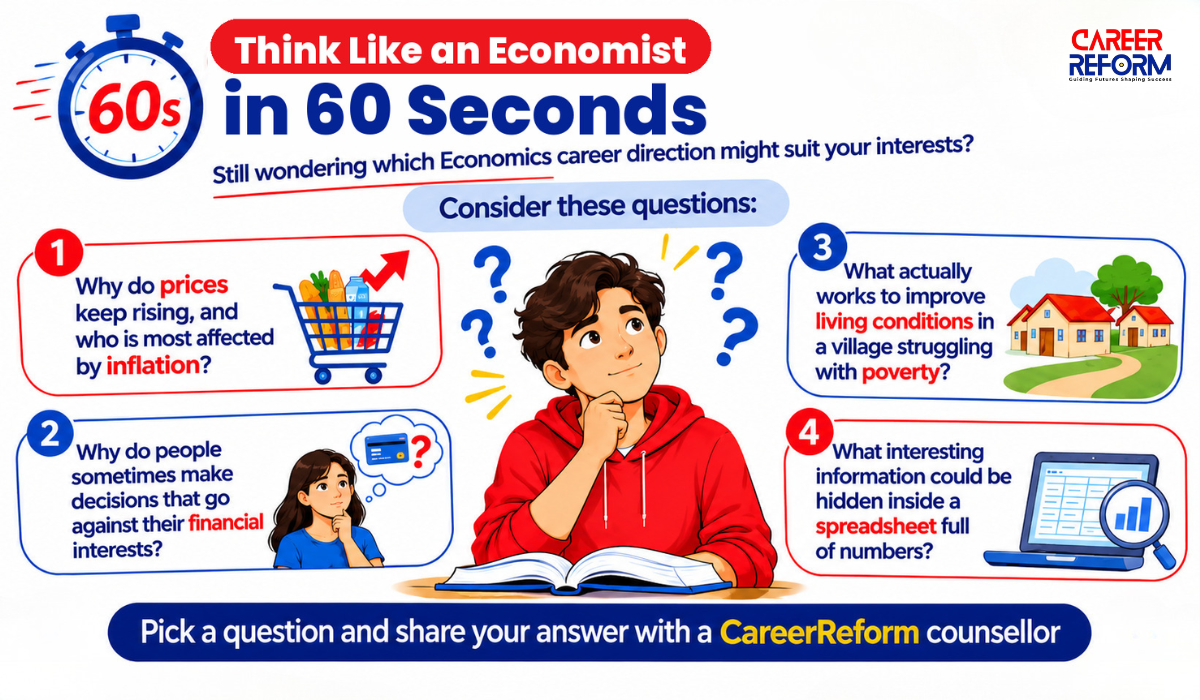
Try the 60-Second Economics Compass
Your Economics Journey Begins With One Question
Which question made you stop and think: prices, decisions, poverty or data?
Every economist, policy analyst, researcher and data scientist starts with curiosity about the world. The right degree, university and guidance can help turn that curiosity into a career.
At CareerReform, our counsellors help students explore Economics pathways in India and abroad, compare university options and admission requirements, and build a personalised roadmap based on their interests, strengths and goals.
Want to explore where Economics could take you? Connect with CareerReform and take the first step towards planning your career journey.