

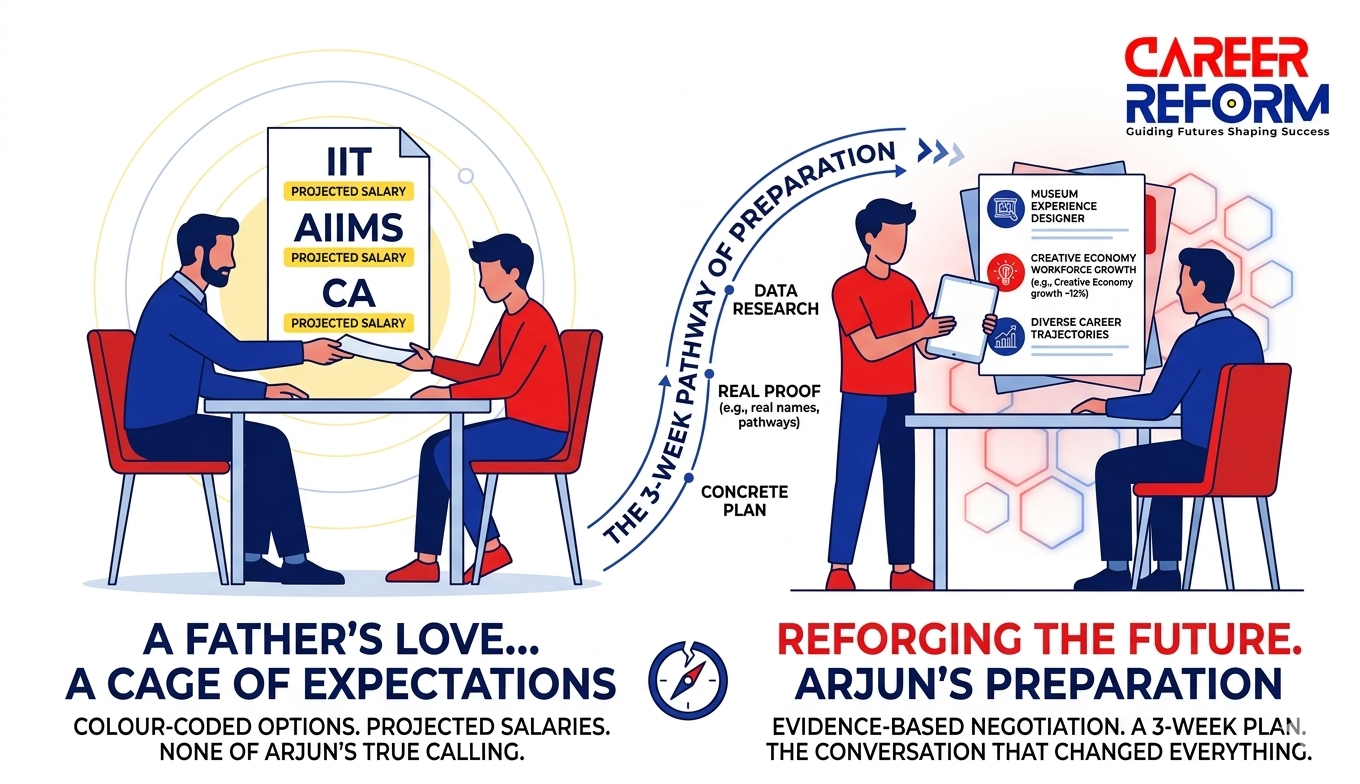
Arjun was seventeen when his father slid a colour-coded printout across the dining table. IIT. AIIMS. CA. Three options, projected salaries highlighted in yellow. His father had spent a Sunday afternoon on it. The love in that gesture was real. So was the cage.
Arjun wanted to build interactive experiences for museums. He had already won a national design competition. None of that was on the printout.
He did not fight. He did not storm off. He also did not say yes. Instead, he prepared. Three weeks later, he sat back down at that same table and had a conversation that changed the trajectory of his life — without destroying his relationship with his family.
This piece is about that preparation.
THE REAL PROBLEM IS NOT YOUR PARENTS
Your parents are not wrong to be afraid. They are just afraid of the wrong things.
The anxiety most families carry about “offbeat” careers was formed during a very specific economic era. They watched neighbours lose everything. They saw relatives with degrees in fine arts or theatre struggle to pay rent in their thirties. They built their understanding of “stability” from real evidence — drawn from a world that no longer fully exists. The world has restructured around them. The evidence has shifted. But nobody sat down and told them that.
That is the actual problem. It is not stubbornness. It is not a lack of love. It is an information gap dressed up as a values conflict.
Three numbers worth knowing:
→ 65% of children entering primary school today will work in jobs that do not yet exist.
→ ₹28L+ is the median annual salary for UX designers with 3–5 years of experience in India.
→ 40% of India’s creative economy workforce is under 30, and the sector grows at 12% annually. Most family conversations about career fail before they begin because students show up with passion and parents show up with a spreadsheet of fears. Neither side is speaking the other’s language.
What nobody teaches students is how to translate. How to take what you feel in your chest and render it into the language of security, trajectory, and social proof that your parents actually need to hear.
WHY THE CURRENT APPROACH KEEPS FAILING
The way most students handle this conversation goes one of two ways. Both are disasters.
The first is the Explosion. Voices rise. Old wounds surface. Someone says something they cannot say. The career discussion becomes a referendum on respect and autonomy. Nobody wins. The second is the Retreat. The student senses the resistance, swallows their ambition, and ticks the boxes their family approves of . They spend years building a career they tolerate. The resentment compounds quietly. Neither approach respects both people in the room.
The path through is harder and rarer: a genuine negotiation, conducted with evidence, empathy, and structure.
THE FRAMEWORK: FOUR MOVES THAT CHANGE EVERYTHING
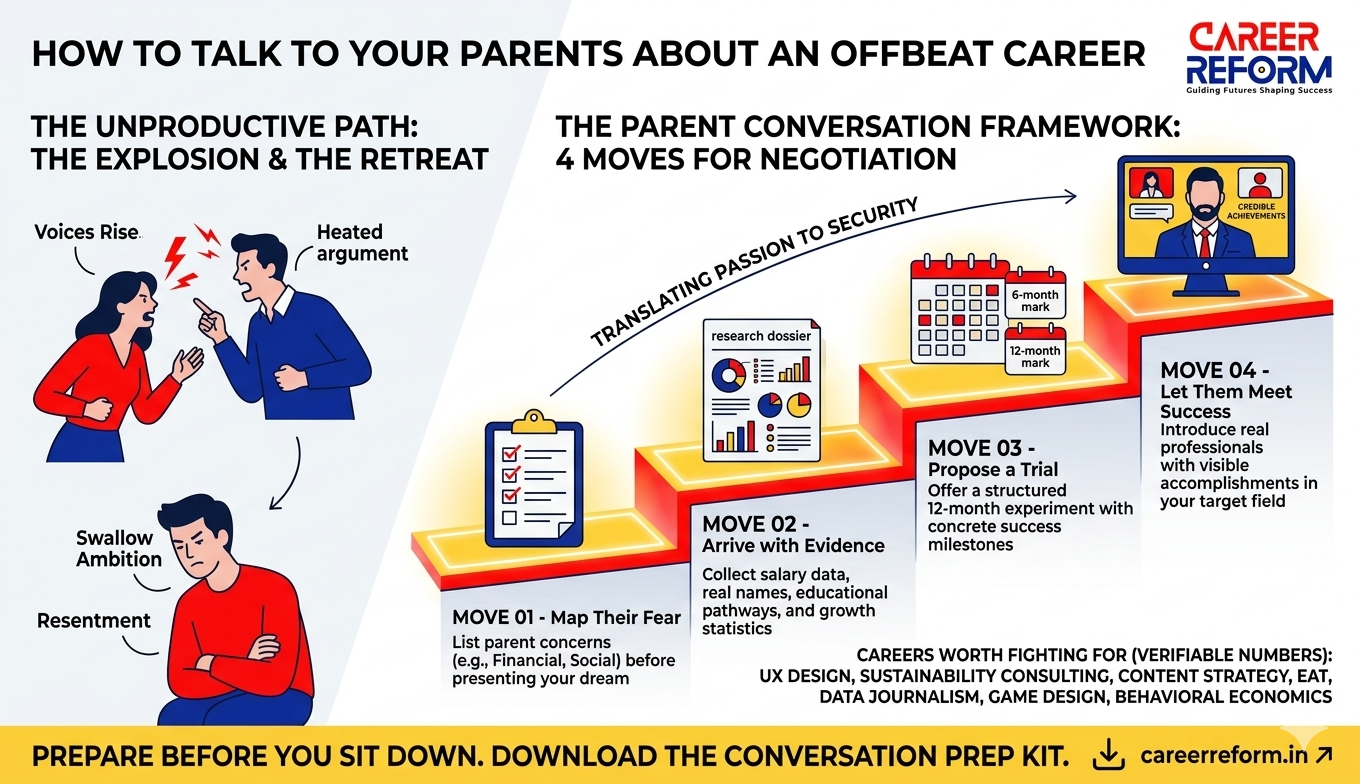
MOVE 01: Map their fear before you present your dream
Before you say a single word about what you want, understand what your parents are actually afraid of.
- Financial security fear: “They won’t earn enough to be independent.”
- Social standing fear: “What will relatives say?”
- Competence credibility fear: “They’re chasing a fantasy without a plan.”
- Connection fear: “They’re leaving for a world we don’t understand.”
Each fear requires a different response. Ask directly: “What worries you most about this?” Then listen without defending. Write it down. That list is your actual agenda for the conversation.
MOVE 02: Arrive with evidence, not emotion
You need to show up with a research dossier. Not a rough idea. A dossier.
- Salary data from LinkedIn Salary Insights, Glassdoor India, or NSDC reports.
- Real names of real people who built this career from similar backgrounds.
- The educational pathway: qualifications, institutions, costs, placement records.
- Industry growth trajectory over 5 and 10 years.
- A backup scenario: what does the adjacent stable path look like?
When you walk in with printed data and real names, you signal two things: you are serious, and you have already done what responsible adults do before making a big decision. That shifts the dynamic from child-asking-permission to young adults making a case.
MOVE 03: Propose a trial, not a declaration
The hardest thing for parents to say yes to is permanence. “I want to be a game designer” sounds like a life sentence with no escape clause.
Instead:
- Propose a structured experiment. “Can we agree I spend the next 12 months building real skills in this area, and then we evaluate together?”
- Identify one concrete milestone in 6 months: a portfolio piece, a certification, a paid project.
- Give your parents a role. Ask them to define what “success” needs to look like for them to feel comfortable.
- If the parallel path matters, offer to maintain one traditional qualification alongside your primary goal, for a defined period.
A trial is not a surrender. It is a negotiation. You are buying yourself time and credibility simultaneously.
MOVE 04 — Let them meet someone who already made it
Nothing changes a parent’s mind faster than a conversation with a credible adult who chose an unconventional path and built a stable, respected life from it.
- Identify 2–3 professionals in your target field from similar backgrounds.
- Ask them if they would speak briefly with your family. Most will say yes.
- If in-person is impossible, a LinkedIn profile with visible accomplishments does the same job.
- Let your parents ask the questions. Don’t script it. The authenticity is the point.
Your parents need to see that the person you want to become is real, not theoretical.
CAREERS WORTH FIGHTING FOR (WITH NUMBERS)
- UX and Product Design — ₹6–40L annually
Every digital product needs designers. India’s tech ecosystem generates thousands of UX roles annually. No engineering degree required. Portfolio-based hiring is standard.
- Climate and Sustainability Consulting — ₹8–35L annually
ESG reporting is now mandatory for listed companies. Carbon accountants and climate risk advisors are among the fastest-growing white-collar roles globally.
- Content Strategy and Brand Storytelling — ₹4–25L annually
Every company with a digital presence needs content. Senior content strategists at funded startups command salaries that rival mid-level engineering roles.
- Data Journalism and Visual Storytelling — ₹5–20L annually
Combines quantitative literacy with narrative craft. News organizations, NGOs, and policy think-tanks compete for professionals who can turn data into stories.
- Game Design and Immersive Experience — ₹5–30L annually
India’s gaming industry hit $3.1 billion in 2024 and is projected to double by 2028. EdTech is also hiring immersive designers at speed.
- Behavioural Economics and Choice Architecture — ₹10–45L at senior levels
Governments and financial institutions hire behavioural scientists to design systems that help people make better decisions. Highly specialised, very underserved.
WHAT NOBODY TELLS YOU ABOUT THE PARENT CONVERSATION
- Your parents’ fear is not about you failing. It is about them feeling responsible for your failure.
They don’t want to carry the weight of having said “follow your dream” and watched it not work out. Permit them to trust you by demonstrating you have a real plan.
- The degree is not really about the degree.
It is about the social signal: that their child is disciplined, credentialed, and respectable. If you can deliver that signal through your chosen path, the resistance often softens.
- The first conversation is really the last one.
Plant seeds. Come back with more evidence two weeks later. Let them see you doing the work in real time. Consistency is more persuasive than any single argument.
- Some parents will not come around until you start earning.
For some families, the only thing that will move them is the moment you send home your first substantial paycheck from your “risky” career. If that is your situation, the goal of early conversations is not to win approval. It is to buy yourself space to build early evidence.
- Counsellors carry more weight than students realise.
A single call or meeting from a trusted school counsellor saying, “I have seen this student’s abilities, and this path makes sense” can accomplish in 20 minutes what the student could not accomplish in 20 conversations. Ask your counsellor to be part of the dialogue.
A SCRIPT FOR THE ROOM
Opening:
“I want to talk about my career path, and I want to do it properly this time — not as an argument, but as a real conversation. I have done some research I’d like to share. Can we set aside an hour this weekend?”
After listening to their fears:
“I hear you saying the main worry is financial stability. That is a fair concern, and I took it seriously. Let me show you what I found.”
Presenting the proposal:
“I am not asking you to simply trust me. I am asking for 12 months to build visible, verifiable proof. By next year, I will have completed this certification, built a portfolio of three paid projects, and connected you with two professionals who can answer your questions. If the evidence is not there, I will revisit with fresh eyes. Fair?”
If the conversation stalls:
“I understand this is not the path you imagined for me. I respect that your caution comes from love. Can we agree to keep this conversation open rather than closed?”
Notice what is absent: “you don’t understand me,” “this is my life,” “other parents support their children.” These phrases close conversations. They may feel righteous. They are strategically useless.
HOW THE STORY ENDED
Arjun came back three weeks later with a folder. Salary data from three Indian experience design firms. A course breakdown. A LinkedIn message from a senior designer willing to speak with his family. A one-page twelve-month milestone plan.
His father did not say yes that evening. He said he would think about it. That was enough. The door was still open.
Six months later, Arjun completed his first paid project — a way finding experience for a cultural institution in Pune. His father quietly mentioned it to a relative at a family gathering. Not because of the money. Because it was proof.
By nineteen, his father had attended two of his client presentations. He still does not fully understand what experience design is. He understands that his son gets paid to do it, that clients respect him, and that he wakes up wanting to go to work. For most parents, when it is real and visible and sustainable, that is always enough. The conversation you are afraid to have is not as dangerous as the silence you are choosing instead.
Prepare for it. Walk in with evidence. Listen before you speak. Propose a trial.
PREPARE BEFORE YOU SIT DOWN
The table is waiting.
Don’t walk into that conversation with just hope.
Walk in with clarity.
Download the Career Conversation Prep – Kit —a simple, structured one-page template to:
• Map your parents’ real concerns
• Organise your research clearly
• Build a focused 12-month plan
Because when your thinking is clear,
Your conversation becomes easier.
Sania Q