

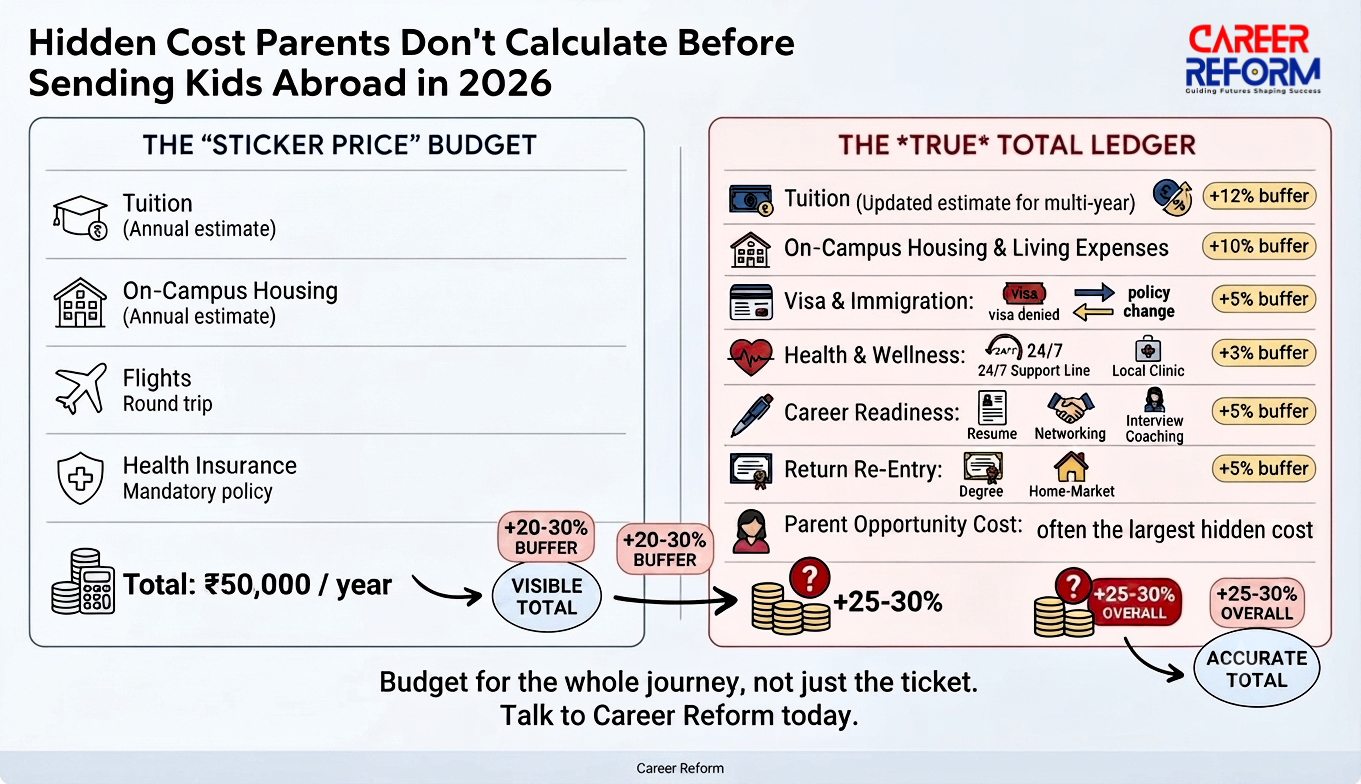
Every year, thousands of parents sit down with a calculator, a tuition estimate, and a hopeful heart, and they arrive at a number. That number becomes “the cost” of sending their child abroad for education. It covers tuition, flights, maybe a laptop, and a cushion for emergencies. It feels complete. It is not.
The real cost of an international education is rarely the one written on the university’s fee page. It is the one that shows up eighteen months later, in a currency exchange rate that shifted, a visa policy that tightened, a part-time job that never materialized, or a career path that quietly narrowed instead of widened. In 2026, with global mobility rules shifting faster than ever and the job market rewarding adaptability over credentials alone, parents need a more honest ledger. This is that ledger.
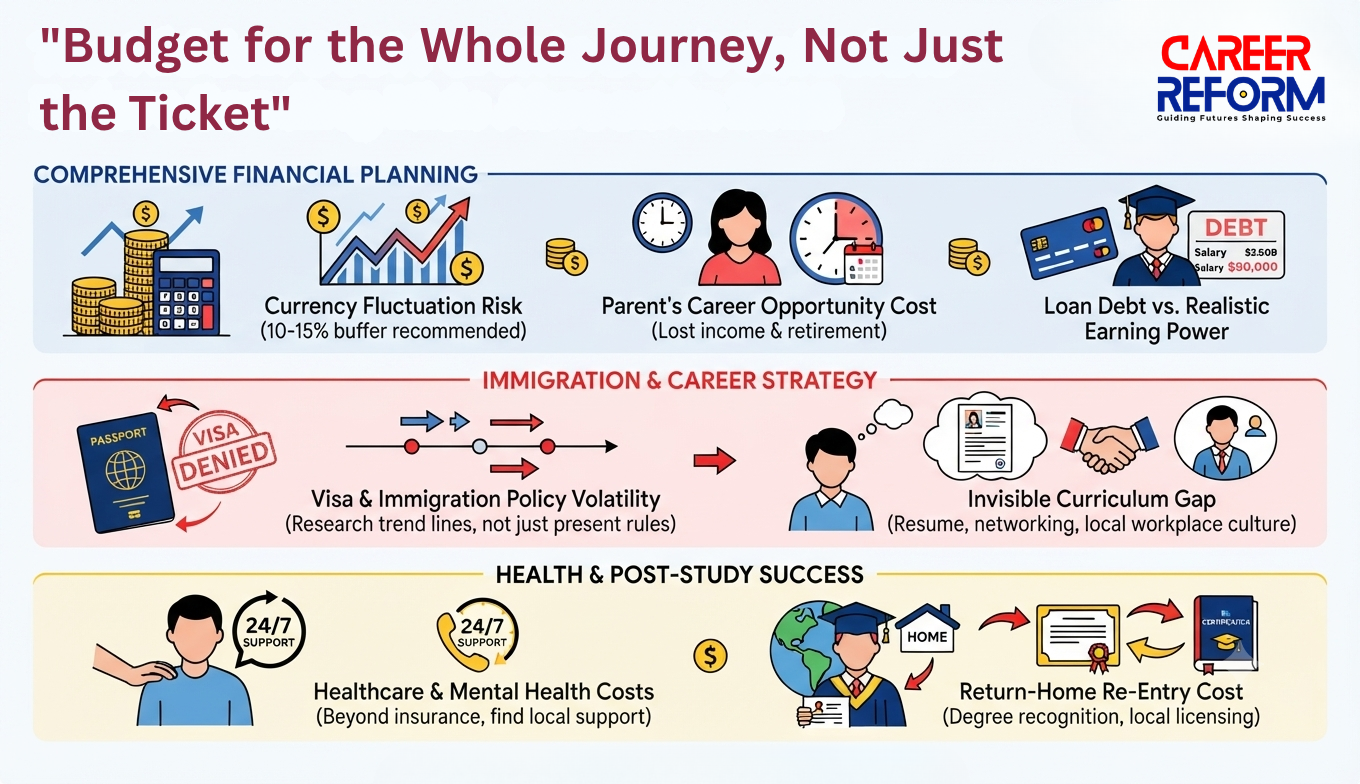
1. The Currency Risk No One Puts in the Brochure
Tuition quotes are almost always given in the destination country’s currency, but parents earn and save in their own. A fee that looks manageable at today’s exchange rate can balloon by 15–20% over a three or four-year degree if the home currency weakens. Parents rarely budget for this swing because it feels abstract until the semester bill actually converts at a worse rate than expected.
What to do instead: Build a currency buffer of at least 10–15% into your total budget, and consider whether fixed-rate education loans or forward currency contracts make sense for multi-year commitments.
2. The Opportunity Cost of the Parent’s Own Career
This is the cost almost no one calculates, and it is often the largest one. In many households, one parent reduces working hours, delays a promotion, or steps back from their own career to manage the logistics, finances, and emotional weight of a child studying abroad. Over a decade, that pause can mean a meaningfully smaller pension, a stalled professional network, and lost seniority that is hard to reclaim.
What to do instead: Treat this as a real line item, not a sacrifice that happens silently. If a career pause is likely, calculate its long-term value in lost income and retirement contributions, and discuss it as openly as you would discuss tuition.
3. Visa and Immigration Policy Volatility
Visa rules in popular study destinations have changed multiple times in recent years, sometimes with only months of notice. Post-study work rights, dependent visa allowances, and part-time work hour caps are frequently revised. A country that welcomed international graduates into its workforce two years ago may tighten those pathways before your child even finishes their degree.
What to do instead: Don’t choose a country based solely on its current post-study work policy. Research the last five years of policy changes for that country, not just the present rules, to understand the trend line, and build a plan B that doesn’t depend on staying abroad.
4. The “Invisible Curriculum” Gap
Academic tuition is only part of what a student needs to actually launch a career abroad. Interview coaching for a foreign job market, understanding local workplace culture, building a professional network from zero, and even learning how a local resume should look are skills most students aren’t taught, yet employers expect them anyway. Families who don’t budget time and money for this often watch their child graduate with excellent grades and no job offers.
What to do instead: Treat career-readiness as a parallel track to academics from year one, not a scramble in the final semester. This might mean budgeting for a career coach, an internship-focused summer, or simply intentional networking events.
5. Healthcare and Mental Health Costs
International student health insurance is usually mandatory and included in the visible cost. What’s often missing is a realistic plan for mental health support. Studying abroad means navigating homesickness, cultural adjustment, and academic pressure without the usual family support system nearby. Counseling services abroad can be expensive, waitlisted, or simply hard to access in a new language and system.
What to do instead: Research what mental health support is actually accessible on campus and in the city, not just what’s listed in the insurance policy, and set aside a specific budget for it.
6. The Return-Home Re-Entry Cost
If the plan is for the child to return home after studying abroad, families rarely calculate the cost of that transition. Foreign degrees don’t always translate cleanly into local job markets. Some professions require additional certification or licensing exams. There’s also a real adjustment period as the returning graduate re-learns how to network and job-hunt in a market they’ve been away from.
What to do instead: If a foreign degree is meant to serve a home-country career, verify in advance how that degree and any professional licenses will be recognized, and budget time and money for re-certification if needed.
7. Debt That Outlives the Degree’s Earning Power
Education loans are often taken out with the assumption that the resulting salary will comfortably cover repayment. But starting salaries, tax rates, and cost of living in the destination country can shift the math significantly, especially if the graduate doesn’t land a job immediately or the industry they trained for cools down.
What to do instead: Model loan repayment against a realistic, not best-case, starting salary, and check what grace periods or income-based repayment options exist before signing.
A Story That Illustrates the Pattern
Consider a composite example, drawn from patterns common to many families, not any one real person. The Aroras plan to send their daughter to Canada for a two-year master’s in engineering. Their budget covers tuition, a shared apartment, and flights home twice a year. It looks complete on paper.
Eighteen months in, three things happened that weren’t in the plan. The exchange rate shifts, adding nearly 12% to what was already paid in local currency for the remaining fees. Her mother, who had been coordinating the visa paperwork, insurance claims, and constant time-zone phone calls, quietly turns down a promotion at work because she can’t commit to the extra travel it requires. And when graduation approaches, the daughter learns that the post-study work permit rules have been tightened since she enrolled, narrowing her path to stay and work in the field she trained for.
None of these individually would have derailed the decision to study abroad. Together, unbudgeted, they turn a “known” cost into a much larger and more stressful one. This is exactly the kind of compounding most families don’t see coming, because each piece looks small and manageable in isolation.
By the Numbers: What the Data Shows
- Over 6.3 million students were enrolled in higher education outside their home country as of the most recent global count, according to the UNESCO Institute For Statistics , reflecting a steady long-term rise in international mobility.
- The United States alone hosts over 1.1 million international students each year, per the Institute of International Education’s Open Doors report, the longest-running annual study of international academic mobility.
- Destination-country visa and post-study work policies have been revised multiple times across major study destinations in recent years; current, country-specific rules are best verified directly through each country’s official immigration authority (for example, gov.uk, canada.ca, or homeaffairs.gov.au) rather than relying on older articles or agent guidance, since these pages are updated as policy changes.
- Currency movements of 10% or more against a home currency are not unusual over a multi-year study period, which is why financial institutions commonly recommend building a buffer rather than budgeting at a single fixed exchange rate.
Note: Figures above reflect the most recent widely reported data at the time of writing and are provided for general context. Always confirm current numbers directly with the official sources linked, since international education statistics and visa policies are updated regularly.
Frequently Asked Questions
How much extra should I budget beyond tuition for studying abroad? As a general rule of thumb, plan for an additional 20–30% on top of the advertised tuition and living cost estimate. This buffer should cover currency fluctuation, healthcare or mental health support not included in mandatory insurance, career-readiness activities like coaching or networking events, and a cushion for visa-related delays or extra semesters.
Do visa rules change after my child has already enrolled? Yes, this happens more often than most families expect. Post-study work rights, dependent visa allowances, and part-time work hour limits can all be revised by a government after a student has already started their program. Enrollment does not lock in the rules that existed on day one, which is why it’s important to have a backup plan that doesn’t depend entirely on the current policy environment.
Is a foreign degree recognized when returning home? It depends heavily on the field. Fields like engineering, medicine, law, and accounting often require additional local certification or licensing exams regardless of where the degree was earned. Fields like business, technology, and the arts tend to transfer more smoothly. Always verify recognition requirements with the relevant professional body in the home country before committing to a program.
Should the destination country’s post-study work policy be the main factor in choosing where to study? No, it shouldn’t be the only factor. Because these policies can change with little notice, it’s safer to choose a program and country based on its educational quality, cost transparency, and long-term career relevance, and treat favorable post-study work rights as a bonus rather than a guarantee.
What’s the single biggest hidden cost families underestimate? Based on the categories above, it’s usually the opportunity cost to the parent’s own career. Tuition and flights are visible and get budgeted for. A parent quietly stepping back from their job to manage the transition is a slow, invisible cost that often isn’t measured until years later, when its financial impact on retirement savings and career trajectory becomes clear.
Pre-Departure Hidden Cost Checklist
Rather than filling this in on the page, use the companion worksheet below. Print it, fill in your own estimate for each hidden cost from this article, and add the total to the visible tuition and living cost quote for your true total budget.
📄 Download: pre-departure hidden cost checklist.
The Real Lesson: Budget for the Whole Journey, Not Just the Ticket
None of this means sending a child abroad is a bad decision. For many families, it remains one of the most valuable investments they will ever make, in education, independence, and opportunity. But an accurate budget isn’t just about affording the flight and the first year’s tuition. It’s about understanding the full, sometimes invisible, cost structure that unfolds over four to six years.
The parents who navigate this best are the ones who treat it like a long-term financial and career plan for the whole family, not a single upfront payment. That means having honest conversations early: about currency risk, about whose career might pause, about what happens if visa rules change, and about what “success” actually looks like at the end of the journey, whether that’s staying abroad, coming home, or something in between.
The brochure will always show you the sticker price. This is the version that shows you the whole picture.
Ready to Plan Beyond the Brochure?
A study-abroad decision shouldn’t be made on tuition numbers alone — it should be made with a full picture of the financial, career, and family trade-offs involved. At Career Reform, we help parents and students look past the sticker price and build a plan that actually holds up over four, six, or ten years.
Talk to Career Reform today and turn your child’s international education into a career strategy, not just an expense.
Disclaimer: This article is for general informational purposes and does not constitute financial, legal, or immigration advice. Policies and costs vary significantly by country and change frequently; consult a qualified financial advisor and immigration professional for guidance specific to your situation.