

Can a student scoring 95% still choose the wrong career?
It may sound surprising, but the answer is yes.
Every year, thousands of academically brilliant students enrol in courses they later abandon, struggle in professions they once believed were their dream careers, or realise that the path they chose reflects other people’s expectations rather than their own aspirations. Their report cards told one story, but their strengths, interests, and personalities told another.
Now consider a second question:
What if academic marks reveal only half the story?
We are living through one of the most significant transformations in the history of education and work. Artificial Intelligence (AI) is reshaping industries, automating routine tasks, and creating entirely new career opportunities at a pace never seen before. Simultaneously, today’s students are navigating an environment filled with endless notifications, social media distractions, information overload, rising academic pressure, and increasing anxiety about choosing the “right” career.
According to the World Economic Forum, employers increasingly value analytical thinking, resilience, creativity, adaptability, and lifelong learning as essential skills for the future workforce. Similarly, the OECD has consistently highlighted that success in modern economies depends not only on academic knowledge but also on problem-solving, critical thinking, collaboration, and the ability to continuously learn and adapt. UNESCO also advocates for education systems that develop future-ready competencies rather than focusing exclusively on examination performance.
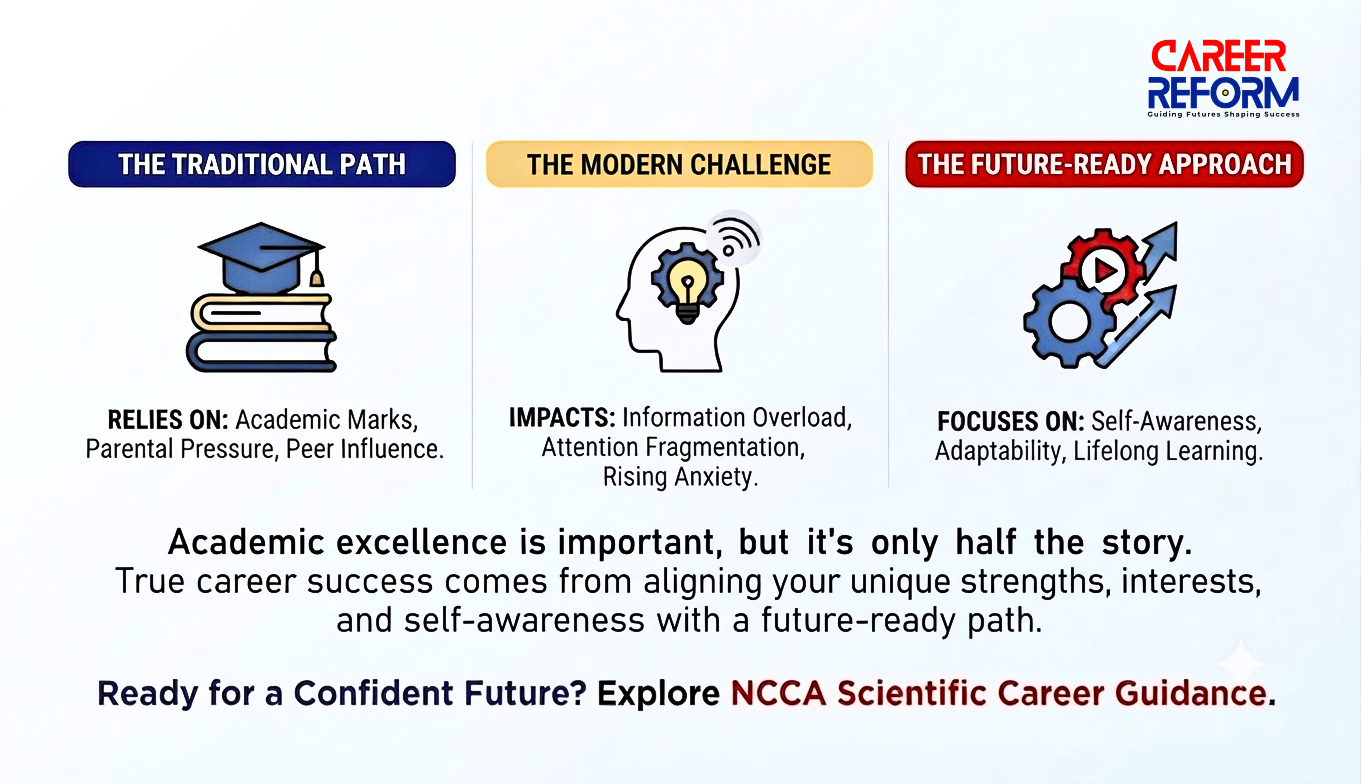
These findings point to a fundamental shift: academic excellence remains important, but it is no longer enough.
The future belongs to students who understand not only what they know but also how they think, learn, solve problems, and adapt to change. Career decisions can no longer rely solely on examination scores, family traditions, or peer influence. They require a deeper understanding of each student’s unique strengths, motivations, and potential.
This is where scientific career guidance becomes increasingly important. Instead of asking only, “What marks did this student score?”, parents, educators, and counsellors must begin asking more meaningful questions:
- What motivates this student to learn?
- Which environments help them perform at their best?
- What problems do they naturally enjoy solving?
- Which careers align with their interests, personality, aptitude, and long-term aspirations?
The answers to these questions often determine whether a student merely succeeds academically—or builds a fulfilling, future-ready career.
Why Modern Students Are Struggling to Focus
Generation Z and Generation Alpha are the first generations to grow up in a world where information is available instantly. Smartphones, artificial intelligence, online learning platforms, and social media have made knowledge more accessible than ever before. While these technologies have transformed education for the better, they have also changed how young minds process information.
There is a growing body of research on how constant digital engagement influences attention, memory, and decision-making. The general concern raised across this research is not that students are becoming less intelligent, but that their brains are adapting to environments characterised by continuous stimulation and frequent interruptions.
Short-form videos, constant notifications, and algorithm-driven content encourage rapid switching between tasks rather than sustained concentration. Over time, this can reduce opportunities for deep thinking, reflective learning, and complex problem-solving.
Another widely misunderstood concept is multitasking. Although many students believe they can study while simultaneously messaging friends, watching videos, or scrolling through social media, cognitive science suggests otherwise. The brain does not truly perform multiple demanding tasks at once. Instead, it rapidly shifts attention between them, increasing cognitive load, reducing accuracy, and weakening long-term retention.
This has important implications for career planning.
Choosing a career is one of the most significant decisions a student will make. It requires careful research, thoughtful reflection, and informed judgement. Students who constantly rely on quick online opinions or trending career advice may unknowingly replace critical thinking with convenience.
The issue, therefore, is not declining intelligence—it is changing cognitive habits. Fortunately, cognitive habits can be strengthened through intentional learning, reflection, and self-awareness.
AI Has Changed the Rules of Career Planning
For decades, career choices followed relatively predictable paths. Students selected Science, Commerce, or Humanities, pursued a university degree, and often remained in the same profession for much of their working lives.
Today’s reality is dramatically different.
Artificial Intelligence is transforming healthcare, finance, education, agriculture, manufacturing, marketing, media, and countless other industries. Routine tasks are increasingly automated, while demand continues to grow for uniquely human capabilities such as creativity, emotional intelligence, ethical reasoning, communication, collaboration, and innovation.
At the same time, entirely new careers continue to emerge. Roles such as AI Ethics Consultant, Sustainability Analyst, Cybersecurity Specialist, User Experience Designer, Climate Risk Consultant, Digital Health Strategist, and Creator Economy Manager illustrate how rapidly the employment landscape is evolving.
Many of these careers combine multiple disciplines rather than belonging to a single field of study. An architect may integrate environmental science with engineering. A psychologist may collaborate with AI developers to improve digital wellbeing. A business graduate may specialise in data analytics and behavioural economics.
This shift means that choosing a career based solely on examination marks has become increasingly inadequate.
Two students may achieve identical academic scores while possessing entirely different personalities, learning styles, interests, motivations, and strengths. One may thrive in research-intensive environments, while another may excel in entrepreneurship, leadership, or creative problem-solving.
Marks measure academic performance. They do not measure career fit.
Understanding Metacognition: The Missing Skill in Career Planning
One of the most powerful yet least understood concepts in education is metacognition, often described as “thinking about thinking.”
Metacognition is the ability to understand and regulate one’s own learning. It involves planning how to approach a task, monitoring progress while completing it, reflecting on outcomes, and adjusting strategies for future improvement.
Students with strong metacognitive skills do not simply study harder—they study smarter.
A Grade 8 student, for example, may recognise that creating mind maps helps them understand science concepts more effectively than repeatedly reading the textbook.
A Grade 10 student preparing for board examinations may discover that breaking revision into smaller weekly goals leads to better retention than last-minute cramming.
A Grade 12 student exploring university options may realise that genuine interest in solving business challenges motivates them far more than pursuing engineering simply because it is considered prestigious.
These examples demonstrate how self-awareness influences both academic performance and career decision-making.
Metacognitive learners plan, monitor, evaluate, and refine their learning strategies. They become more resilient when facing setbacks because they view mistakes as opportunities for improvement rather than evidence of failure.
In a rapidly changing world, this mindset is one of the strongest predictors of lifelong learning and career success.
Why Self-Awareness Matters More Than Ever
Metacognition is more than an academic strategy—it is the foundation of informed career decision-making. Students who understand how they learn, what motivates them, and where their strengths lie are better equipped to navigate an unpredictable world of work. Instead of choosing careers based on trends or external pressure, they make decisions that reflect their abilities, interests, and long-term aspirations.
Metacognitive learners develop several qualities that employers increasingly value. They learn faster because they can identify the study methods that work best for them. They adapt more effectively to change because they are comfortable evaluating and improving their own performance. They recover from setbacks with resilience, viewing challenges as opportunities to grow rather than reasons to give up. Most importantly, they become lifelong learners—a quality that will remain essential as technology continues to transform industries.
Imagine two students with similar academic records. One chooses a career because friends are pursuing the same path or because it is considered prestigious. The other takes time to understand their interests, personality, aptitude, and learning preferences before making a decision. While both students may begin their journey with comparable grades, the second student is more likely to remain motivated, perform consistently, and build a satisfying career because their choice is rooted in self-awareness rather than social influence.
Unfortunately, this is where traditional career guidance often falls short.
For decades, career decisions have been heavily influenced by examination scores, parental expectations, peer pressure, and societal perceptions of “successful” careers. Students who excel academically are frequently encouraged to pursue Science, while others are directed towards Commerce or Humanities based primarily on marks. Social media has added another layer of complexity by presenting glamorous versions of careers without showing the realities, required skills, or long-term commitment behind them.
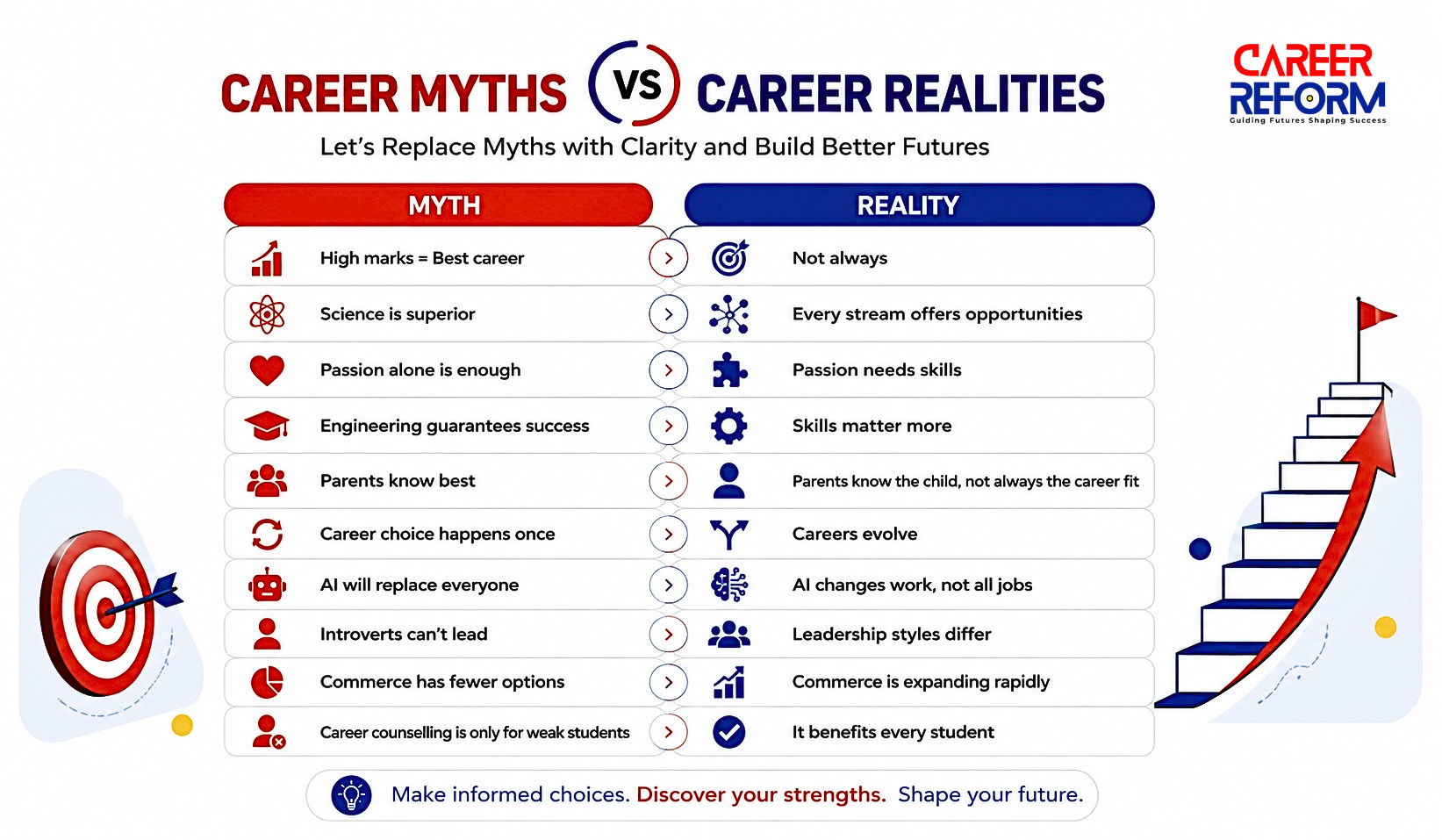 motivation. As careers become more dynamic and interdisciplinary, relying on marks alone becomes increasingly risky.Consider these real-life scenarios.
Scenario 1: Aditi scores 96% in her Grade 10 examinations and naturally assumes that engineering is the obvious next step. However, a comprehensive career assessment reveals that her strongest abilities lie in visual-spatial reasoning, creative problem-solving, communication, and innovation. After exploring these strengths, she discovers a passion for user experience (UX) design and product strategy—fields where she can combine technology with creativity. Her academic performance reflected her dedication, but the assessment helped identify where she was most likely to thrive.
Scenario 2: Arjun’s marks place him in the middle of his class, and he often compares himself with classmates who score higher. A scientific career assessment, however, highlights exceptional entrepreneurial aptitude, leadership potential, and interpersonal strengths. Instead of viewing himself as an average student, he begins exploring business management, entrepreneurship, and innovation. His confidence grows because he finally understands that success is determined by much more than examination scores.
These examples highlight an important truth: career success depends on alignment, not just achievement.
The Role of Scientific Career Assessment
As career decisions become more complex, students need guidance that is objective, comprehensive, and evidence-based. This is where scientific career assessments play a valuable role.
Rather than predicting a single “perfect” profession, a high-quality assessment helps students understand the combination of factors that influence career satisfaction and long-term success. The Neuro-Cognitive Career Architecture (NCCA) Assessment is designed with this holistic approach in mind. Instead of evaluating students only on academic performance, it examines six scientifically validated dimensions:
- Cognitive Ability — core reasoning, problem-solving, and analytical thinking
- Interests — genuine areas of curiosity and engagement
- Personal Traits — personality factors that shape work style and resilience
- 21st-Century Skills — cognitive flexibility, systems thinking, and adaptability
- Subject Competencies — academic strengths across core subject areas
- Metacognition — self-awareness of how a student learns and thinks
The assessment carries the following scientific credentials:
- 60-item battery — each of the six dimensions is measured through 10 scored items
- Internal Consistency (Cronbach’s Alpha) exceeding 0.92 — indicating exceptional reliability across all items
- Aligned with global frameworks — mapped to OECD, PISA, and World Economic Forum standards
- Normed for the Indian context — calibrated specifically for Tier 1–3 schools and NEP 2020 guidelines
Each of these dimensions provides a different perspective on the student. Interests reveal what naturally engages them. Cognitive Ability identifies areas where they demonstrate strong reasoning potential. Personal Traits help determine the environments in which they are likely to perform well. Subject Competencies show where their academic strengths already lie. Metacognition explains how well they understand and regulate their own learning.
Individually, these insights are useful. Together, they create a comprehensive picture that supports more informed career decisions.
This holistic approach is particularly important because no single measure can define a student’s future. High cognitive ability without genuine interest may lead to disengagement. Strong interest without the required competencies may require additional preparation. Personality, metacognition, subject strength, and 21st-century skills all interact to shape career success. Understanding these relationships enables students to make decisions that are realistic, personalised, and future-focused.
Benefits for Schools, Parents, and Students
Scientific career assessments create value not only for individual students but also for the broader educational ecosystem.
For Schools
Schools benefit by providing structured, evidence-based career guidance that goes beyond conventional counselling. This can lead to better subject selection, higher student engagement, fewer stream changes, stronger parent confidence, and more personalised support. It also complements the vision of the National Education Policy (NEP) 2020, which encourages holistic development, competency-based education, and informed career planning. Schools that invest in meaningful career guidance demonstrate a commitment to preparing students not just for examinations but for life beyond the classroom.
For Parents
For parents, scientific assessments replace uncertainty with clarity. Instead of relying solely on assumptions, family expectations, or societal trends, they gain objective insights into their child’s strengths, interests, and learning preferences. This often reduces disagreements during stream selection and encourages more constructive conversations about future opportunities. Parents become partners in their child’s career journey, supporting decisions that are based on evidence rather than pressure.
For Students
For students, perhaps the greatest benefit is confidence. Understanding themselves helps reduce anxiety, strengthens motivation, and encourages thoughtful career exploration. Rather than comparing themselves with friends or chasing popular career trends, they begin making choices that reflect their unique abilities and aspirations. This sense of clarity empowers them to embrace learning, adapt to change, and approach the future with greater purpose.
Conclusion
The world of work is changing faster than ever before. Artificial Intelligence, automation, and emerging industries are redefining the skills needed for long-term success. In this environment, academic achievement remains important, but it is only one part of the equation.
Students also need self-awareness, adaptability, critical thinking, resilience, and the confidence to make informed decisions. These qualities are not developed through examination scores alone—they emerge through reflection, exploration, and a deeper understanding of one’s own strengths and potential.
That is why career guidance must evolve from simply recommending courses to helping students discover who they are and where they are most likely to flourish.
“The careers of tomorrow will belong not merely to the most intelligent students, but to those who understand themselves best.”
Ready to make informed career decisions? Explore the NCCA Assessment by CareerReform and discover how scientific career guidance can help students build a confident, future-ready path.