Reading Time: 9 minutes
Getting your Trinity Audio player ready...

The test your child just took might be measuring the wrong thing entirely.

Every week, parents get handed a report with a score. A number. Maybe a chart. And they walk away thinking they understand their child. But one test score tells you roughly as much about your child’s full potential as one photograph tells you about their entire personality. It captures one angle, on one day, in one mood.

Big decisions follow. Subject choices, tutoring investments, career conversations. All rooted in incomplete data.

This guide changes that. By the end, you will know what each major test actually measures, which tests suit your child’s age, and why the parents who get the clearest picture are the ones who stop shopping for one test and start building a complete profile.

Meet Priya. She Did Everything Right. And Still Got It Wrong.

Priya is the mother of a Grade 8 son named Aryan. Organised, involved, the kind of parent who reads every school newsletter and attends every parent-teacher evening. When Aryan started struggling — distracted, disengaged, average grades despite obvious brightness — she did what every responsible parent would do.

She booked an IQ test.

The results came back: 112. Above average. The counsellor said he was fine and probably just needed to focus more. Priya went home with a report, a number, and no real answers. Aryan continued to drift.

Two years later, a different counsellor suggested a bundled psychometric assessment. Multiple Intelligence. Aptitude. Career Interest. EQ.

What came back changed everything.

Aryan’s strongest intelligence types were Bodily-Kinaesthetic and Spatial. His aptitude scores lit up in mechanical and abstract reasoning. His career interest profile showed a strong Realistic-Investigative combination. His EQ report flagged high empathy but low self-regulation under pressure — a child who cared deeply but crumbled under stress.

He was not a distracted student. He was a hands-on, systems-oriented thinker sitting in a curriculum designed almost entirely for linguistic and logical learners. He was not struggling to think. He was struggling to think in the one format his school kept demanding he use.

Within a year of redirecting his energy, engineering electives, a robotics club, a study strategy built around his learning style, Aryan was one of the most engaged students in his year group.

The IQ test said he was fine. The complete profile told them who he actually was.

Priya’s story is not unusual. It plays out in thousands of households every year. And the gap between a single test and a complete profile is almost always the gap between confusion and clarity.

Why a Single Test Misleads You

Here is what an IQ test cannot tell you:

  • Whether your child will thrive in science or the arts
  • How well they handle conflict, pressure, or disappointment
  • Whether they are a natural builder, communicator, or leader
  • What careers will actually feel meaningful to them
  • How do they learn best in a classroom

An IQ test measures a specific cluster of cognitive abilities. Valuable. But limited. The modern world does not hire IQ scores. It hires humans who think critically, collaborate effectively, and solve real problems. A complete profile speaks to all of that. A single test touches only one dimension.

“The parents who make the best decisions for their children are not the ones with the highest test scores. They are the ones with the most complete picture.”

What Each Test Actually Measures

Plain English. No textbook definitions.

IQ Test: Cognitive Horsepower

Measures how efficiently your brain processes certain kinds of information. Think of it as testing the raw engine.

  • Verbal reasoning and non-verbal/spatial reasoning
  • Working memory and processing speed
  • Pattern recognition and logical sequencing

What IQ does NOT measure: creativity, persistence, emotional depth, social skill, or domain-specific talent. A score of 95 does not mean less capable. It may mean strengths that simply do not show up in this particular 90-minute test.

📌 When is it most useful? When a child is struggling academically, the reason is unclear. When a child seems far more capable than their grades suggest. When there are genuine questions about learning difficulties or giftedness.

EQ Test: The Intelligence School Never Taught

Emotional intelligence determines how your child handles failure, conflict, relationships, and pressure. Research consistently shows that EQ often predicts life success better than IQ alone.

  • Self-awareness: Do they understand their own emotional states?
  • Self-regulation: Can they manage impulses and recover from setbacks?
  • Empathy: Can they understand and respond to how others feel?
  • Social skills: How effectively do they build relationships and work in groups?

A child with high EQ will often outperform a higher-IQ peer in leadership, client-facing, and collaborative environments. The good news: unlike IQ, emotional intelligence is highly trainable with the right coaching.

📌 Best age: 13 onwards. Before that, emotional regulation is still developing rapidly, and results may not be stable.

Multiple Intelligence Testing: How Does Your Child Actually Think?

Harvard psychologist Howard Gardner identified at least eight distinct types of intelligence, not one. Most children have two or three dominant types.

  • Linguistic: Words, writing, storytelling, debate
  • Logical-Mathematical: Patterns, analysis, coding, science
  • Spatial: Design, architecture, art, navigation
  • Musical: Rhythm, tonal patterns, composition
  • Bodily-Kinaesthetic: Physical performance, craftsmanship, sport
  • Interpersonal: Leadership, teaching, sales, counselling
  • Intrapersonal: Self-knowledge, philosophy, psychology
  • Naturalist: Biology, ecology, agriculture, veterinary work

Why does a child lose focus in class but become completely absorbed when building something? Bodily-Kinaesthetic dominance in a curriculum built for linguistic learners. This test makes those patterns visible.

📌 Works for all ages: Valid from age 7 upwards. For younger students, it informs learning strategies. For older students, it aligns career exploration with genuine cognitive strengths.

Aptitude Tests: What Are They Naturally Good At?

Aptitude tests measure specific, task-related natural abilities, the capabilities that emerge with less effort because the brain is wired for them.

  • Verbal: Speed and accuracy with language-based tasks
  • Numerical: Comfort and efficiency with numbers
  • Spatial: Mentally visualising and manipulating shapes and structures
  • Mechanical: Understanding physical and mechanical principles
  • Abstract reasoning: Pattern recognition with symbols and diagrams

A child with high spatial and mechanical aptitude who pursues engineering will find the learning curve less steep than a peer with the same grades but different natural wiring. This does not close doors. It just tells you which ones open more easily.

📌 Best age: Most meaningful from Grade 9 onwards (age 13–14), when academic differentiation begins, and career conversations become relevant.

Career Interest Assessment: What Will Actually Make Them Happy?

This is the test parents most often skip and later most wish they had not. It measures intrinsic motivation — what environments and problems genuinely energise your child. Not ability. Fit.

The widely used Holland RIASEC framework identifies six career personality types: Realistic (hands-on), Investigative (analytical), Artistic (creative), Social (people-focused), Enterprising (leadership/business), and Conventional (structured/detail). Most people carry a two or three-letter combination.

When career choices align with this profile, job satisfaction and long-term performance both rise significantly. When they do not, burnout follows — regardless of salary.

📌 Pair it with aptitude: The aptitude test tells you what your child is naturally good at. The interest test tells you what they will actually want to do with that goodness. Together, they answer the complete question.

Quick Reference: Which Test Tells You What

Test What It Measures Best Age Key Benefit
IQ Logic, memory, processing speed Any age Spots gifted learners or learning gaps
EQ Emotions, empathy, self-regulation 13–18 Reveals leadership and social potential
Multiple Intelligence 8 cognitive styles (linguistic, spatial, etc.) 7–18 Shows HOW your child learns best
Aptitude Natural verbal, numerical, spatial ability 13–18 Aligns strength with subject/career path
Career Interest Intrinsic motivation and work preferences 14–18 Matches passion to career direction
Bundled Package All of the above, cross-referenced 7–18 Complete, actionable picture

Which Test Is Right for Which Age?

Grades 7–9 (Ages 12–15): The Exploration Stage

Identity is forming. Interests are shifting. The brain is reorganising. This is the stage for building self-knowledge, not prescribing careers.

  • Multiple Intelligence Assessment — reveals how they learn and where natural engagement lies.
  • Early Career Interest Exploration — begin the conversation, not the decision
  • IQ Testing — only where academic challenges seem disconnected from effort and instruction.

📌 Goal at this stage: Help your child understand how they think, what lights them up, and where their natural strengths lie. That foundation makes every future decision sharper.

Grades 9–12 (Ages 14–18): The Positioning Stage

Subject choices lock in. University applications approach. Career conversations turn from abstract to concrete. This is when psychometric data becomes genuinely strategic.

  • Aptitude Battery — aligns natural ability with academic and professional demands.
  • EQ Assessment — critical for understanding collaborative and leadership performance.
  • Career Interest Assessment — maps intrinsic motivation to career categories.
  • Multiple Intelligence (if not done earlier) — provides the cognitive baseline.

📌 Goal at this stage: Build a clear, evidence-based career direction that aligns both natural strengths and genuine interests. Then identify the development areas that will matter most in their chosen field.

Why a Bundled Package Gives You a Picture, Not Just a Score

When you run a single test, you get one dimension. When you run a bundled package, the tests begin to talk to each other. That cross-referencing is where the real insight lives.
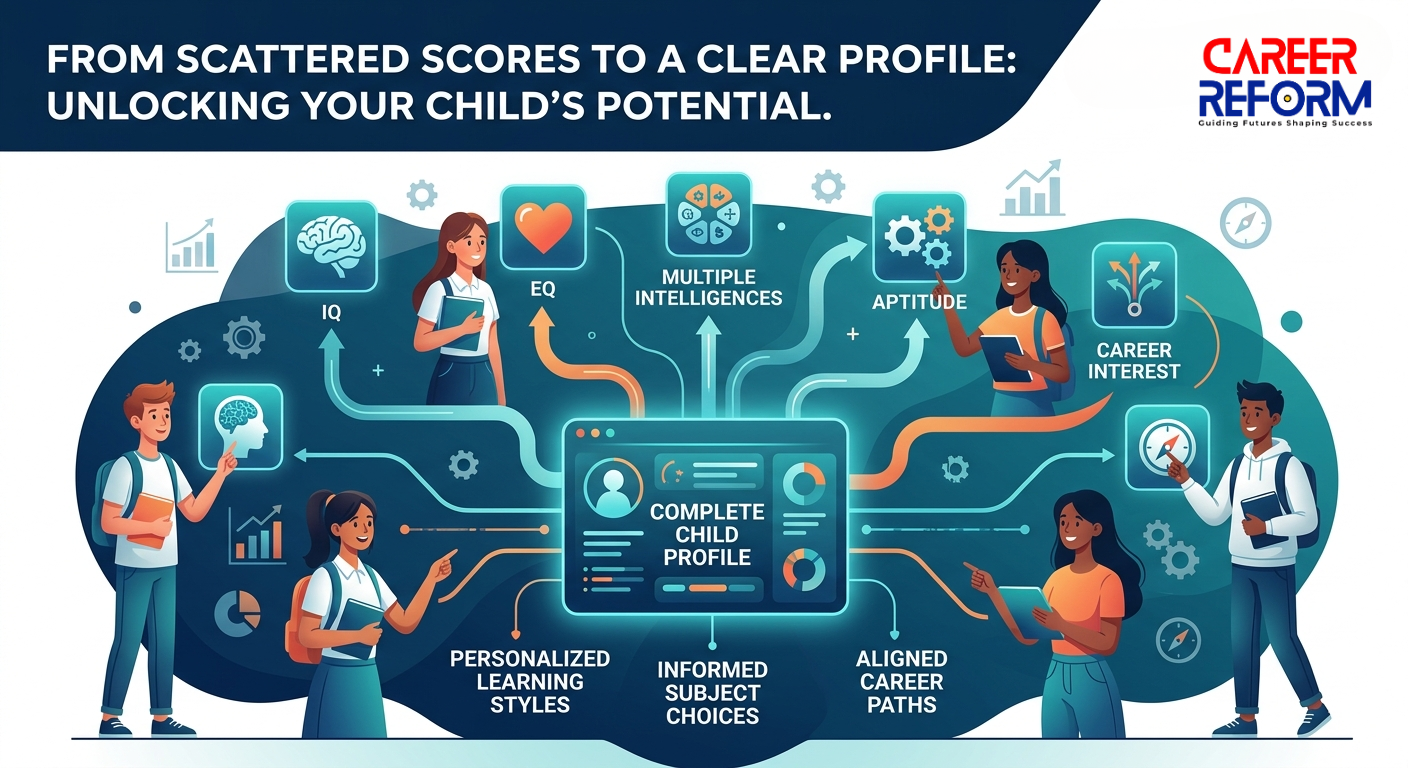
What it looks like in practice:

  • High IQ + Low EQ: Intellectually strong but likely to struggle in team settings. Focus coaching on emotional regulation before entering collaborative environments.
  • High Spatial Aptitude + Naturalist Intelligence + Investigative Interest: Powerful alignment towards environmental science, architecture, or biology.
  • High Verbal Aptitude + Linguistic Intelligence + Artistic Interest: A clear signal for journalism, law, marketing, or content creation.
  • Strong Interpersonal Intelligence + Social Interest: A natural fit for leadership, HR, education, or counselling roles.

“One test tells you a fact. A complete profile tells you a story. And stories are what parents and students can actually use.”

A bundled package assessed by a qualified counsellor in a single session also gives you one unified, coherent report. You are not trying to reconcile documents from three different providers. You get one clear narrative about your child.

What Nobody Tells You About Psychometric Testing

1. The test is only as good as the interpreter.

A raw report without a qualified counsellor to contextualise it is only marginally useful. Ask who will debrief the results and what their qualifications are. If the answer is vague, keep asking.

2. Your child’s state on the day affects results.

Anxiety, poor sleep, a fight with a friend, a headache — all of these suppress performance, particularly on IQ and aptitude assessments. A reputable practitioner will flag concerns and recommend a retest where needed.

3. These tests do not predict destiny.

They are tools for informing decisions, not delivering verdicts. A child with a below-average IQ score can still build an exceptional career in the right domain. What the tests give you is a starting point, not a ceiling.

4. Interest data ages better than aptitude data.

Aptitudes continue developing through the teenage years. A 14-year-old with moderate verbal aptitude may test significantly stronger at 17. Career interests, however, tend to stabilise from mid-adolescence onwards. Retest aptitude closer to major academic decisions.

5. The conversation matters more than the report.

The most powerful outcome is not the document filed in a drawer. It is the conversation that the results enable between you and your child. Use the data as a catalyst. Ask what resonates. Ask what surprises them. That conversation is where the real value lives.

Your Four-Step Action Framework

Step 1: Start with the question, not the test. Write down what you are actually trying to answer before booking anything. Different questions require different assessments.

Step 2: Match the test to the developmental stage. Grades 7–9: Multiple Intelligence and early interest exploration. Grades 9–12: Aptitude, EQ, and career interest. Do not run a full career aptitude battery on a 12-year-old.

Step 3: Choose integrated over isolated. A bundled package outperforms a single test every time. If the budget is genuinely constrained, prioritise Multiple Intelligence and Career Interest as the most versatile combination across all age groups.

Step 4: Use the debrief as a coaching session. Come with questions. Bring your child if possible. Leave with a clear next step they are genuinely excited about pursuing.

Your Child Deserves a Complete Picture

Priya wished she had known all of this when Aryan was in Grade 7. You do not have to wait. One test cannot give you the full picture. But the right combination of assessments, interpreted by a skilled counsellor, can give you something genuinely valuable: clarity.

Ready to dive into NCCA test? Whatsapp us @9311837200 for free code to apply.

Free · Takes 20 minutes

Do you know which career
is actually built for your brain?

The NCCA reveals how you think, learn and work —
and which paths fit you best.

1
Take the
NCCA test
2
Get your
personalised report
3
Book a free
expert session

Limited offer: Take the test today and get a free 1-on-1 report interpretation session with a CareerReform expert — worth ₹999, yours at no cost.

Facebook
Twitter
LinkedIn
Reddit

Leave a Comment

Your email address will not be published. Required fields are marked *

Getting your Trinity Audio player ready...

The test your child just took might be measuring the wrong thing entirely.

Every week, parents get handed a report with a score. A number. Maybe a chart. And they walk away thinking they understand their child. But one test score tells you roughly as much about your child’s full potential as one photograph tells you about their entire personality. It captures one angle, on one day, in one mood.

Big decisions follow. Subject choices, tutoring investments, career conversations. All rooted in incomplete data.

This guide changes that. By the end, you will know what each major test actually measures, which tests suit your child’s age, and why the parents who get the clearest picture are the ones who stop shopping for one test and start building a complete profile.

Meet Priya. She Did Everything Right. And Still Got It Wrong.

Priya is the mother of a Grade 8 son named Aryan. Organised, involved, the kind of parent who reads every school newsletter and attends every parent-teacher evening. When Aryan started struggling — distracted, disengaged, average grades despite obvious brightness — she did what every responsible parent would do.

She booked an IQ test.

The results came back: 112. Above average. The counsellor said he was fine and probably just needed to focus more. Priya went home with a report, a number, and no real answers. Aryan continued to drift.

Two years later, a different counsellor suggested a bundled psychometric assessment. Multiple Intelligence. Aptitude. Career Interest. EQ.

What came back changed everything.

Aryan’s strongest intelligence types were Bodily-Kinaesthetic and Spatial. His aptitude scores lit up in mechanical and abstract reasoning. His career interest profile showed a strong Realistic-Investigative combination. His EQ report flagged high empathy but low self-regulation under pressure — a child who cared deeply but crumbled under stress.

He was not a distracted student. He was a hands-on, systems-oriented thinker sitting in a curriculum designed almost entirely for linguistic and logical learners. He was not struggling to think. He was struggling to think in the one format his school kept demanding he use.

Within a year of redirecting his energy, engineering electives, a robotics club, a study strategy built around his learning style, Aryan was one of the most engaged students in his year group.

The IQ test said he was fine. The complete profile told them who he actually was.

Priya’s story is not unusual. It plays out in thousands of households every year. And the gap between a single test and a complete profile is almost always the gap between confusion and clarity.

Why a Single Test Misleads You

Here is what an IQ test cannot tell you:

  • Whether your child will thrive in science or the arts
  • How well they handle conflict, pressure, or disappointment
  • Whether they are a natural builder, communicator, or leader
  • What careers will actually feel meaningful to them
  • How do they learn best in a classroom

An IQ test measures a specific cluster of cognitive abilities. Valuable. But limited. The modern world does not hire IQ scores. It hires humans who think critically, collaborate effectively, and solve real problems. A complete profile speaks to all of that. A single test touches only one dimension.

“The parents who make the best decisions for their children are not the ones with the highest test scores. They are the ones with the most complete picture.”

What Each Test Actually Measures

Plain English. No textbook definitions.

IQ Test: Cognitive Horsepower

Measures how efficiently your brain processes certain kinds of information. Think of it as testing the raw engine.

  • Verbal reasoning and non-verbal/spatial reasoning
  • Working memory and processing speed
  • Pattern recognition and logical sequencing

What IQ does NOT measure: creativity, persistence, emotional depth, social skill, or domain-specific talent. A score of 95 does not mean less capable. It may mean strengths that simply do not show up in this particular 90-minute test.

📌 When is it most useful? When a child is struggling academically, the reason is unclear. When a child seems far more capable than their grades suggest. When there are genuine questions about learning difficulties or giftedness.

EQ Test: The Intelligence School Never Taught

Emotional intelligence determines how your child handles failure, conflict, relationships, and pressure. Research consistently shows that EQ often predicts life success better than IQ alone.

  • Self-awareness: Do they understand their own emotional states?
  • Self-regulation: Can they manage impulses and recover from setbacks?
  • Empathy: Can they understand and respond to how others feel?
  • Social skills: How effectively do they build relationships and work in groups?

A child with high EQ will often outperform a higher-IQ peer in leadership, client-facing, and collaborative environments. The good news: unlike IQ, emotional intelligence is highly trainable with the right coaching.

📌 Best age: 13 onwards. Before that, emotional regulation is still developing rapidly, and results may not be stable.

Multiple Intelligence Testing: How Does Your Child Actually Think?

Harvard psychologist Howard Gardner identified at least eight distinct types of intelligence, not one. Most children have two or three dominant types.

  • Linguistic: Words, writing, storytelling, debate
  • Logical-Mathematical: Patterns, analysis, coding, science
  • Spatial: Design, architecture, art, navigation
  • Musical: Rhythm, tonal patterns, composition
  • Bodily-Kinaesthetic: Physical performance, craftsmanship, sport
  • Interpersonal: Leadership, teaching, sales, counselling
  • Intrapersonal: Self-knowledge, philosophy, psychology
  • Naturalist: Biology, ecology, agriculture, veterinary work

Why does a child lose focus in class but become completely absorbed when building something? Bodily-Kinaesthetic dominance in a curriculum built for linguistic learners. This test makes those patterns visible.

📌 Works for all ages: Valid from age 7 upwards. For younger students, it informs learning strategies. For older students, it aligns career exploration with genuine cognitive strengths.

Aptitude Tests: What Are They Naturally Good At?

Aptitude tests measure specific, task-related natural abilities, the capabilities that emerge with less effort because the brain is wired for them.

  • Verbal: Speed and accuracy with language-based tasks
  • Numerical: Comfort and efficiency with numbers
  • Spatial: Mentally visualising and manipulating shapes and structures
  • Mechanical: Understanding physical and mechanical principles
  • Abstract reasoning: Pattern recognition with symbols and diagrams

A child with high spatial and mechanical aptitude who pursues engineering will find the learning curve less steep than a peer with the same grades but different natural wiring. This does not close doors. It just tells you which ones open more easily.

📌 Best age: Most meaningful from Grade 9 onwards (age 13–14), when academic differentiation begins, and career conversations become relevant.

Career Interest Assessment: What Will Actually Make Them Happy?

This is the test parents most often skip and later most wish they had not. It measures intrinsic motivation — what environments and problems genuinely energise your child. Not ability. Fit.

The widely used Holland RIASEC framework identifies six career personality types: Realistic (hands-on), Investigative (analytical), Artistic (creative), Social (people-focused), Enterprising (leadership/business), and Conventional (structured/detail). Most people carry a two or three-letter combination.

When career choices align with this profile, job satisfaction and long-term performance both rise significantly. When they do not, burnout follows — regardless of salary.

📌 Pair it with aptitude: The aptitude test tells you what your child is naturally good at. The interest test tells you what they will actually want to do with that goodness. Together, they answer the complete question.

Quick Reference: Which Test Tells You What

Test What It Measures Best Age Key Benefit
IQ Logic, memory, processing speed Any age Spots gifted learners or learning gaps
EQ Emotions, empathy, self-regulation 13–18 Reveals leadership and social potential
Multiple Intelligence 8 cognitive styles (linguistic, spatial, etc.) 7–18 Shows HOW your child learns best
Aptitude Natural verbal, numerical, spatial ability 13–18 Aligns strength with subject/career path
Career Interest Intrinsic motivation and work preferences 14–18 Matches passion to career direction
Bundled Package All of the above, cross-referenced 7–18 Complete, actionable picture

Which Test Is Right for Which Age?

Grades 7–9 (Ages 12–15): The Exploration Stage

Identity is forming. Interests are shifting. The brain is reorganising. This is the stage for building self-knowledge, not prescribing careers.

  • Multiple Intelligence Assessment — reveals how they learn and where natural engagement lies.
  • Early Career Interest Exploration — begin the conversation, not the decision
  • IQ Testing — only where academic challenges seem disconnected from effort and instruction.

📌 Goal at this stage: Help your child understand how they think, what lights them up, and where their natural strengths lie. That foundation makes every future decision sharper.

Grades 9–12 (Ages 14–18): The Positioning Stage

Subject choices lock in. University applications approach. Career conversations turn from abstract to concrete. This is when psychometric data becomes genuinely strategic.

  • Aptitude Battery — aligns natural ability with academic and professional demands.
  • EQ Assessment — critical for understanding collaborative and leadership performance.
  • Career Interest Assessment — maps intrinsic motivation to career categories.
  • Multiple Intelligence (if not done earlier) — provides the cognitive baseline.

📌 Goal at this stage: Build a clear, evidence-based career direction that aligns both natural strengths and genuine interests. Then identify the development areas that will matter most in their chosen field.

Why a Bundled Package Gives You a Picture, Not Just a Score

When you run a single test, you get one dimension. When you run a bundled package, the tests begin to talk to each other. That cross-referencing is where the real insight lives.

What it looks like in practice:

  • High IQ + Low EQ: Intellectually strong but likely to struggle in team settings. Focus coaching on emotional regulation before entering collaborative environments.
  • High Spatial Aptitude + Naturalist Intelligence + Investigative Interest: Powerful alignment towards environmental science, architecture, or biology.
  • High Verbal Aptitude + Linguistic Intelligence + Artistic Interest: A clear signal for journalism, law, marketing, or content creation.
  • Strong Interpersonal Intelligence + Social Interest: A natural fit for leadership, HR, education, or counselling roles.

“One test tells you a fact. A complete profile tells you a story. And stories are what parents and students can actually use.”

A bundled package assessed by a qualified counsellor in a single session also gives you one unified, coherent report. You are not trying to reconcile documents from three different providers. You get one clear narrative about your child.

What Nobody Tells You About Psychometric Testing

1. The test is only as good as the interpreter.

A raw report without a qualified counsellor to contextualise it is only marginally useful. Ask who will debrief the results and what their qualifications are. If the answer is vague, keep asking.

2. Your child’s state on the day affects results.

Anxiety, poor sleep, a fight with a friend, a headache — all of these suppress performance, particularly on IQ and aptitude assessments. A reputable practitioner will flag concerns and recommend a retest where needed.

3. These tests do not predict destiny.

They are tools for informing decisions, not delivering verdicts. A child with a below-average IQ score can still build an exceptional career in the right domain. What the tests give you is a starting point, not a ceiling.

4. Interest data ages better than aptitude data.

Aptitudes continue developing through the teenage years. A 14-year-old with moderate verbal aptitude may test significantly stronger at 17. Career interests, however, tend to stabilise from mid-adolescence onwards. Retest aptitude closer to major academic decisions.

5. The conversation matters more than the report.

The most powerful outcome is not the document filed in a drawer. It is the conversation that the results enable between you and your child. Use the data as a catalyst. Ask what resonates. Ask what surprises them. That conversation is where the real value lives.

Your Four-Step Action Framework

Step 1: Start with the question, not the test. Write down what you are actually trying to answer before booking anything. Different questions require different assessments.

Step 2: Match the test to the developmental stage. Grades 7–9: Multiple Intelligence and early interest exploration. Grades 9–12: Aptitude, EQ, and career interest. Do not run a full career aptitude battery on a 12-year-old.

Step 3: Choose integrated over isolated. A bundled package outperforms a single test every time. If the budget is genuinely constrained, prioritise Multiple Intelligence and Career Interest as the most versatile combination across all age groups.

Step 4: Use the debrief as a coaching session. Come with questions. Bring your child if possible. Leave with a clear next step they are genuinely excited about pursuing.

Your Child Deserves a Complete Picture

Priya wished she had known all of this when Aryan was in Grade 7. You do not have to wait. One test cannot give you the full picture. But the right combination of assessments, interpreted by a skilled counsellor, can give you something genuinely valuable: clarity.

Ready to dive into NCCA test? Whatsapp us @9311837200 for free code to apply.

Free · Takes 20 minutes

Do you know which career
is actually built for your brain?

The NCCA reveals how you think, learn and work —
and which paths fit you best.

1
Take the
NCCA test
2
Get your
personalised report
3
Book a free
expert session

Limited offer: Take the test today and get a free 1-on-1 report interpretation session with a CareerReform expert — worth ₹999, yours at no cost.

Leave a Comment

Your email address will not be published. Required fields are marked *

Scroll to Top