

Australia is one of the world’s leading study destinations, hosting well over 700,000 international students every year. With globally ranked universities, a safe and multicultural environment, generous post-study work rights, and a genuinely high quality of life, it’s easy to see why so many undergraduates choose “Down Under” for their degree. This guide walks you through everything you need to know — from choosing a course to landing your first job after graduation — with links to official Australian government and university sources so you can verify every detail yourself.
Note: Visa fees, financial requirements, and immigration rules change frequently. Always cross-check figures on the official Department of Home Affairs website before you apply.
1. Why Study in Australia?
- Globally ranked universities — Several Australian universities regularly appear in the world’s top 100 (QS World University Rankings, Times Higher Education).
- Practical, industry-linked degrees — Courses often include internships, placements, and project-based learning.
- Multicultural, English-speaking environment — Easy to settle in, with students from 140+ countries.
- Post-study work rights — Eligible graduates can stay and work in Australia after finishing their degree (see the career pathways section below).
- High quality of life — Australia consistently ranks among the safest and most liveable countries in the world.
2. Top Universities to Consider
Australia’s university sector includes the prestigious Group of Eight (Go8) — the country’s leading research-intensive universities — as well as many other excellent public universities.
| University | City | Known For |
|---|---|---|
| University of Melbourne | Melbourne | Arts, Law, Business, Sciences |
| University of Sydney | Sydney | Business, Engineering, Health Sciences |
| Australian National University (ANU) | Canberra | Research, Public Policy, Sciences |
| University of New South Wales (UNSW) | Sydney | Engineering, Business, Design |
| University of Queensland (UQ) | Brisbane | Biotechnology, Engineering, Business |
| Monash University | Melbourne | Pharmacy, IT, Engineering |
| University of Western Australia (UWA) | Perth | Engineering, Agriculture, Sciences |
| Adelaide University | Adelaide | Wine Science, Health Sciences, Engineering |
Note: In January 2026, the former University of Adelaide and University of South Australia merged into Adelaide University. Older sources listing them separately are now outdated.
Check independent, government-verified data on teaching quality, graduate employment, and student satisfaction at
- QILT: https://www.qilt.edu.au
- University rankings and profiles: https://www.universitiesaustralia.edu.au
3. Choosing a Course and Checking Registration
Every course offered to international students must be listed on CRICOS (Commonwealth Register of Institutions and Courses for Overseas Students). Never enrol in a course that isn’t CRICOS-registered — you won’t be eligible for a student visa.
- Search CRICOS-registered courses: https://cricos.education.gov.au
- Compare courses, cities, and costs: https://www.studyaustralia.gov.au
Popular undergraduate fields include Business, Information Technology, Engineering, Health Sciences, and Data Science — they combine strong job prospects with practical, industry-relevant training.
4. Entry Requirements
- Academic: Completion of secondary school (Year 12 or equivalent), with minimum grades set by each university.
- English proficiency: Most undergraduate courses ask for an overall IELTS score of around 6.0–6.5 (or equivalent PTE Academic/TOEFL iBT). Health, Education, and Law often require higher scores.
- Pathway options: Foundation programs and English courses (ELICOS) can help you qualify if you don’t yet meet academic or English requirements.
5. How to Apply
Applications go either directly to the university or through a state-based Tertiary Admissions Centre (TAC):
- NSW/ACT — UAC: https://www.uac.edu.au
- Victoria — VTAC: https://www.vtac.edu.au
- Queensland — QTAC: https://www.qtac.edu.au
Steps:
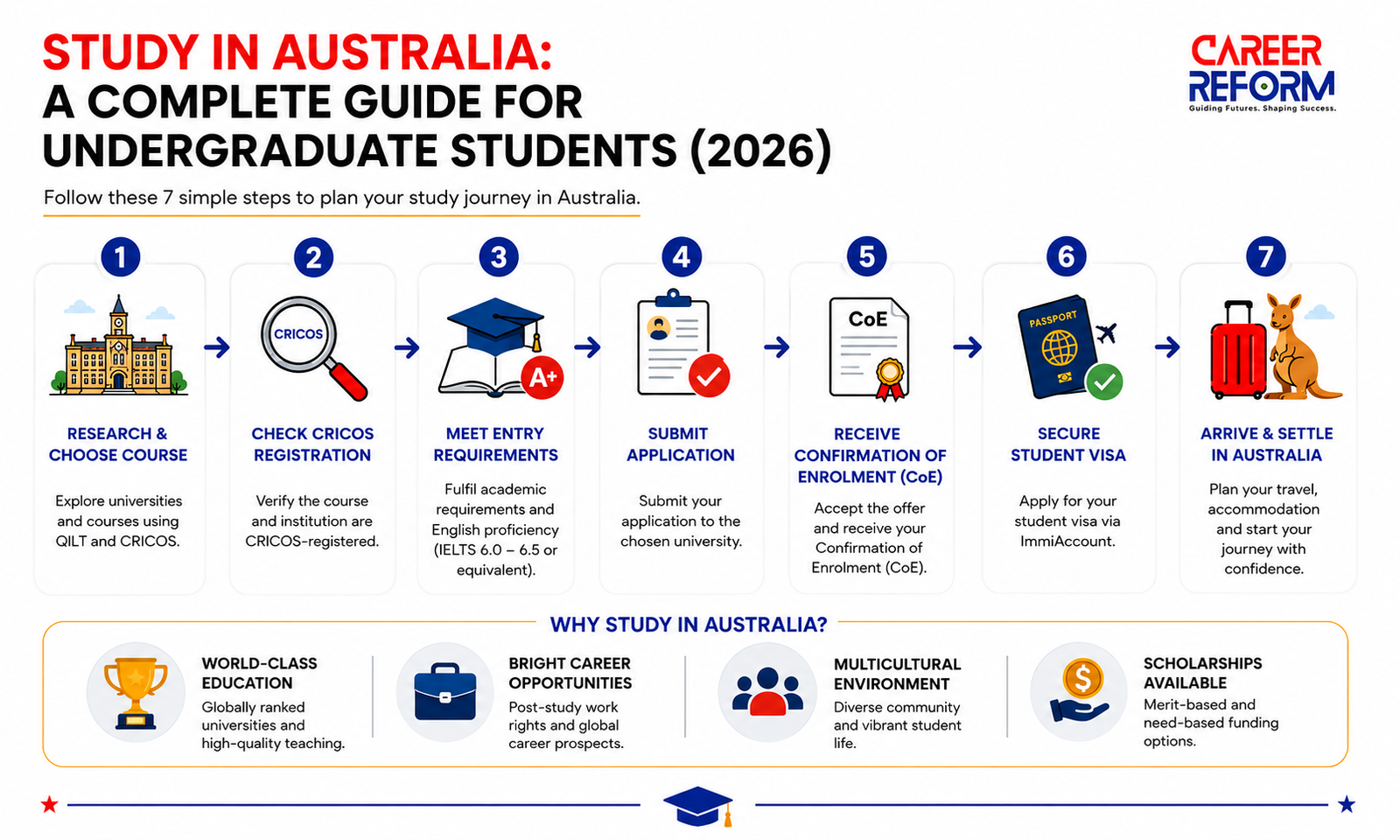
- Research courses and universities using QILT and CRICOS.
- Check entry requirements and prepare transcripts, English test scores, and a passport.
- Submit your application directly or via the relevant TAC (fees typically AUD 50–150; many universities waive these).
- Receive a Letter of Offer; accept it and pay the deposit.
- Receive your Confirmation of Enrolment (CoE) — essential for your visa application.
- Apply for your Student Visa (Subclass 500).
Main intakes: February (widest availability) and July, with a smaller intake in November at some universities.
6. Cost of Studying in Australia
- Tuition: Roughly AUD 20,000–45,000/year for undergraduate courses (higher for Medicine, Engineering, and specialised programs).
- Living costs: Set annually by the Australian Government for visa purposes.
- Additional costs: OSHC, textbooks, accommodation, and travel.
7. Scholarships
- Australia Awards — the Australian Government’s flagship scholarship, mainly for students from eligible developing countries: https://www.dfat.gov.au/people-to-people/australia-awards
- University-specific scholarships — the most accessible option for most undergraduates; check each university’s financial-aid page directly.
- General scholarship guidance: https://www.studyaustralia.gov.au
Note: Destination Australia stopped accepting new applicants from 1 July 2024. Confirm current status: https://www.education.gov.au/destination-australia
8. Student Visa: Subclass 500
Core requirements:
- A valid CoE from a CRICOS-registered course.
- Meeting the Genuine Student (GS) requirement — this replaced the older “Genuine Temporary Entrant” test in March 2024.
- Financial capacity to cover tuition, travel, and living costs.
- OSHC for your entire stay.
- English language and health/character requirements.
Apply online through ImmiAccount and pay a non-refundable visa charge: https://immi.homeaffairs.gov.au/visas/getting-a-visa/visa-listing/student-500
Work rights: Up to 48 hours per fortnight during term, unlimited during scheduled breaks. This cap has changed before, so confirm the current limit before starting a job.
9. Health Insurance (OSHC)
Subclass 500 holders must keep Overseas Student Health Cover (OSHC) active for their entire stay — it covers medical, hospital, and ambulance costs plus some prescriptions. A lapse can mean no cover for treatment during the gap. Compare providers: https://www.privatehealth.gov.au/health_insurance/overseas/overseas_student_health_cover.htm
10. Life as a Student in Australia
- Accommodation: On-campus halls, homestays, or private rentals — most universities have a housing office to help.
- Transport: Melbourne and Sydney have extensive public transport with student concession fares.
- Support services: Orientation programs, international student advisers, career counselling, and wellbeing services — use them.
- Safety and welfare: Protected under the National Code of Practice and ESOS framework: https://www.education.gov.au
11. Career Pathways and Recent Career Reforms
Immigration policy has undergone significant reform since 1 July 2024 for the Temporary Graduate Visa (Subclass 485) — Australia’s main post-study work visa. Plan your course and graduation timing around the current rules, not last year’s.
| Reform | What changed |
|---|---|
| Stream names | “Graduate Work Stream” → Post-Vocational Education Work Stream; “Post-Study Work Stream” → Post-Higher Education Work Stream |
| Age limit | Reduced to 35 for most applicants (exceptions apply, e.g. HK/BNO passport holders) |
| Visa duration | Now tied more closely to qualification level; the previous 2-year skill-shortage bonus was discontinued |
| English requirements | Tightened, with shorter test validity periods |
Verify current 485 conditions: https://immi.homeaffairs.gov.au/visas/getting-a-visa/visa-listing/temporary-graduate-485
For Indian students: Under the Australia–India Economic Cooperation and Trade Agreement (AI-ECTA), Indian passport holders get a longer post-study stay than most other nationalities on the same qualification — a genuine bilateral concession, not marketing:
| Qualification | Standard duration | Indian nationals (AI-ECTA) |
|---|---|---|
| Bachelor’s | 2 years | 2 years |
| Bachelor’s, First-Class Honours (STEM/ICT) | 2 years | up to 3 years |
| Master’s (coursework or research) | 2–3 years | up to 3 years |
| PhD | 3 years | up to 4 years |
Confirm eligibility and current duration with Home Affairs before finalising your course choice. For broader skilled migration pathways: https://immi.homeaffairs.gov.au
12. Official Resource Checklist
Final Thoughts and Next Steps
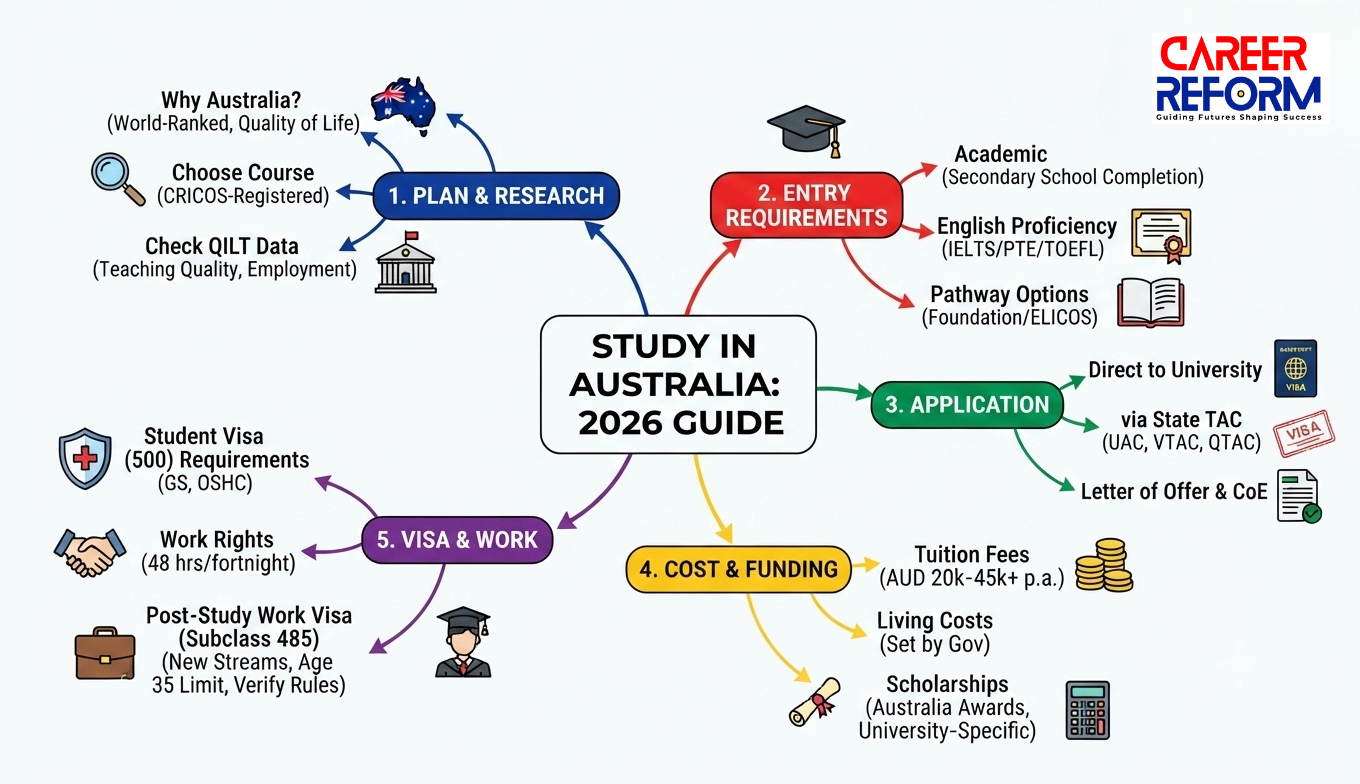
Studying in Australia can be genuinely life-changing — academically, culturally, and professionally — but it rewards students who plan carefully rather than those chasing shortcuts. Start by shortlisting CRICOS-registered courses on QILT, confirm your English test requirements early, and build your visa and finances timeline around the current Subclass 500 and Subclass 485 rules, not outdated blog posts.
Ready to take the next step?
- Shortlist 3–5 universities using QILT and CRICOS.
- Check entry requirements and application deadlines on each university’s official page.
- Apply for scholarships early — many have deadlines months before the course intake.
- Stay updated on the ongoing post-study work visa (485) career reforms, since your eligible work duration after graduation now depends heavily on your course level and graduation date — this can directly shape which degree and university you choose. Indian students should also factor in the AI-ECTA extended stay benefit (see Section 11) when comparing a standard Bachelor’s, an Honours year in STEM, or a Master’s — it can meaningfully change how long you’re able to work in Australia after graduating.
- Once you have your CoE, begin your Subclass 500 visa application well ahead of your intake date.
For the most accurate, current details at every step, always go back to the official government links above, they are updated far more reliably than third-party guides. Download our e-book here: Study in Australia
Need personalised guidance on top of this guide? Visit careerreform.in for tailored support on course selection, applications, and career planning for your Australia study journey.