

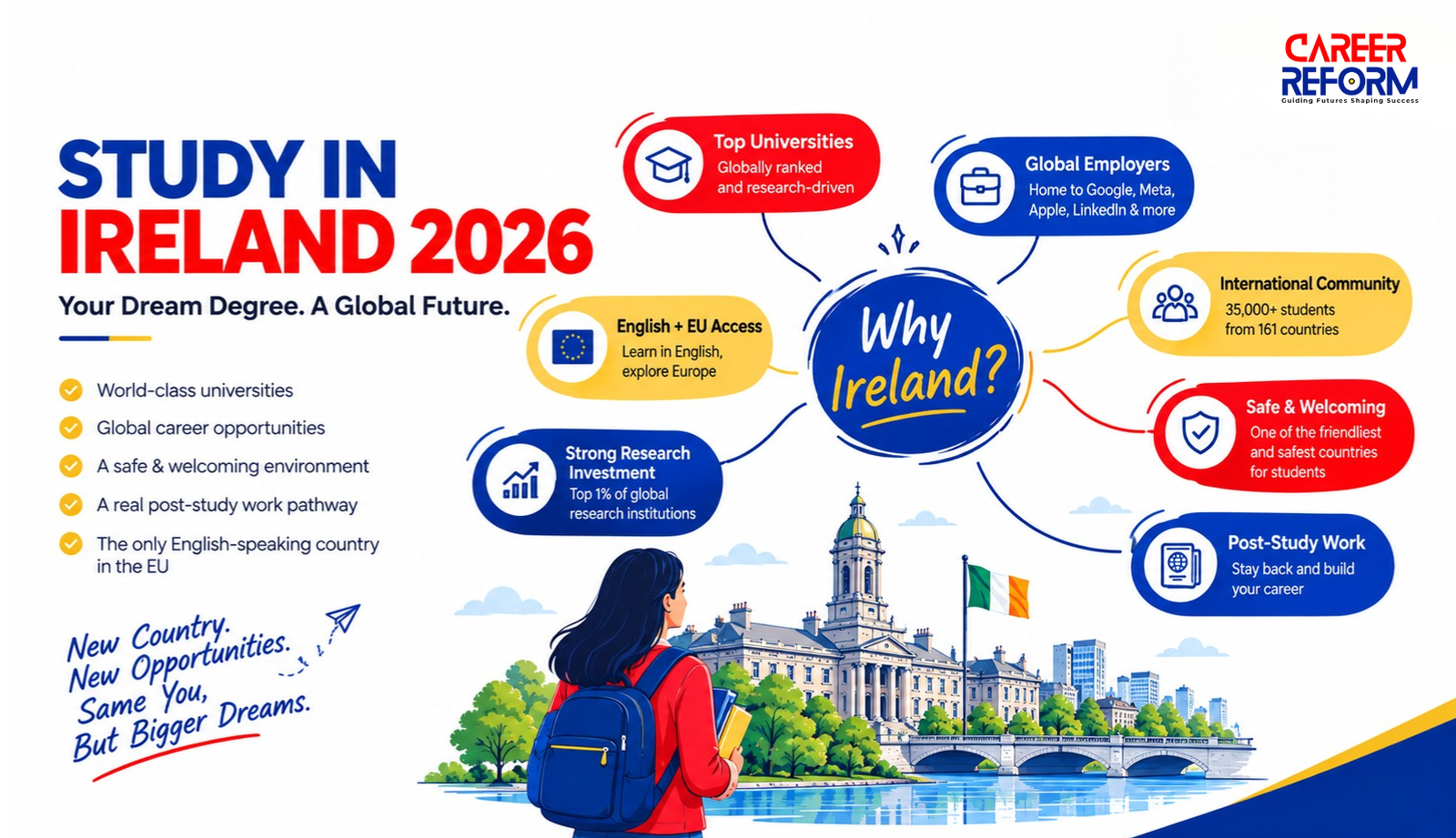
Ireland has become one of the most popular study-abroad destinations in the world. It is the only English-speaking country left in the European Union, hosts the European headquarters of Google, Meta, Apple, and LinkedIn, and offers a genuine post-study work pathway for graduates. If you are considering Ireland for your bachelor’s degree, here is a complete, up-to-date guide covering everything you need to know.
(Note: All monetary figures below are shown in Indian Rupees and are approximate. Costs vary by university, course, and prevailing exchange rates, so always confirm exact figures on the official university and visa websites before making financial decisions.)
Why Study in Ireland?
The Irish Government invests heavily in higher education — over ₹1,10,000 crore in total education spending, with over ₹8,600 crore invested annually in research at its higher education institutions. This investment pays off: Irish universities rank in the top 1% of research institutions in the world for research impact across 19 fields, including natural sciences, social sciences, and the humanities.
Key advantages include:
- An English-medium degree with EU access. Ireland is the only fully English-speaking member state of the European Union, so you get an English-language education while still gaining access to the wider European academic and professional network.
- Strong ties to global employers. Dublin hosts the European headquarters of Google, Meta, Apple, and LinkedIn, creating excellent internship and placement opportunities during your degree.
- A large, diverse student community. Ireland welcomes around 35,000 international students from 161 countries.
- A safe and welcoming country. Ireland is consistently ranked among the friendliest and safest countries in the world for students.
- A genuine stay-back option after graduation, explained in detail below.
Top Universities in Ireland (QS World Rankings 2026)
| University | QS World Ranking 2026 |
|---|---|
| Trinity College Dublin (TCD) | 75 |
| University College Dublin (UCD) | 118 |
| University College Cork (UCC) | 246 |
| University of Galway | 284 |
| University of Limerick | 401 |
| Dublin City University (DCU) | 410 |
| Maynooth University | 771–780 |
| Technological University Dublin | 781–790 |
Source:https://www.topuniversities.com/where-to-study/europe/ireland/guide#
Trinity College Dublin, founded in 1592, is Ireland’s oldest and most internationally recognised university, particularly strong in law, computer science, business, and the humanities. UCD is Ireland’s largest university, with over 39,000 students, including more than 11,000 international students from over 150 countries.
Popular Courses
Students most commonly choose:
- Computer Science and Data Science — driven by Dublin’s status as a European technology hub
- Business and Commerce
- Engineering (Mechanical, Electronic, Civil, and Biomedical)
- Pharmaceutical Science and Life Sciences — supported by Ireland’s large pharmaceutical industry
- Nursing and Health Sciences
- Law
Tuition Fees in Ireland (2026)
Tuition depends on the university and the course. Here is a realistic annual range for international students at bachelor’s level:
| Programme | Annual Tuition (INR, approx.) |
|---|---|
| Arts, Humanities, and Social Sciences | ₹11,00,000 – ₹18,70,000 |
| Business and Commerce | ₹13,20,000 – ₹22,00,000 |
| Science | ₹13,20,000 – ₹22,00,000 |
| Engineering | ₹14,30,000 – ₹24,20,000 |
| Computer Science | ₹14,30,000 – ₹24,20,000 |
| Law | ₹13,20,000 – ₹22,00,000 |
| Nursing | ₹11,00,000 – ₹17,60,000 |
| Medicine (MB BCh) | ₹19,80,000 – ₹55,00,000 and above |
These are indicative figures compiled from publicly available university prospectuses. Always confirm the exact fee for your specific course on the university’s official admissions page before applying.
Scholarships for International Students
Given the tuition costs above, it’s worth knowing that most major Irish universities run their own scholarship schemes for international students, alongside a national government award.
Government of Ireland International Education Scholarship (GOI-IES)
Ireland’s flagship national scholarship, funded by the Irish Government and administered by the Higher Education Authority. It offers a full tuition fee waiver plus a stipend of approximately ₹11,00,000 for one year of study. Note that this scholarship is aimed primarily at postgraduate applicants (Master’s and PhD) — most undergraduate students will not be eligible, so it’s included here mainly for awareness rather than as a primary funding route.
Trinity College Dublin
- Global Excellence Undergraduate Scholarships: Awarded to outstanding non-EU students with a full-time undergraduate offer, worth up to ₹5,50,000 as a reduction on first-year tuition. Medicine and Dentistry are excluded.
- India Undergraduate Scholarships: A dedicated scholarship track for Indian students applying to full-time undergraduate programmes (excluding Medicine, Dental Science, and Acting), reflecting Trinity’s academic ties with Indian institutions.
University College Dublin (UCD)
Global Excellence Scholarship offers a 50% or 100% tuition fee waiver for outstanding non-EU undergraduate and taught postgraduate applicants. Requires an active offer before applying, and cannot be combined with other tuition awards.
University College Cork (UCC)
Runs automatic, faculty-based awards for undergraduates — for example, around a 25% fee reduction for Science, Engineering, and Food Science, and roughly 15% for Arts, Celtic Studies, and Social Sciences, along with a separate ₹5,50,000 award for Business and Law undergraduates. Most are applied automatically once you accept your offer.
Dublin City University (DCU)
Offers automatic Merit Scholarships for eligible non-EU undergraduates, plus faculty-specific awards such as the Science and Health International Scholarship (up to ₹6,71,000 for eligible nursing programmes).
University of Galway
Offers merit-based scholarships for international students, including awards tied to academic results at the point of accepting an offer. Exact undergraduate terms vary by year, so confirm current eligibility directly on the university’s official scholarships page.
University of Limerick
Offers Kemmy Business School Scholarships for Indian undergraduate applicants (typically requiring 75%+ in Standard X and XII), plus one general scholarship per faculty for students exceeding entry requirements.
Technological University Dublin (TU Dublin)
Undergraduate Global Entry Scholarship supports a small number of non-EEA students annually with roughly ₹2,20,000 per year throughout their degree, subject to continued academic progress.
Maynooth University
International Undergraduate Scholarship offers one award per faculty, worth roughly ₹2,20,000 per year in tuition reduction, with automatic consideration for eligible international students.
General eligibility across most schemes:
- A conditional or unconditional offer of admission from an eligible Irish institution
- Classification as a non-EU/non-EEA student for tuition fee purposes
- A strong academic record (specific grade thresholds vary by scholarship)
- Being a self-funding applicant — scholarships reduce costs, but do not replace the need to show visa-required funds
Scholarship terms, amounts, and deadlines change every year and are often awarded automatically upon acceptance of an offer, so always confirm current details on each university’s official scholarships page before applying.
Official source: Higher Education Authority (HEA)
Cost of Living
Besides tuition, you will need to budget for daily expenses. A reasonable annual estimate for a single student:
| Expense | Annual Estimate (INR, approx.) |
|---|---|
| Accommodation | ₹9,24,000 – ₹19,80,000 |
| Food and groceries | ₹4,62,000 – ₹7,92,000 |
| Transportation | ₹1,32,000 – ₹2,64,000 |
| Health insurance | ₹55,000 – ₹1,32,000 |
| Books and supplies | ₹55,000 – ₹1,10,000 |
| Personal expenses | ₹2,20,000 – ₹4,40,000 |
Dublin is the most expensive city to live in. Cork, Galway, and Limerick offer noticeably lower accommodation costs while still hosting excellent universities, so they are worth considering if you want to manage your budget carefully.
Entry Requirements
While exact requirements vary by university and course, the general expectations for international applicants are:
- A Letter of Acceptance (LOA) for a full-time course requiring at least 15 hours of daytime study per week. This letter must be unconditional, not conditional.
- English language proficiency, usually demonstrated through IELTS, TOEFL, or an equivalent recognised test.
- Completed secondary school qualifications equivalent to the Irish Leaving Certificate, along with official transcripts.
- Your course must appear on the Interim List of Eligible Programmes (ILEP), which confirms it is recognised for immigration purposes.
Student Visa Requirements (2026 Rules)
If you are not a national of an EEA country or Switzerland, here is what the current student visa rules require:
Financial evidence:
- For courses lasting more than 8 months, you must show immediate access to approximately ₹11,00,000 to cover living costs for the first academic year.
- For courses of 8 months or less, the requirement is approximately ₹91,600 per month, up to a maximum of about ₹7,33,000.
- You must also demonstrate ready access to roughly ₹11,00,000 for each subsequent year of study, in addition to that year’s tuition fees.
Tuition payment proof:
- Your visa application must show that at least approximately ₹6,60,000 has been paid toward your tuition (or the institution’s required minimum deposit), supported by official receipts or bank transfer confirmations.
Financial vetting: Immigration authorities have tightened checks on the source, stability, and accessibility of student funds. Large, last-minute deposits must be clearly explained, and funds in locked savings accounts may not be accepted unless the bank confirms you can withdraw them during your studies.
Biometrics: Students from certain countries, including India and Nepal, must provide fingerprints and a photograph at a VFS Global centre as part of the visa application process.
Registration after arrival: If you are staying longer than 90 days, you must register for an Irish Residence Permit (IRP) within 90 days of arrival. This involves a document check, photograph, fingerprints, and a stamp confirming your permission to stay, and typically carries a fee of approximately ₹33,000.
Apply well in advance — processing can take longer during the busy June–August period, so submit your application 8 to 12 weeks before you plan to travel.
Official source: Irish Immigration Service Delivery – Coming to Study in Ireland
Working While You Study
Students holding a valid Stamp 2 permission can work part-time. You are permitted to work:
- Up to 20 hours per week during term time
- Up to 40 hours per week during scheduled college holidays (typically June–September and 15 December–15 January)
This part-time income can help offset your living expenses.
Post-Study Work Visa: The Third Level Graduate Programme (Stamp 1G)
One of the biggest advantages of an Irish degree is the stay-back scheme available after graduation. Graduates who are not EEA nationals, who complete their studies in Ireland, and who are awarded a Level 8 qualification (an honours bachelor’s degree) on the National Framework of Qualifications while holding a valid Stamp 2 permission are eligible for a twelve-month Stamp 1G permission.
During this period, you can work full time for any employer while you search for graduate-level employment and apply for a longer-term work permit, such as a Critical Skills Employment Permit.
Official source: Irish Immigration Service – Third Level Graduate Programme
How to Apply
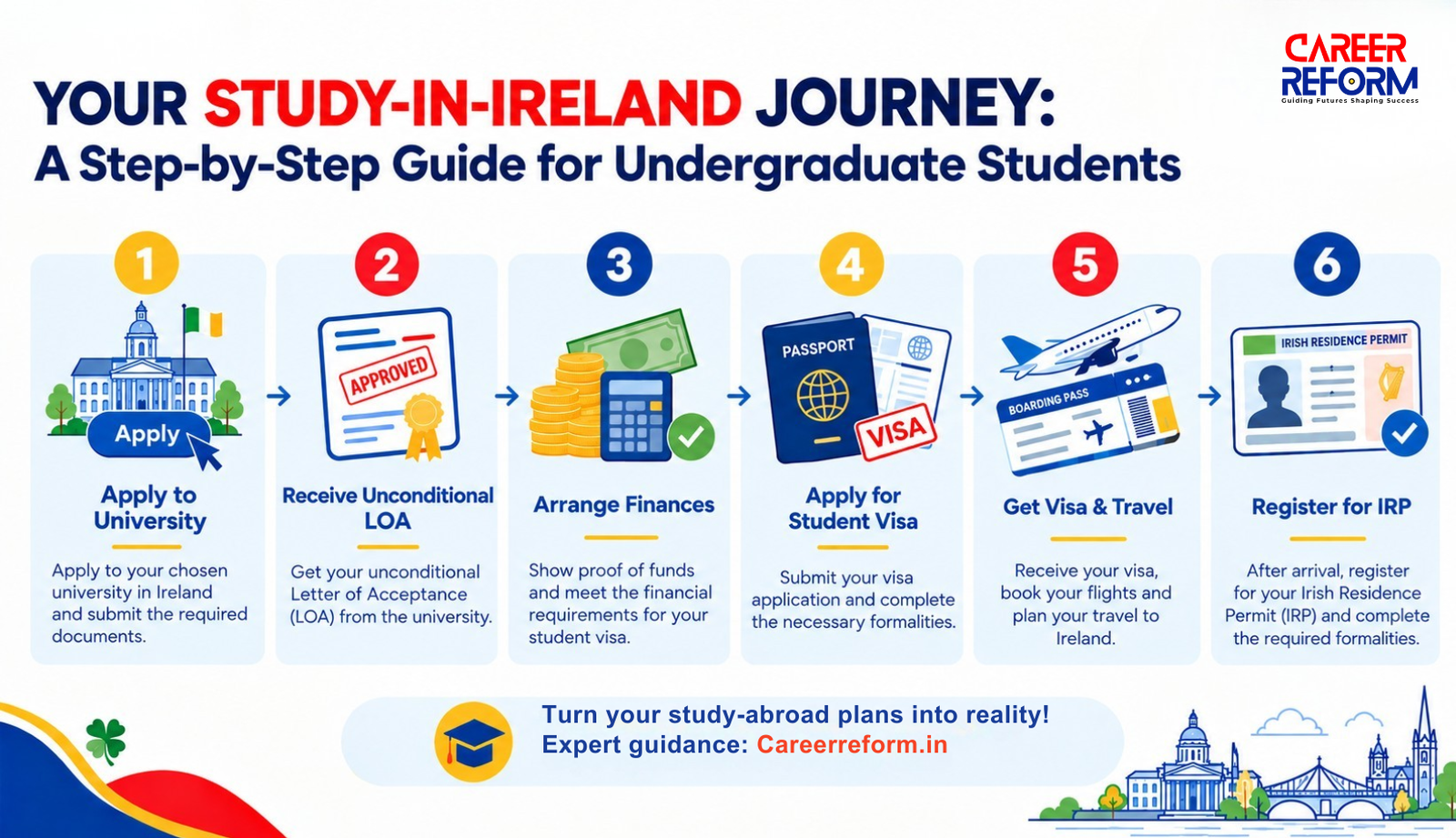
- Research and shortlist your course and university through Education in Ireland, the official government portal promoting Irish higher education abroad.
- Check course eligibility on the Interim List of Eligible Programmes to ensure your chosen course qualifies for a student visa.
- Apply directly to your chosen university’s international admissions office. Most Irish universities have a dedicated international admissions portal; EU applicants generally apply through the Central Applications Office (CAO).
- Secure your unconditional Letter of Acceptance and pay the required tuition deposit.
- Arrange your finances to meet the visa’s financial requirements outlined above.
- Apply for your student visa, if required, through irishimmigration.ie, ideally 8 to 12 weeks before your travel date.
- Register for your Irish Residence Permit (IRP) within 90 days of arriving in Ireland.
Useful Official Resources
- Education in Ireland — official government portal for international students.
- Higher Education Authority (HEA) — Ireland’s statutory body for higher education policy and institutions
- Irish Immigration Service Delivery — student visas, registration, and Stamp permissions.
- Citizens Information: Coming to Study in Ireland — plain-language guidance on rights and procedures.
- Central Applications Office (CAO) — admissions body for Irish higher education.
- Quality and Qualifications Ireland (QQI) — verifies recognised qualifications and course providers.
Final Thoughts
Ireland offers a rare combination of benefits: an English-medium education inside the European Union, universities with strong global rankings, close connections to multinational employers, and a genuine twelve-month post-study work option. If you organise your English test scores, financial documentation, and course eligibility early, the journey from application to arrival is straightforward and well-supported by official government resources.
Want a deeper, step-by-step breakdown before you apply? Download our free Study Abroad E-Book — a detailed guide covering university selection, application timelines, visa documentation, and budgeting, designed to help you plan your Ireland journey with confidence.
Planning your study journey to Ireland and need expert guidance on university selection, visa documentation, and scholarships? Get in touch with CareerReform.in today for personalised support in turning your study-in-Ireland plans into reality.