

For decades, the career conversation in Indian households followed a predictable script. Engineering meant stability. Medicine meant respect. A government job meant security for life. Commerce led to chartered accountancy, and chartered accountancy led to a comfortable retirement.
That script is being rewritten — not by trend or fashion, but by artificial intelligence.
In 2026, AI tools can write code, draft legal contracts, analyze financial statements, diagnose medical scans, and even generate marketing campaigns — often in seconds. For Indian parents guiding their children through one of the most consequential decisions of their lives, the question is no longer “which degree is prestigious?” It is: “which career will still need a human being to do it?”
This article cuts through the panic and the hype to give you a grounded, evidence-based answer.
First, Let’s Correct a Common Misunderstanding
Most parents ask, “Will AI take over this job?” That’s the wrong question. AI doesn’t take over jobs — it takes over tasks.
Every profession is really a bundle of tasks. Some of those tasks are repetitive, rule-based, and data-heavy — the kind AI is excellent at. Others require judgment, trust, physical presence, creativity, or accountability for real-world consequences — the kind AI still cannot reliably do.
The careers that survive and thrive are not necessarily the ones with no AI involvement. They are the ones where humans remain the irreplaceable core, even as AI becomes a powerful assistant around them.
Keep this distinction in mind as you read on — it’s the single most useful lens for evaluating any career your child is considering.
What Makes a Career Genuinely AI-Resistant
Based on how AI systems currently function and their well-documented limitations, careers tend to hold up well when they require one or more of the following:
- Physical presence and dexterity in unpredictable environments — AI can’t yet reliably navigate the messy, physical, real-time nature of many hands-on jobs.
- High-stakes judgment with accountability — Someone must be legally, ethically, or professionally responsible when things go wrong. AI cannot bear that responsibility.
- Deep interpersonal trust — Situations where people specifically want to be understood, comforted, negotiated with, or led by another human.
- Novel problem-solving in ambiguous, unprecedented situations — AI is trained on patterns from the past; it struggles when there is no precedent to draw from.
- Regulatory or ethical gatekeeping — Fields where a human must formally certify, approve, or take liability for a decision.
- Creative strategy and vision — Deciding what story to tell, why it matters to a specific audience, and how to align it with a brand’s or client’s real goals.
With that framework, let’s look at where this actually leaves your child’s career options.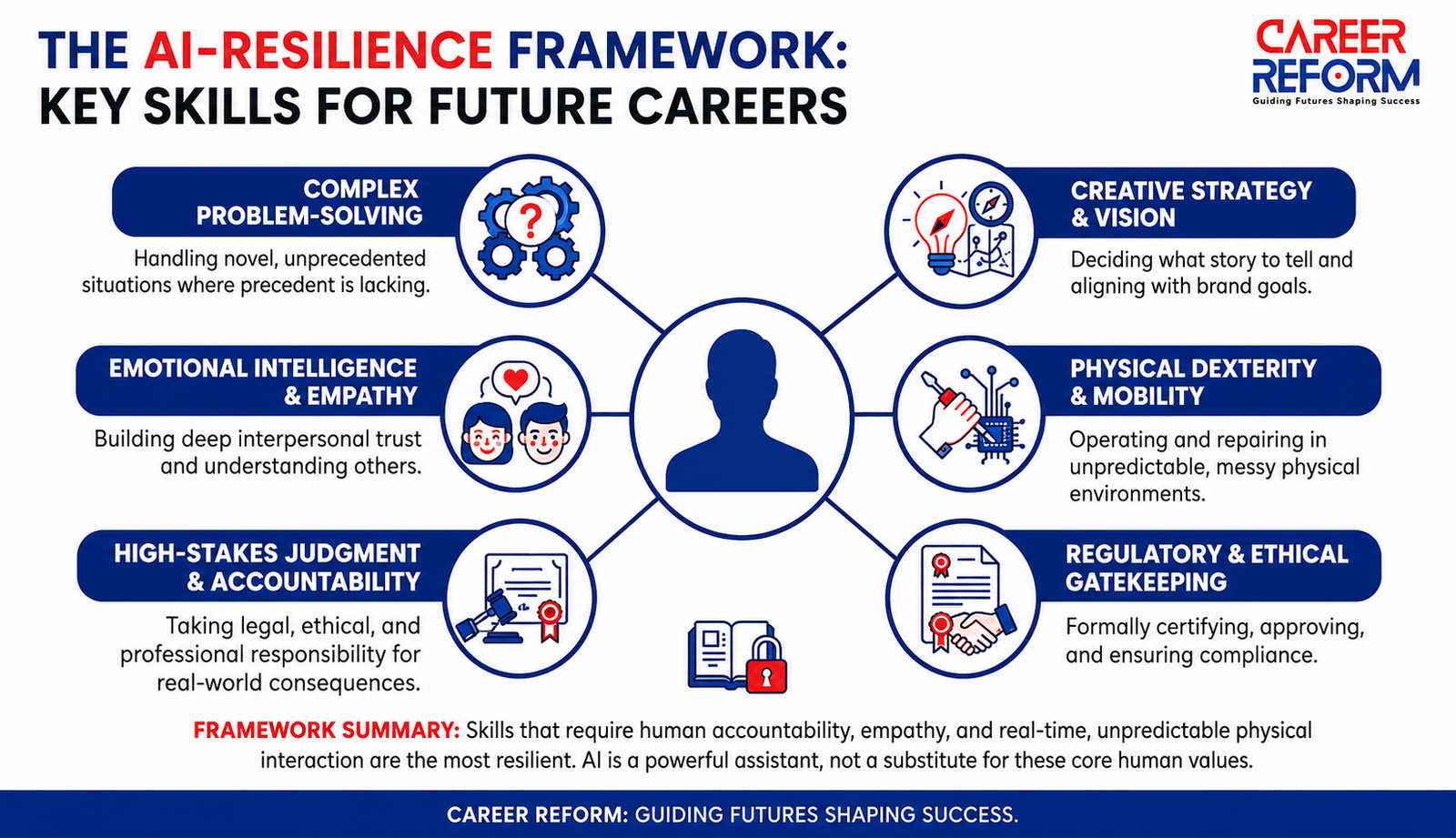
Careers That Are Genuinely Well-Positioned
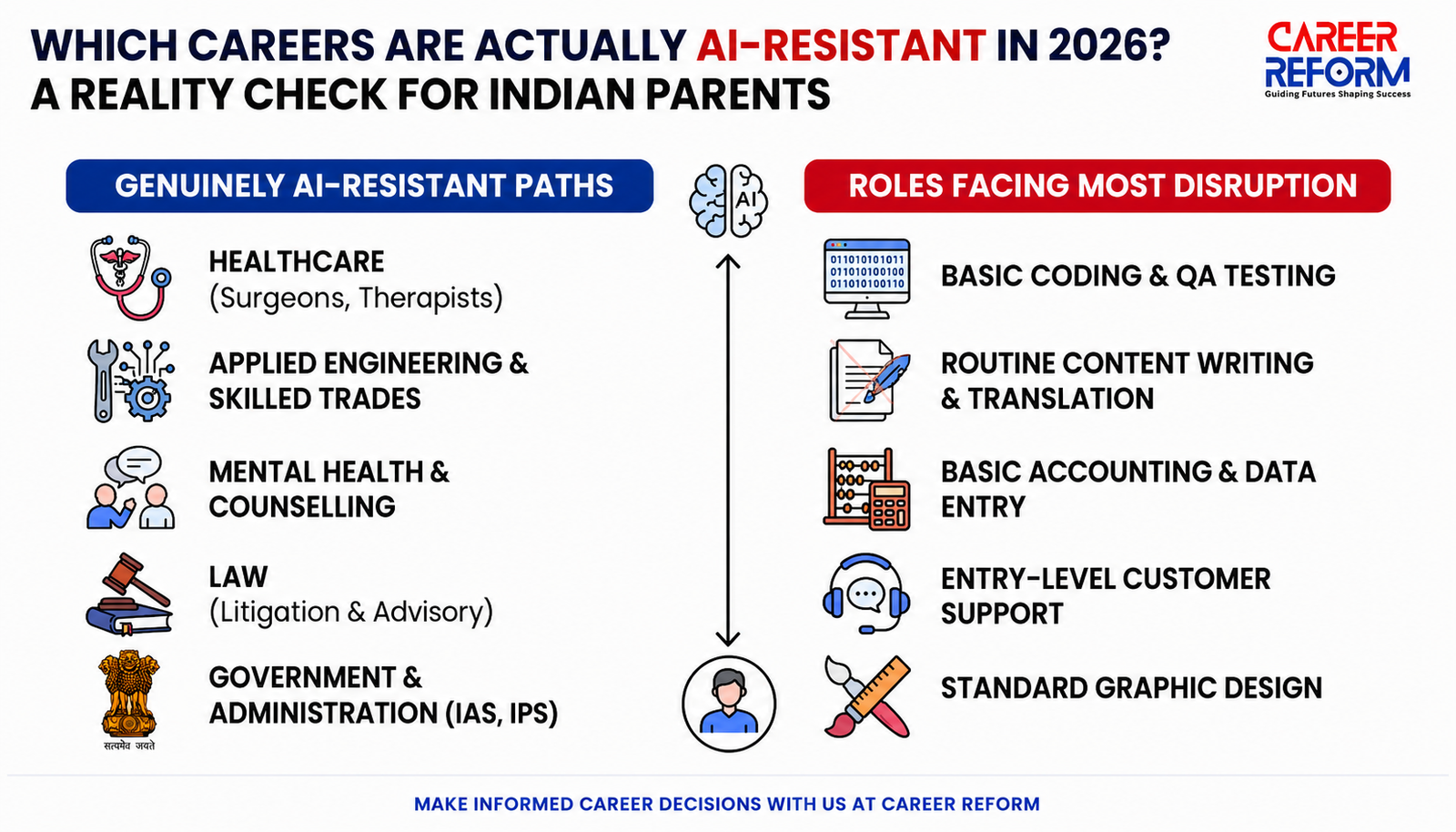
1. Healthcare — But Not All of It
Doctors who perform surgery, manage complex or emergency cases, or build long-term patient relationships remain difficult to replace. Nursing, physiotherapy, and hands-on caregiving are similarly resilient because they combine physical care with emotional trust.
Caution: Roles centred on reading standard scans, routine diagnostics, or basic report generation are already being reshaped by AI-assisted tools. The value is shifting from “interpreting data” to “using AI-generated data to make the final human call.”
2. Skilled Trades and Applied Engineering
Electricians, plumbers, HVAC technicians, machine repair specialists, and civil site engineers do work that is physical, situational, and often occurs in unpredictable environments — inside old buildings, under time pressure, with non-standard problems. This is precisely the territory where AI and robotics remain weak. In fact, India’s shortage of skilled tradespeople means demand here may increase, not decrease.
3. Mental Health and Counselling Professions
Psychologists, therapists, and counsellors succeed because of trust, empathy, and confidentiality — qualities people are unlikely to outsource to a machine, especially for deeply personal matters. Demand for these professionals is rising sharply across urban India.
4. Law — Litigation and Advisory Roles
Routine contract review and legal research are increasingly AI-assisted. But courtroom advocacy, negotiation, client counselling, and judgment calls involving nuanced human circumstances remain firmly human territory. Lawyers who adapt by using AI for research — rather than competing with it — will be the most successful.
5. Skilled Sales, Relationship Management, and Negotiation
High-value B2B sales, wealth management, real estate negotiation, and client relationship roles depend on trust-building over time. AI can generate a pitch; it cannot build a decade-long relationship with a client.
6. Teaching — Especially Early Childhood and Specialized Education
AI can deliver information, but mentorship, motivation, classroom management, and emotional development in young learners remain deeply human tasks. Teachers who integrate AI tools into their teaching (rather than being replaced by them) are becoming more effective, not less relevant.
7. Creative Direction and Strategic Roles
AI can generate content, but someone still needs to decide what story to tell, why it matters to a specific audience, and how to align it with a brand’s or client’s real goals. Creative direction, strategy, and cultural judgment remain human strengths — even as AI tools handle execution.
8. Entrepreneurship and Business Ownership
This deserves special mention. Building and running a business demands judgment, risk-taking, relationship management, and adaptability — precisely the bundle of skills AI cannot replicate. Entrepreneurs who use AI as leverage (for content, coding, or research) are often more competitive today than those without it.
9. Government Jobs (UPSC, State PSCs, and PSUs)
No conversation about career security in Indian households is complete without addressing government employment — and for good reason. Roles secured through UPSC, State Public Service Commissions, banking exams (IBPS, SBI), and Public Sector Undertakings carry a structural form of AI-resistance that private-sector roles simply do not:
- Constitutional and administrative authority cannot be delegated to AI. An IAS or IPS officer’s decisions carry legal and civic weight that requires a human, accountable office-holder — not a system.
- Policy-making, law enforcement, and judicial roles require human accountability to citizens and to the Constitution, not just technical accuracy.
- Job security frameworks (pension structures, service protections, and recruitment via constitutional bodies) are governed by law, not market efficiency — making these roles resistant to the kind of rapid restructuring AI is driving in the private sector.
- PSU technical and engineering roles (in power, railways, defence, and oil & gas) do face automation of routine operations, but supervisory, safety-certification, and on-ground engineering roles remain firmly human-led due to regulatory and safety accountability.
Caveat: Entry-level clerical and data-processing roles within government offices are gradually being automated or digitized (e.g., through e-governance initiatives), so this resilience applies most strongly to decision-making, regulatory, and administrative roles — not routine paperwork positions.
For many Indian families, this makes government service one of the most structurally AI-resistant career paths available — not because AI can’t assist these roles, but because the authority to decide is, by design, reserved for accountable human office-holders.
Careers Facing the Most Disruption
Indian parents should be clear-eyed about roles where AI is already displacing entry-level work:
- Basic coding and QA testing — AI now writes functional code and tests directly; junior-level “pure coding” roles are shrinking fast, even as senior engineering judgment remains valuable.
- Routine content writing and translation — Generic, templated writing is now largely automated.
- Basic accounting and data entry — Bookkeeping, invoice processing, and standard tax filing are increasingly automated.
- Customer support (Tier 1) — Chatbots now resolve a large share of routine queries.
- Standard graphic design and basic illustration — AI image tools have compressed timelines and costs for template-based design work.
This does not mean these fields are dead. It means the entry point has changed. A junior developer who only writes boilerplate code is vulnerable; a senior engineer who architects systems, makes technical trade-off decisions, and manages AI tools is not just safe — they’re more valuable than ever.
A Real-World Example: Two Career Paths, Two Outcomes
Consider two young professionals who graduated from the same engineering college in 2020, both with computer science degrees.
Professional A joined a mid-sized IT services company and focused primarily on routine, template-based coding tasks — writing standard modules for internal business tools with well-defined, repetitive requirements. By 2025, AI coding assistants could generate the same output faster and more cheaply. Professional A’s role was restructured, and the position was eventually merged into a smaller team overseeing AI-generated code rather than writing it directly — a significant change in both scope and career trajectory.
Professional B graduated from the same batch but chose a different path: they specialized in systems architecture, spent time understanding client business problems directly, and took on technical leadership responsibilities early. When AI coding tools became mainstream, Professional B didn’t compete with them — they used AI to accelerate execution while focusing their own time on designing systems, making trade-off decisions, and managing client relationships. By 2026, this professional was leading a technical team and was, if anything, more valuable to their organization than before.
The lesson isn’t “avoid coding” or “avoid IT.” Both professionals had the same degree and the same starting point. The difference was where in the task bundle they positioned themselves — execution versus judgment, repetition versus decision-making. This is precisely the distinction Indian parents need to help their children navigate, regardless of which field they choose.
(This example is illustrative — a composite drawn from well-documented, widely reported patterns in the IT services industry, not a specific individual case. It is included to make the underlying trend concrete, not as a verified case study.)
The Real Advice for Indian Parents in 2026
- Stop asking “which degree?” and start asking “which skill bundle?” A B.Tech isn’t inherently safe or unsafe — it depends on what your child specializes in and how they use AI as a tool rather than being replaced by it.
- Favour careers with a human-trust component. Ask: “Would a client or patient still want a human here, even if AI could technically do the task?” If yes, that role has staying power.
- AI fluency is now a baseline skill, not a specialization. Every career — from medicine to law to trades — will reward professionals who can use AI tools effectively. Encourage your child to learn with AI, not just about it.
- Don’t dismiss vocational and skilled-trade paths. Indian parents have historically undervalued trades in favour of white-collar prestige. In an AI economy, the calculus is shifting — hands-on, situational work is proving more durable than many desk jobs.
- Reward adaptability over credentials. The half-life of technical knowledge is shrinking. A student who can learn continuously will outlast one who simply holds a prestigious degree.
A Closing Thought
No career is 100% “AI-proof” — technology continues to advance, and predictions made today may need revision tomorrow. But there is a clear and consistent pattern: careers built around human trust, physical presence, high-stakes judgment, and adaptability are proving far more resilient than those built purely around repeatable, rule-based tasks.
The most important gift you can give your child in 2026 isn’t a “safe” degree — it’s the ability to keep learning, keep adapting, and keep asking where they, as humans, add value that a machine cannot.
That mindset, more than any single career choice, is what will genuinely stand the test of time.
If you found this reality check useful, we invite you to continue the conversation with us. At careerreform.in, we work with Indian parents and students every day to translate exactly these kinds of shifts into clear, personalized career guidance. Reach out to our team for one-on-one guidance tailored to your child’s strengths and goals — we would be glad to help you plan the next step with confidence.
Disclaimer: This article reflects analysis based on current trends and publicly available information as of early 2026. AI capabilities are evolving rapidly, and readers are encouraged to stay updated on developments in their specific field of interest.