

“The result is on the screen. Your child is quiet. You are pretending to be calm. Across 2 crore Indian households this week, the same dangerous silence is playing out, and in that silence, careers are being decided by panic, not purpose. Here is what to do instead — day by day, for the next 30 days.”
Whether you are sitting in an apartment in Delhi, Mumbai, or a bustling hub like Jaipur, the day the board results drop changes the gravity in your home. The WhatsApp groups are pinging. Relatives are calling. You want the best for your child, but beneath the surface, you are incredibly anxious.
As career experts, we see this cycle repeat every May. But it doesn’t have to be this way. Career Reform founders Dr. Chetna Sabharwal , UCLA and Chetan Khurana, an IIM Alumni, have guided over 30,000 Indian families through this exact transition. If you are frantically searching for what to do after board results India 2026, pause. Do not rush to a coaching centre. Do not pay a non-refundable college fee today.
Instead, follow this highly practical, shortened 30-day roadmap to help your child navigate this milestone with clarity, not chaos.
Days 1-2: The 48-Hour Rule — No Decisions Yet
When the CBSE, ICSE, UP Board, or Maharashtra SSC servers finally unfreeze, your child’s brain goes into a state of high alert.
Take Priya, a mother from Delhi. Her son Aditya expected a 92% in his Class 12 boards; he got an 81%. His Science score was just 72. In Priya’s house, the first hour was spent in panicked calculations, followed by Aditya locking himself in his room. His fight-or-flight response was activated.
Because of this, the first 48 hours are strictly for emotional regulation. No career decisions should be made during this window. As Dr. Chetna Sabharwal, Founder of Career Reform, powerfully notes:
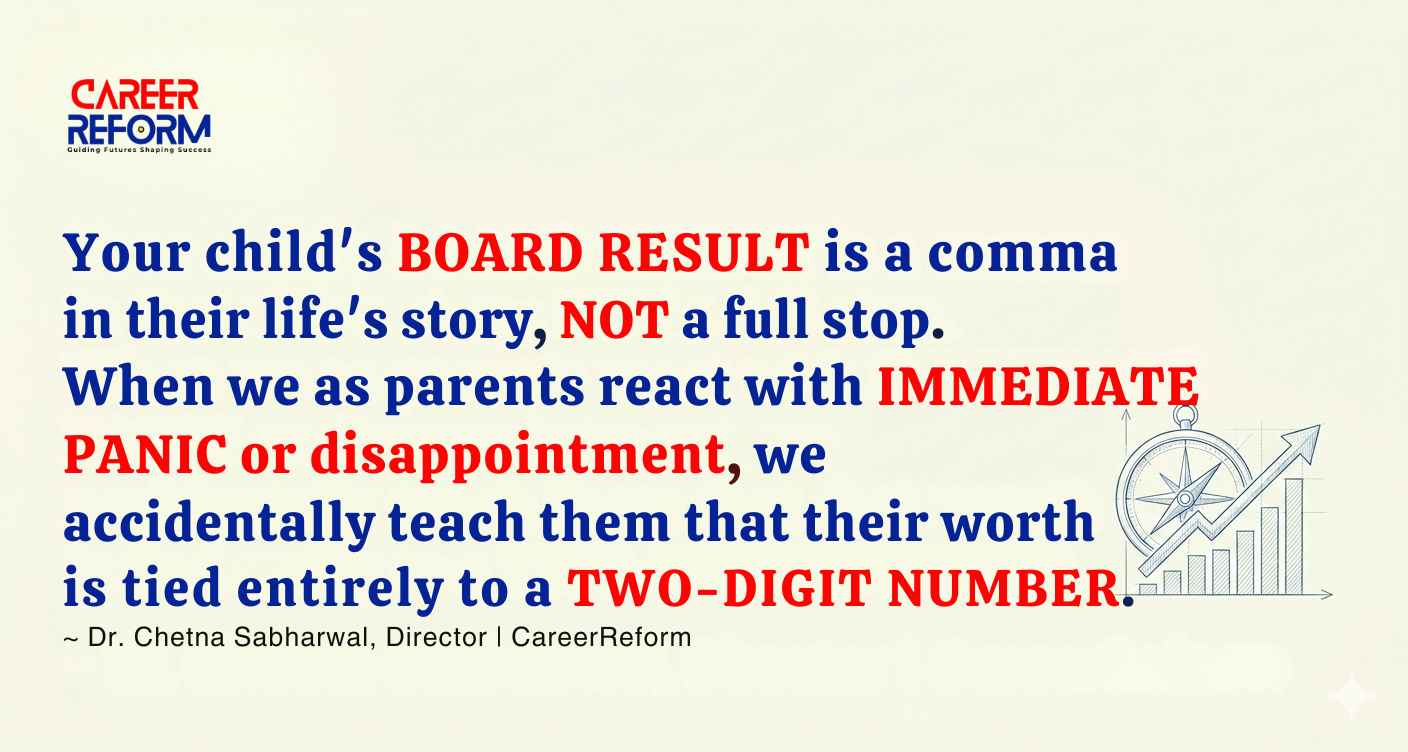
“Your child’s board result is a comma in their life’s story, not a full stop. When we as parents react with immediate panic or disappointment, we accidentally teach them that their worth is tied entirely to a two-digit number.”
3 Things You MUST Say:
- “I see how hard you worked, and I am proud of your effort, regardless of this number.”
- “This mark sheet does not close as many doors as you think.”
- “Let’s put the phones away and go grab dinner.”
3 Things You MUST NEVER Say:
- “Look at Sharma ji’s son, he got 95% without any extra tuition.” (Comparison destroys self-esteem).
- “With these marks, you can forget about a good college.” (Catastrophising shuts down communication).
- “We spent Rs. 1,50,000 on your coaching for this?” (Guilt-tripping breeds resentment).
Today: Put the phone on silent, order their favourite dinner, and absolutely refuse to discuss the future.
Days 3-5: What Your Child’s Marks Actually Tell You (And What They Don’t)
By Day 3, the adrenaline has faded. Now, look at the mark sheet objectively.
When Priya finally looked at Aditya’s marks, she fixated on the 72 in Science. She missed 94 in English and 88 in Social Studies. More importantly, she assumed the Science score meant he lacked intelligence.
This is where Indian parents often get trapped. Career Reform Co-Founder Chetan Khurana explains this trap perfectly:
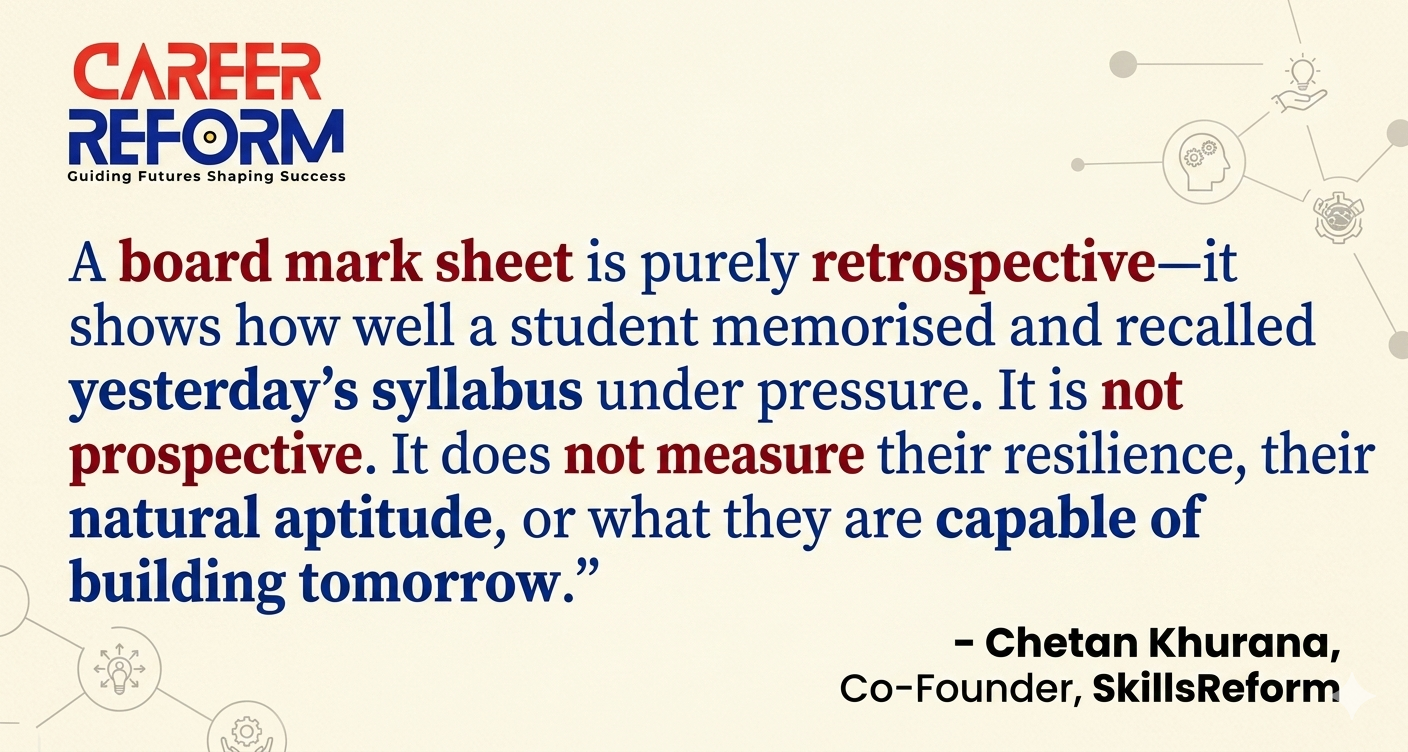
“A board mark sheet is purely retrospective—it shows how well a student memorised and recalled yesterday’s syllabus under pressure. It is not prospective. It does not measure their resilience, their natural aptitude, or what they are capable of building tomorrow.”
The gap between academic scores and real-world aptitude is why, according to the India Skills Report 2024, roughly 50% of Indian graduates remain unemployable. They are pushed into degrees based on marks, not natural alignment. Did your child score low in Math because they lack logic, or because of severe exam anxiety? Did they excel in languages but struggle with spatial subjects? Look for patterns, not just percentages.
Today: File the mark sheet away and spend an hour quietly observing what your child reads, watches, or creates in their free time without you prompting them.
Days 6-10: The Stream Selection Conversation
If you are figuring out the after CBSE Class 10 result next steps, this window is for the great Stream Selection debate.
Historically, stream selection after Class 10 India has been brutal: Above 90% gets Science, 75-90% gets Commerce, and below 75% gets Arts/Humanities. This outdated hierarchy destroys brilliant careers. We frequently see students in Pune and Bengaluru forced into Science due to high marks, only to face massive burnout by Class 11 mid-terms.
Instead of asking, “What stream pays the most?”, Priya used the Career Reform framework and asked Aditya the golden question: “What do you do without anyone asking you to?” Aditya’s answer wasn’t physics; it was video editing and storytelling. He had a natural flair for the media.
- Dismantle the Hierarchy: Remind them that a top-tier corporate lawyer (Humanities) or a financial analyst (Commerce) often out-earns a mid-tier engineer.
- Audit the Syllabus: Don’t assume Commerce is just “easy math.” Go to a bookstore and look at Class 11 Accountancy books before deciding.
Today: Sit down with two blank sheets of paper—one for you, one for your child, independently write down their top three natural strengths, and compare notes over tea.
Days 11-15: The College Application Sprint
For Class 12 parents, the focus of career guidance after board exam India shifts rapidly to college logistics.
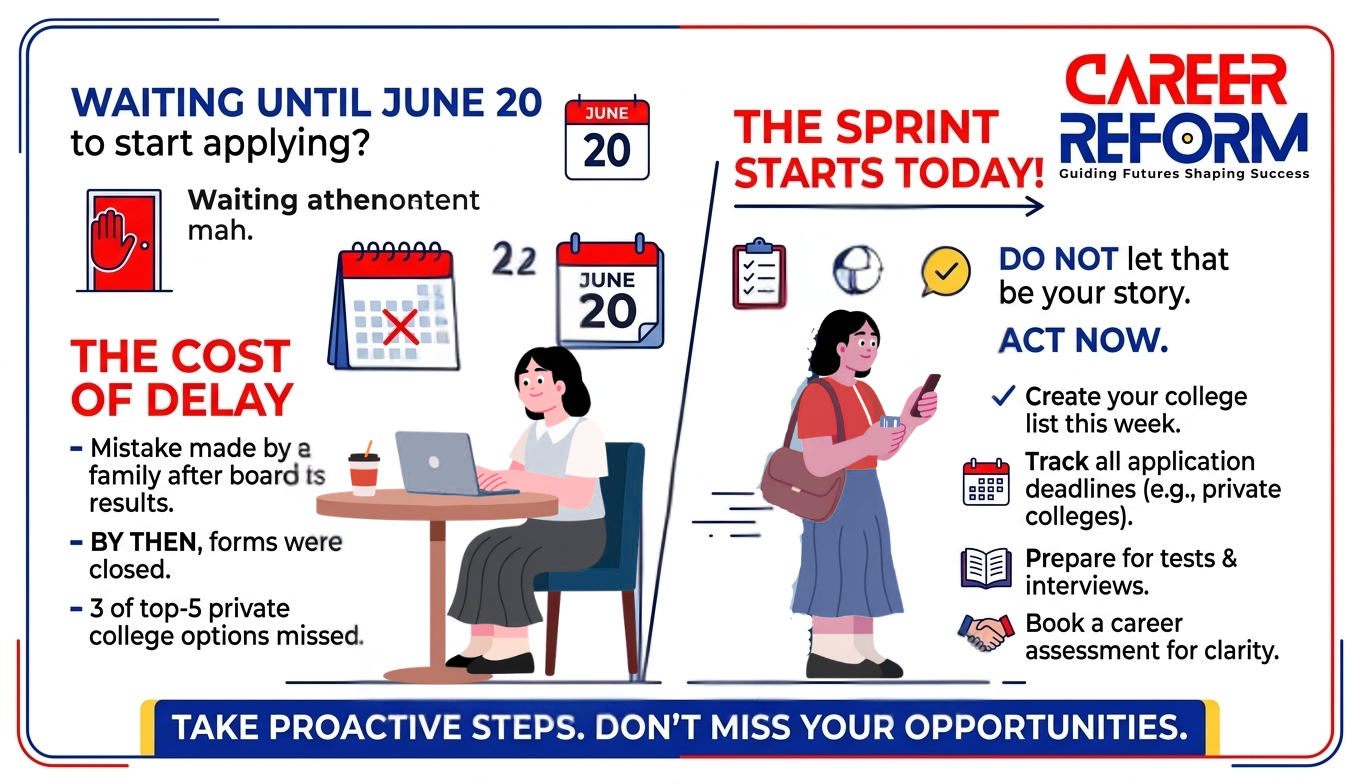
In May 2026, the landscape is chaotic. The CUET 2026 window is incredibly competitive. Meanwhile, state university direct admissions (often relying on Karnataka SSLC/PUC or similar state board marks) are opening. Private universities in Chennai and Hyderabad are sending emails with aggressive “last date” warnings.
It is very easy to make a Rs. 50,000 mistake out of FOMO (Fear Of Missing Out).
- The CUET Strategy: For central universities, board marks are just a baseline. Ensure your child’s CUET domain subjects perfectly match their desired programme’s requirements.
- Categorise Your Colleges: Sort applications into “Reach” (highly competitive), “Match” (strong chance), and “Safety” (guaranteed admission).
- Avoid the Booking Fee Trap: Do not pay massive, non-refundable “provisional admission fees” to private colleges unless it is a calculated safety backup you are willing to let go of.
Today: Create a master spreadsheet with your top 5 colleges, their specific entrance/CUET requirements, application fees, and definitive deadlines.
Days 16-20: Why May-June Is the Best Time for a Career Assessment
You’ve settled the emotions and looked at deadlines. But a nagging question remains: Are we making the right choice? Late May to early June is the absolute best time for a psychometric test after board results. Why? Because your child’s brain is finally uncluttered. No pre-boards, no tuition. They are rested, making their cognitive responses highly accurate. A study in the International Journal of Indian Psychology noted that structured psychometric testing reduces career indecision by over 65% in Indian adolescents.
A proper assessment measures three things:
- Aptitude: What are they naturally good at?
- Personality: How do they interact with stress, people, and leadership?
- Interest: What do they actually enjoy?
If Aditya has an interest in architecture but zero spatial aptitude, he will struggle. If he has an aptitude for data but a highly extroverted personality, sitting alone coding will make him miserable. A scientifically validated test replaces guesswork with undeniable data.
Today: Visit careerreform.in and book a scientifically validated psychometric assessment to discover your child’s true potential.
Days 21-30: Your 90-Day Action Plan
By Day 21, the fog has lifted. You have objective data. It is time to transition into a sustainable 90-day plan for the new academic year.
- Lock in the Decision: After a session with a career counsellor, finalise “Plan A” and “Plan B.” For Aditya, Plan A became Humanities with a focus on Mass Communication, and Plan B was Commerce with Digital Marketing.
- Complete Formalities: Gather transfer certificates, migration certificates, and get everything attested. Colleges in cities like Lucknow and Delhi require precise, error-free paperwork.
- Prepare for the Transition: Class 11 is a massive academic jump from Class 10. The first semester of college requires intense independent study. Set realistic expectations and tell your child it is perfectly normal if their grades dip initially as they adjust.
You have survived the dangerous silence of result day. You have chosen purpose over panic. Now, watch them thrive.
Today: Write down the single most important career goal for the next three months, stick it on the refrigerator, and take your child out for ice cream to celebrate.