


Imagine you are the owner of an IPL franchise. The auction table is packed. You have 90 crores left in your purse, one bowling spot to fill, and three players in front of you. The first one is a pure pacer. Wickets every other match when conditions suit him. The second is a wrist-spinner who only bowls in the power play. The third bats at five, bowls medium pace, fields like a gazelle, and once took three wickets and scored 55 off 30 in the same match.
You spend on the third player. Every time.
Not because the first two are bad cricketers. But because T20 cricket punishes teams that depend on one-dimensional players. The game moves too fast. Conditions change too quickly. Situations demand improvisation.
The 2026 job market is doing the exact same thing to your child’s career.
“A single degree used to be a launch pad. Today, it is barely the entry ticket.”
65% of jobs kids will hold in 2035 do not exist yet (World Economic Forum, 2023) 44% of core skills across industries will be disrupted in the next five years 3.2x salary premium earned by professionals with two or more complementary skills
THE PROBLEM
Why the “One Good Degree” Strategy Is Losing the Match
Every April, while the TATA IPL takes over every screen in the country, millions of Indian families are simultaneously playing a very different game. School examinations are winding down. Board results are weeks away. College counselors are fielding calls. Parents are comparing notes at dinner tables, weddings, WhatsApp groups.
And the strategy is almost always the same: get into a good college, study one respected subject, secure a stable job.
“Beta, pehle engineering karo. Baaki sab baad mein dekh lena.” (Do engineering first. Everything else can wait.)
This advice was perfect for 1995. It was reasonable in 2005. It started cracking in 2015. In 2026, it is a strategy that fields a T20 team with eleven Rahul Dravids. Brilliant individually. But not built for this format.
Here is what is actually happening in hiring rooms right now, and I say this after speaking with talent acquisition leads at some of India’s largest companies:
Candidates with only a single specialisation, no matter how good their marks, are being passed over in favor of candidates who can do two things decently well and communicate the connection between them. A psychology graduate who also understands basic UX research is hired before the psychology graduate who only knows psychology. A data analyst who can present findings to a non-technical board gets promoted faster than the one who lives only inside Python notebooks.
The employers are not looking for jacks of all trades. They are looking for all-rounders with a specialty. Exactly like an IPL franchise builds its playing eleven.
THE ANALOGY
Your Career Is a Playing XI. Build It Like One.
Let us break down what makes a winning IPL team and map it directly onto career planning. This is not a loose metaphor. This is a structural blueprint.
A championship-winning T20 side is never built around one superstar. It is built around roles that complement each other and players who can cover more than one role when the situation demands it.
The Opener — Core Degree / Primary Skill Sets the foundation. Your MBA, B.Tech, MBBS, or B.Com. This is your credential, your credibility. It gets you to the table. But it cannot win the match alone.
The All-Rounder — The Complementary Skill Stack Data analytics + marketing. Psychology + product design. Finance + behavioural economics. This is where modern careers are actually built. The all-rounder wins you the match.
The Finisher — Soft Power: Communication and Leadership The ability to sell your ideas, lead with empathy, and communicate across functions. Without this, brilliant skills die in silos. The finisher turns good innings into trophies.
The Powerplay Specialist — Digital and AI Fluency You do not need to code. But you need to understand how AI tools, automation, and data shape your industry. Every field has a power play now. Arrive ready for it.
Notice what is not on this list: ten years of grinding one skill to perfection while ignoring everything else. That is not a team. That is a batting lineup with no bowlers.
THE FRAMEWORK
Four Moves That Actually Change the Scoreboard
These are not things you will find in a standard college counselling session. They are not on any school notice board. But they are what actually works in the current market.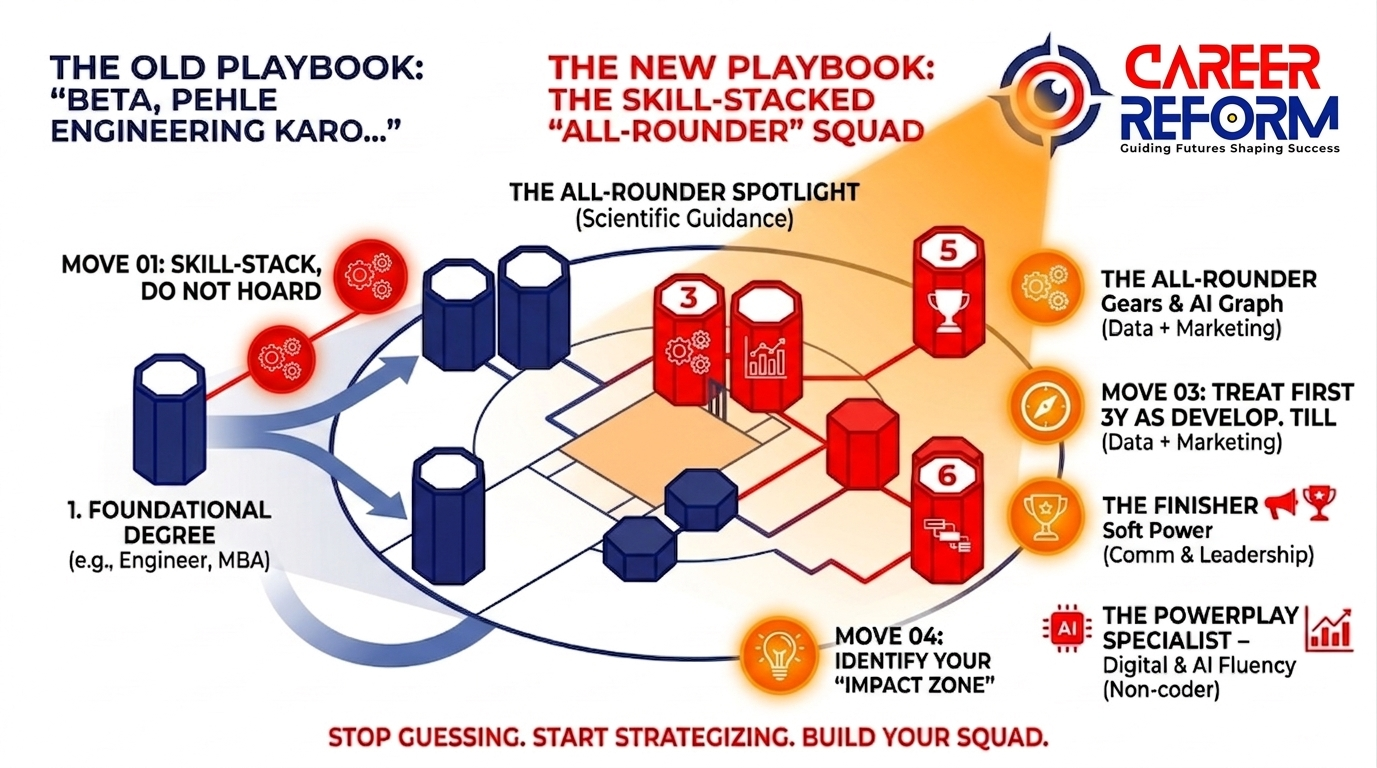
Move 01: Skill-Stack, Do Not Skill-Hoard
Skill-hoarding is collecting certificates without connecting them. Skill-stacking is deliberately combining two fields to create a perspective that neither field has on its own.
- A student studying Commerce can add a certification in behavioural psychology. Suddenly they understand why consumers make irrational financial decisions. That is a career in UX research, financial wellness products, or consumer strategy.
- An engineering student who studies philosophy of technology graduates ready to work on AI ethics, something every major tech company is desperate to hire for.
- A humanities student who learns basic data literacy can work in social research, public policy analytics, or content strategy in ways their pure-humanities peers cannot.
The combination does not need to be perfectly logical. It needs to be genuinely yours.
Move 02: Build a “Situation Room” Mindset, Not a “Syllabus” Mindset
In the IPL, a captain does not apply a fixed plan. They read the match. They adapt. They ask: what does this exact situation need from me right now?
- Teach students to ask: what problem does the world need solved, and which combination of my skills is best positioned to solve it?
- Encourage internships and projects outside the primary field of study. A law student who interns at a startup learns how businesses actually break rules and why. That is not a distraction; that is strategic intelligence.
- Counselors: stop asking students “what do you want to be?” Start asking them “what kind of problems do you want to solve, and for whom?”
Move 03: Treat Your First Three Years of Work Like a Trial Series, Not a Final
One of the most damaging ideas we sell young people is that the first job defines the career. It does not. The first job is Test match cricket: you are figuring out your game, reading the pitch, understanding your weaknesses.
- Parents: stop treating a “not-so-prestigious” first job as failure. Treat it as player development.
- Actively choose roles in the first three years that stretch you into adjacent skills, even if the title or pay is not glamorous.
- Document every project, every cross-functional contribution, every problem you solved. You are building your career portfolio, not a resume. There is a difference.
Move 04: Identify Your “Impact Zone” Before You Enter the Auction
In the IPL auction, players who command the highest bids are those who have demonstrated impact in a specific, measurable situation: death overs, powerplay, pressure chases. They have a story. Recruiters are exactly the same.
- Students need to identify one specific impact they have created before graduation. Not a grade. An outcome. “I led a team of four and reduced our NGO’s outreach costs by 30% using social media automation.” That sentence is worth more than a 9.2 GPA in many rooms.
- School leaders: create formal structures for impact projects. Make real-world problem solving as credit-worthy as examinations.
- Counselors: help students craft impact statements, not just grade reports.
REAL TALK
What Nobody Tells You About Building a Modern Career in India
Nobody tells you that the job title your child is preparing for may not exist by the time they graduate. Not because they failed. Because industries are restructuring faster than university curricula can track. The average time between a new skill emerging in the market and it appearing in a university course is still three to five years in India.
Nobody tells parents that the biggest career risk today is not choosing the wrong field. It is choosing to stay only inside one field while every high-value role moves to the intersection of two or three fields.
Nobody tells students that your comfort with ambiguity is a skill your employer will pay for. Companies are not hiring for certainty. They are hiring for people who can navigate uncertainty intelligently. That is a trainable skill, not a personality trait. And it starts with being exposed to more than one way of thinking during your education.
Nobody tells school leaders that a student who explored three different fields during their school years and settled on one is more hireable than a student who studied one thing perfectly. Exploration is not indecision. It is due diligence.
And perhaps most importantly: nobody tells counselors that asking a sixteen-year-old to commit to one career path is the same as asking an IPL franchise to spend their entire purse on one player. All-in, one player, no flexibility. Every smart franchise has learned that this strategy ends badly by the final. Every family that doubles down on one-dimensional career planning is learning the same lesson when the results arrive.
THE SKILLS LANDSCAPE
Where the Real Demand Is Building Right Now
These are not predictions. These are current hiring signals from India’s fastest-growing sectors, mapped to the skill combinations generating the most interest.
- Data Literacy + Behavioural Science — Demand: Very High
- Engineering + Communication Design — Demand: High
- Finance + Sustainability Strategy — Demand: Rising Fast
- Healthcare + Technology Management — Demand: High
- Law + Data Privacy / AI Ethics — Demand: Emerging, Extremely High Value
- Pure Single-Domain Specialisation, No Adjacent Skills — Demand: Declining
Based on aggregated job posting trends across LinkedIn India, Naukri, and sector-specific hiring reports, Q1 2026.
FOR PARENTS SPECIFICALLY
The Conversation We Need to Have at the Dinner Table
This section is written directly for you, because counsellors and school leaders already understand the landscape. Parents are where the real shift needs to happen.
You grew up in a world where stability came from depth. Go deep into one field, become indispensable, stay for thirty years. That world existed. It worked. It is largely gone.
The factories that rewarded one skill forever have been automated. The corporate ladders that rewarded tenure over adaptability have been flattened. The economy that promised a single degree would carry someone from twenty-two to sixty-two has been restructured.
Your child is not entering that world. They are entering a world closer to the IPL than to the test match cricket you watched as a child: faster, more volatile, deeply tactical, and wildly rewarding for those who bring versatility to the pitch.
The parent’s job is not to pick the team sheet. It is to make sure the child has the resources, the exposure, and the psychological safety to develop into the all-rounder the market is looking for. That means funding the data certification alongside the degree. That means not panicking when your son wants to do a theatre workshop alongside his MBA preparation. That means asking “what are you curious about?” before “what are you planning to do with that?”
The franchises that win the IPL are not the ones with the biggest stars. They are the ones with the most thoughtful, adaptable, strategically built squads. Build your child’s career like a franchise owner, not like a fan waiting for one player to win the whole tournament.
YOUR NEXT MOVE
The Scorecard Exercise: Do This This Week
Here is something concrete. A five-minute exercise that reframes how you see a student’s current trajectory.
Draw three columns on a page. Label them: What I Study, What I Am Curious About, and Problems That Frustrate Me.
Fill them honestly. No judgment. Then look for the overlap between column two and column three. That overlap almost always contains the all-rounder skill that is waiting to be developed. The student who studies economics, is curious about storytelling, and is frustrated by how badly governments communicate policy to citizens does not need to become a journalist or a politician. They need to become a public policy communications strategist. That role is in massive demand. It sits at the exact intersection of those three columns.
The exercise works for students at fifteen. It works for professionals at thirty-five. The principle does not expire.
“Stop playing for the degree. Start building for the match.”
CLOSING THOUGHT
The Trophy Goes to the Squad, Not the Star
Every IPL season, we watch franchise owners spend crores, build strategies, take risks on young players nobody is watching yet, and back their instincts when the data says something the crowd cannot see.
The best career decisions of this decade will be made the same way. By parents who back their child’s curiosity over convention. By students who invest in adjacent skills before someone tells them it is “practical.” By counselors who ask bigger questions than “which stream?” By school leaders who build programs that reward real-world thinking, not just examination performance.
The job market in 2026 does not want a team of batsmen. It wants Hardik Pandyas: people who can bat, bowl, field, and keep their head when the match is on the line and conditions change without warning.
The degree matters. It is the contract that gets you into the auction room. But the skill stack is the bid that determines what you are worth once you get there.
Build the squad. Win the match.
READY TO BUILD YOUR CAREER PLAYING XI?
Download the Skill Stack Scorecard to discover which two skills, when combined with your current path, put you in the top 10% of hires in your field.
Or start right now: tell us your field and what you are curious about, and we will map your personal Playing XI.