


Most Indian parents spend between ₹8,000 and ₹25,000 per child on back-to-school shopping every year. And much of it is wasted.
Not because they do not care. Because they are reactive.
You return from the school’s authorised stationery shop with four bags, a lighter wallet, and a quiet anxiety you cannot name. You bought everything on the circular. And yet something feels off.
Here is the unspoken truth: the supply list your child’s school sends home was not designed to set them up for success. It was designed to make the first day easier for the administration.
You are not shopping for your child’s education. You are shopping for the appearance of readiness. That distinction changes everything.
A Story Every Indian Parent Will Recognise
Last June, Priya and Suresh from Pune did what most families do. Their son Arjun had just moved to Class 8 at a reputed CBSE school. They followed the two-page supply circular line by line: subject-wise binders, eight notebooks per subject, a geometry box, a branded school bag every child in the colony was carrying, extra workbooks for Maths and Science, and a Hindi grammar guide the teacher had “recommended.”
Total spent: nearly ₹18,000. In three days. Arjun walked into school looking completely prepared. By Diwali break, his bag weighed over six kilograms. Three notebooks had never been opened. His Maths notes were scattered across four different books because no one had told him which one to use. He felt behind. His parents were confused. They had bought everything.
At the parent-teacher meeting, the class teacher said one thing that stopped Priya mid-sentence: “Arjun does not need more books. He needs a system for using the ones he has.” That was the shift.
The following term, they sat down with Arjun before buying anything. Together, they built three simple rules. Homework and revision go into the same subject notebook, divided by a margin. Every Friday evening is a bag-check day. If something feels confusing in class, Arjun asks during lunch break — not the night before the exam.
They reused half the supplies from Class 7. They kept ₹3,000 unspent for needs that came up later. Arjun’s marks improved. But more importantly, the Sunday-night panic disappeared.
The difference was not the ₹18,000 from the stationery shop. It was the fifteen-minute conversation at the kitchen table.
The Problem: Reactive Shopping Is Costing Indian Families More Than Money
India’s back-to-school market is worth over ₹22,000 crore, and it is built for one thing: your urgency. The school circular. The WhatsApp parent group where someone posts “they are running out of the geometry box at the authorised shop.” The fear that if your child does not have what every other child has, they will fall behind.
Indian parents feel this pressure more deeply than almost anyone. We grew up hearing that education determines everything. So when the school sends home a list, most families treat it like a government order.
The result? Twelve notebooks and zero organisational habits. Students arrive equipped with things and starved for skills.
The families who crack the code spend less, decide smarter, and send their children into the new session with something far more powerful than a new Camlin geometry box. They send them in with a system.
The Framework: Four Moves That Actually Work
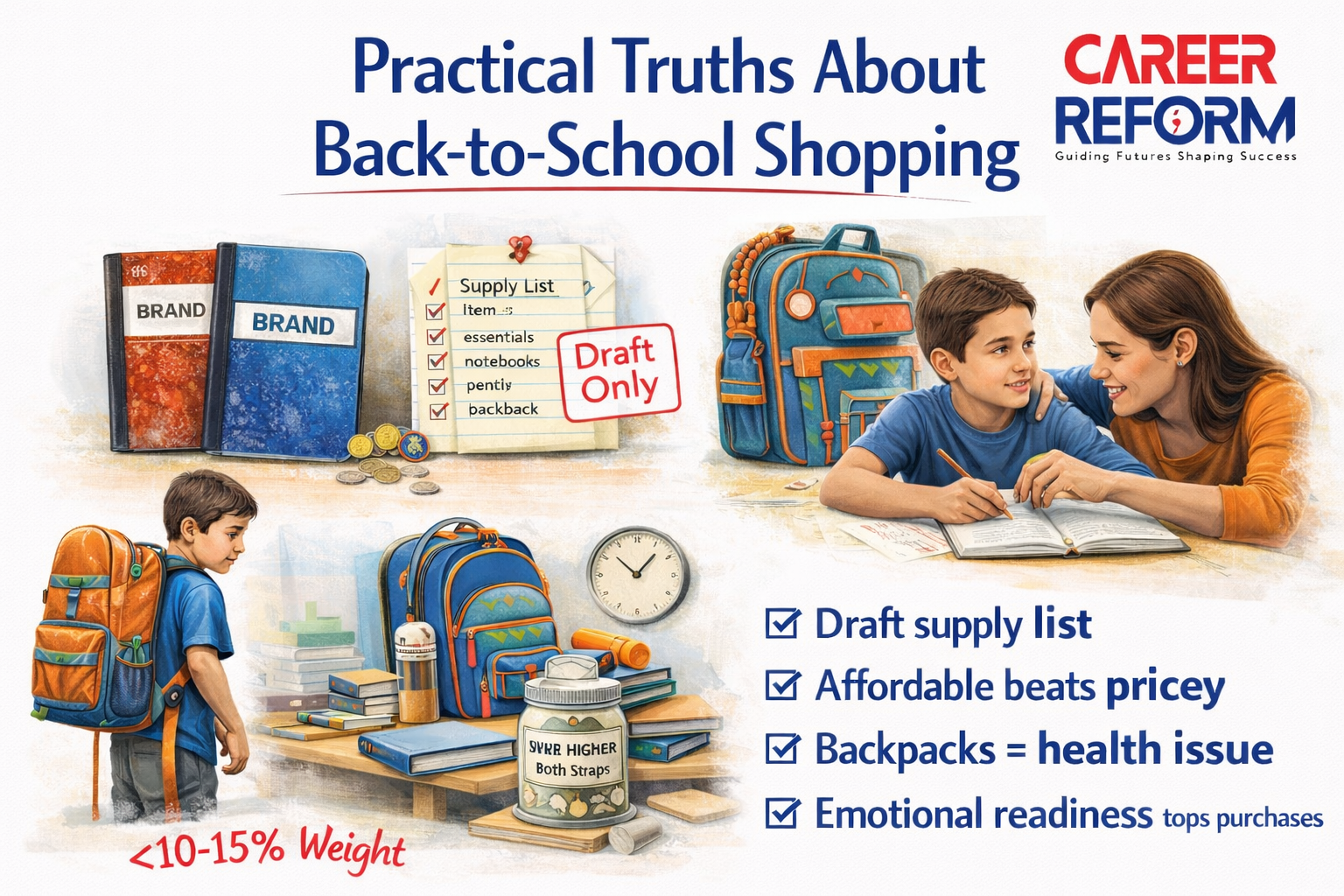
Move 1: Audit Before You Buy Anything. Before stepping into any stationery shop, go to wherever last year’s supplies are kept — the shelf above the study table, the bottom of the school bag, or the cupboard where things go to be forgotten. Pull everything out, sort what is usable, then compare it against the new list. Families who do this cut supply spending by 30 to 45 percent in the very first year. Do this with your child, not for them. Let them see which notebook still has forty pages left. That conversation builds more discipline than any motivational poster on their bedroom wall.
Move 2: Separate Essential from Aspirational. Every school list in India contains two invisible categories that nobody labels. Essential items are the NCERT textbooks, a working compass and protractor, and a ruled notebook. Aspirational items are the ₹2,500 branded bag every child in class is carrying, the colour-coded stationery set, and the extra reference books the tuition teacher casually mentioned. Both have their place. But they deserve separate budgets and separate conversations. Teaching your child to say “this is a need, this is a want” from Class 4 onwards is the same skill they will use at 24, managing their first salary.
Move 3: Invest in Systems, Not Just Supplies. A planner is not a system. Eight subject notebooks are not a system. They are tools. A system is the set of habits that determines how those tools are used every single day. Before shopping, sit with your child and ask: How will you track homework each evening? What will you do when a lesson does not make sense? Where do signed papers go? These questions cost nothing but install a mental infrastructure that makes every tool more effective. Tools without structure create clutter. Tools with structure create performance. Buy supplies that support the system your child describes, not in the hope that supplies will create the system on their own.
Move 4: Build a Mid-Term Reserve. Keep 20 percent of your budget unspent in June. If you plan to spend ₹10,000, spend ₹8,000 and hold ₹2,000 back. Because the Hindi teacher will ask for a separate rough notebook in July. A binder will break. The science project will need chart paper in September. Indian school sessions are long and unpredictable. A small reserve eliminates the mid-term financial stress entirely, and it teaches your child something school will never formally cover: responsible people plan for the unexpected, not just for the ideal.
What Nobody Tells Indian Parents About Back-to-School Shopping
The supply list is a draft, not a mandate. Most CBSE and ICSE schools send lists written months before the session begins, sometimes carried over from the previous year. Some items marked “required” are genuinely optional. Treat the list as a starting point and call the class teacher if you are unsure.
The authorised school shop is not your only option. Many school-appointed vendors charge significantly more than local stationery shops or online platforms for identical products. The bag at the authorised counter for ₹1,800 is often the same quality as one available elsewhere for ₹900.
The school bag is a health issue. Studies by the Indian Spinal Injuries Centre have found that Indian schoolchildren routinely carry bags weighing 6 to 8 kilograms — two to three times the recommended limit. The Indian Medical Association advises that a child’s bag should not exceed 10 percent of their body weight. This is violated in almost every school, every day.
The WhatsApp parent group is the most expensive peer pressure most families experience. Make your shopping decisions before opening the group. Then let the group talk.
Involving your child in the process builds ownership that no parent can manufacture. When Arjun’s parents stopped shopping for him and started shopping with him, he stopped treating supplies as things his parents bought and started treating them as tools he chose. That shift changes behaviour in ways no scolding ever could.
The Bigger Career Lesson Most Indian Parents Miss
Back-to-school season is not really about notebooks. It is about identity.
When you audit first, you teach discernment. When you separate needs from wants, you teach financial literacy. When you build systems with your child, you teach operational thinking. When you involve them in the process, you teach agency.
These are career skills. The same child who learns to manage their Class 8 notebooks with intention becomes the professional who manages their time, money, and decisions with that same quality of thinking. Career clarity is not built in Class 12 under the pressure of board exams. It is built in small, repeated decisions made over years — starting at the kitchen table every June.
At CareerReform.in, we help Indian families connect daily academic habits with long-term career direction, because strategy should start early, not after confusion has already set in.
Your Next Move
In the next 48 hours, do the audit with your child. Have the system conversation. Set your reserve before a single item goes into the cart. And the next time someone posts in the class parent group about a new stationery set, take a breath before adding it to your order.
If you want to go deeper, download the Budget Planning Sheet here.
The best academic year your family ever has does not start at the stationery shop. It starts with a conversation, a plan, and the quiet decision to do things differently this June. Now you have everything you need to begin.
CareerReform.in Guiding Futures. Shaping Success.
Sania Q