

|
Getting your Trinity Audio player ready...
|
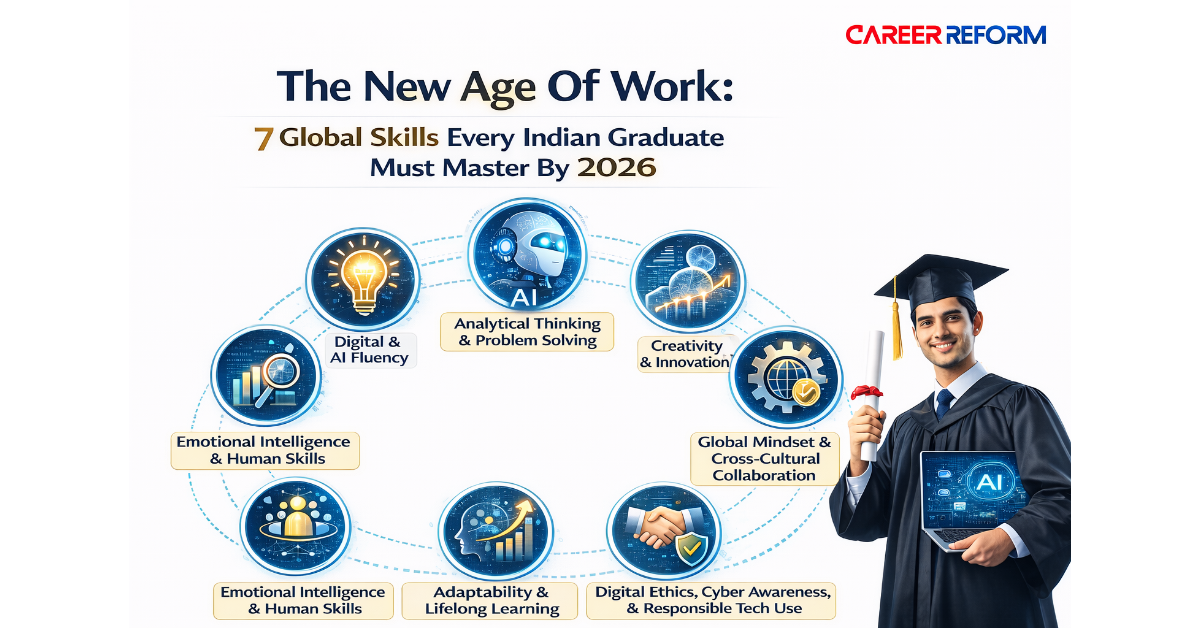
The idea of a “stable career” is being rewritten. Degrees still matter—but they no longer guarantee employability. Today’s employers are looking beyond marksheets and job titles. They want graduates who can think globally, adapt quickly, work with technology, and connect deeply with people.
By 2026, the Indian workforce will be one of the youngest and largest in the world. At the same time, automation, artificial intelligence, remote work, and global hiring are reshaping how jobs are created and filled. According to global workforce projections (hypothetical synthesis based on multiple reports), nearly 60–65% of today’s students will work in roles that do not exist in their current form.
This shift is not a threat—it’s an opportunity. But only for those who prepare intentionally.
Below are the seven global skills that every Indian graduate must master to stay relevant, competitive, and fulfilled in the New Age of Work.
1. Digital & AI Fluency: The New Foundational Skill
Digital literacy is no longer optional—it is the basic language of modern work. But by 2026, fluency will matter more than familiarity.
What Digital & AI Fluency Really Means
It’s not about becoming a coder (unless that’s your goal). It’s about:
- Understanding how AI tools support decision-making
- Using digital platforms efficiently in your field
- Interpreting data rather than fearing it
- Knowing when to rely on automation—and when not to
Hypothetical industry estimates suggest that over 70% of entry-level roles will involve working alongside AI-powered tools, from marketing analytics and finance forecasting to healthcare diagnostics and education platforms.
Why Indian Graduates Must Prioritise This
- Global employers increasingly hire talent who can work remotely using digital systems
- AI is enhancing productivity—but only for those who know how to use it responsibly
- Digital confidence reduces job anxiety and increases career mobility
Digital fluency empowers graduates to work smarter, not harder—and positions them as adaptable professionals rather than replaceable workers.
2. Analytical Thinking & Problem Solving: The Skill Machines Can’t Replace
While machines process information, humans interpret meaning. Analytical thinking sits at the core of this distinction.
What Employers Are Really Looking For
- Ability to break down complex problems
- Logical reasoning combined with contextual judgment
- Decision-making under uncertainty
- Connecting patterns across disciplines
Even in creative or people-oriented roles, professionals are expected to evaluate information, question assumptions, and propose solutions—not just follow instructions.
Why This Skill Defines Career Growth
Graduates with strong problem-solving abilities:
- Move faster into leadership roles
- Adapt better during organisational change
- Add value beyond their job descriptions
In a volatile job market, analytical thinking becomes a career stabiliser—helping individuals navigate challenges, transitions, and new opportunities with confidence.
3. Creativity & Innovation: Standing Out In An Automated World
Automation excels at repetition. Creativity thrives in originality.
Creativity Is No Longer Industry-Specific
Creativity today applies to:
- Designing user experiences
- Developing business strategies
- Communicating ideas clearly
- Solving social and sustainability challenges
Hypothetically, organisations that encourage creative problem-solving are 30–40% more likely to outperform competitors in fast-changing markets.
Why Creativity Matters for Indian Graduates
- It differentiates you in crowded job markets
- It enables career pivots when industries evolve
- It allows professionals to create value, not just execute tasks
Creativity is not a talent reserved for artists—it’s a mindset that helps graduates imagine better ways of working, living, and contributing to society.
4. Emotional Intelligence & Human Skills: The Heart Of Global Careers
As workplaces become more digital, human skills become more valuable.
Core Elements of Emotional Intelligence
- Self-awareness and emotional regulation
- Empathy and active listening
- Clear communication across differences
- Managing conflict constructively
In global and remote teams, misunderstandings can derail productivity faster than technical issues. Emotional intelligence ensures collaboration remains effective and respectful.
Why This Skill Is Critical by 2026
- Hybrid and remote work models rely heavily on trust
- Leadership is increasingly influence-based, not authority-based
- Diverse teams require cultural sensitivity and inclusion
Graduates who master emotional intelligence don’t just perform well—they build strong professional relationships that accelerate long-term success.
5. Adaptability & Lifelong Learning: Staying Relevant In a Moving World
Careers are no longer linear. Most professionals will change roles, industries, or skill sets multiple times.
What Adaptability Looks Like in Practice
- Openness to learning new tools and methods
- Willingness to unlearn outdated approaches
- Comfort with ambiguity and transition
- Curiosity-driven growth
Hypothetical projections suggest that skills acquired today may become partially obsolete within 4–5 years, making continuous learning essential.
Why This Skill Protects Your Future
Adaptable graduates:
- Recover faster from career disruptions
- Seize emerging opportunities early
- Stay employable across economic cycles
Adaptability turns uncertainty into momentum—and learning into a lifelong advantage.
6. Digital Ethics, Cyber Awareness & Responsible Tech Use
As technology becomes deeply integrated into work, responsibility becomes a professional skill.
What Graduates Need to Understand
- Basic cybersecurity practices
- Ethical use of data and AI
- Privacy awareness and digital boundaries
- Accountability in online collaboration
Even non-technical roles now require awareness of digital risks and responsibilities.
Why This Matters in the Global Workforce
- Employers prioritise trust and compliance
- Mishandling digital tools can damage careers
- Responsible tech use builds professional credibility
By 2026, digital responsibility will be viewed as a core professional behaviour—much like punctuality or integrity.
7. Global Mindset & Cross-Cultural Collaboration
Work is no longer limited by geography. Careers are increasingly global—even when you work from home.
What a Global Mindset Involves
- Understanding cultural differences in communication
- Working effectively across time zones
- Respecting diverse perspectives and work styles
- Thinking beyond local career boundaries
India’s growing role in global talent ecosystems means graduates must be prepared to collaborate internationally from day one.
Why This Skill Is a Game-Changer
- Expands job opportunities beyond borders
- Improves leadership potential in multinational environments
- Builds adaptability and cultural intelligence
A global mindset allows graduates to belong anywhere while contributing meaningfully everywhere.
The Bigger Picture: Skills That Build Careers, Not Just Jobs
These seven skills do not exist in isolation. Together, they create a future-ready professional identity—one that balances technology with humanity, ambition with responsibility, and growth with purpose.
At CareerReform.in, the focus is on helping students and professionals understand these shifts early, align their learning journeys accordingly, and build careers that are resilient, ethical, and globally relevant—rather than reactive or uncertain.
Final Thought: 2026 Is Here
The New Age of Work is not arriving someday—it’s already here. The difference between thriving and struggling will depend on how intentionally you prepare today.
Degrees open doors.
Skills sustain careers.
Mindsets shape futures.
The question is no longer “What job should I choose?”
It’s “What kind of professional do I want to become?”