

|
Getting your Trinity Audio player ready...
|
For many Indian students, the idea of studying abroad begins in Class 11 or 12—often driven by dreams of Ivy League universities, global careers, or international exposure. But what if that journey could begin earlier?
In recent years, international schools in India offering global curricula like the IB curriculum and Cambridge IGCSE have gained popularity among families who want to prepare their children for global universities from a younger age.
So the big question is:
Should you apply to an international school now, or wait until college?
Let’s break it down—clearly, honestly, and practically.
What Does “Study Abroad at High School Level” Really Mean?
When we talk about studying abroad for high schoolers, it doesn’t always mean moving overseas at 14 or 15.
It can include:
- Enrolling in international schools in India
- Studying global curricula like IB (International Baccalaureate) or Cambridge IGCSE
- Transferring to an overseas high school in countries like the UK, Canada, Australia, or Singapore
- Preparing early for international education pathways
These options expose students to global academic standards while building skills that universities abroad actively look for.
Why Are More Indian Students Choosing International Education Early?
More Indian families are recognising that early exposure to international education can significantly ease the transition to global universities. Beyond grades, universities today value students who can think independently, manage academic pressure, and adapt quickly to new learning environments. The following real-world student experiences help explain why international curricula like IB and Cambridge IGCSE are gaining momentum.
An IB Student Success Story
A student from Mumbai who studied under the IB Diploma Programme shared that her transition to university abroad felt far less intimidating than she had expected. During high school, she had already completed an Extended Essay, managed multiple internal assessments, and regularly participated in classroom discussions that required defending ideas with evidence.
When she entered a top Canadian university, research papers, group projects, and independent study were already familiar territory. She later reflected that while the IB was academically demanding, it helped her develop confidence, academic discipline, and clarity—skills that many of her peers had to learn for the first time during college.
A Cambridge IGCSE Student Success Story
A student from Bengaluru who completed the Cambridge IGCSE programme described how the curriculum helped him build a strong academic foundation before moving abroad for higher studies. The structured syllabus, clear assessment criteria, and emphasis on conceptual understanding rather than memorisation made subjects like mathematics and economics feel logical and manageable.
After progressing to A-Levels and later joining a UK university, he found the academic transition smooth. He was already comfortable with international exam patterns, analytical writing, and independent revision. Looking back, he credits the Cambridge system for giving him clarity, confidence, and a steady pathway into global education.
Understanding Popular International Curricula
1. IB Curriculum (International Baccalaureate)
Best for students aiming at top global universities
What the IB Curriculum Offers
- Inquiry-based learning: Students are encouraged to ask why and how, not just memorise facts
- Strong research foundation: Extended Essays and internal assessments build academic writing and research skills early
- Balanced academic structure: Subjects across sciences, humanities, languages, and arts
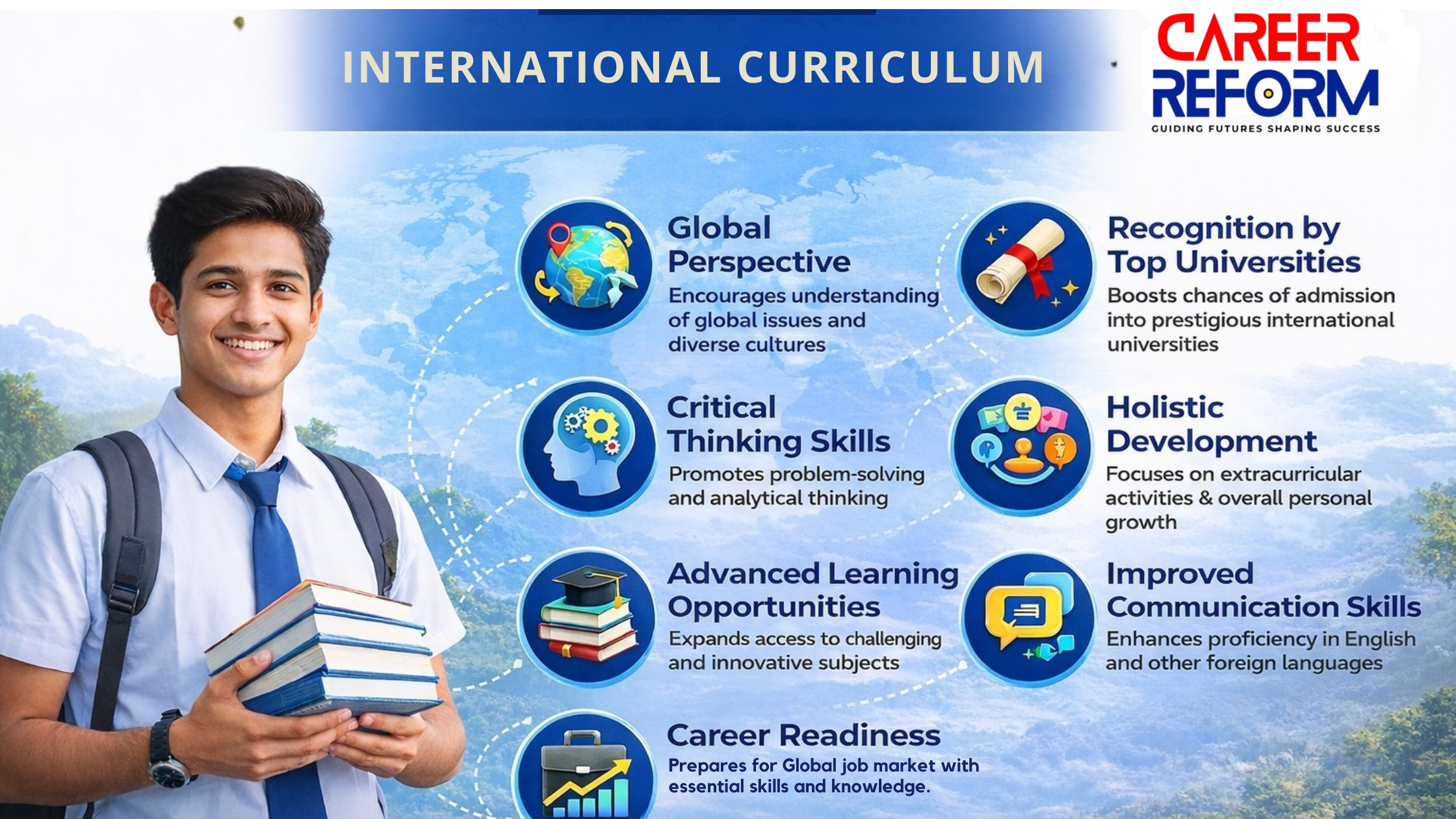
- Global perspective: Emphasis on ethics, international-mindedness, and real-world issues
- Holistic development: Creativity, Activity, and Service (CAS) ensures learning beyond classrooms
Skills Students Develop Through IB
- Critical and analytical thinking
- Academic writing and referencing
- Time management and self-discipline
- Presentation and communication skills
- Independent learning habits
Why IB Helps With Global University Admissions
Universities abroad often view IB students as college-ready because they are already familiar with:
- Research papers
- Academic integrity
- Heavy coursework management
- Discussion-based classrooms
Ideal for:
Students who are curious, self-driven, enjoy discussions, and are aiming for top global universities in the US, UK, Europe, Canada, or Singapore.
2. Cambridge IGCSE (International General Certificate Of Secondary Education)
A strong academic foundation with global recognition
What The Cambridge IGCSE Offers
- Subject flexibility: Students can choose from a wide range of subjects based on interests and strengths
- Clear assessment structure: Exams focus on understanding, application, and problem-solving
- Global benchmarking: Grades are internationally standardised and recognised
- Smooth progression: Direct pathway to A-Levels, IB Diploma, or international foundation programmes
How Cambridge IGCSE Is Different
- Less rote learning compared to traditional systems
- Encourages conceptual clarity rather than memorisation
- Assessment includes written exams, coursework, and practicals (subject-dependent)
Skills Students Build Through IGCSE
- Strong subject fundamentals
- Logical and structured thinking
- Written expression and explanation skills
- Exam preparedness for international standards
Why Universities Value IGCSE Backgrounds
Students with IGCSE experience often adapt faster to:
- International grading systems
- Academic expectations abroad
- Advanced curricula like IB or A-Levels
Ideal for:
Students who want academic rigour with structure, especially those planning a gradual transition to international education or global universities.
IB Curriculum vs Cambridge IGCSE: Which Is Right For You?
| Criteria | IB Curriculum | Cambridge IGCSE |
| Primary Focus | Holistic education, critical thinking, and research | Academic foundation with subject-wise depth |
| Learning Style | Inquiry-based, discussion-driven | Structured and syllabus-focused |
| Assessment Pattern | Internal assessments, projects, presentations, exams | Primarily exams, with coursework/practicals |
| Workload | High and continuous | Moderate to high, exam-oriented |
| Skill Development | Research, analysis, communication, independence | Concept clarity, structured thinking, exam readiness |
| Global Recognition | Accepted by 5,000+ universities worldwide | Recognised in 160+ countries |
| Best Preparation For | Direct entry into top global universities | Transition to IB, A-Levels, or foundation courses |
| Student Profile | Self-driven, curious learners | Students who prefer clarity and structure |
| Suitability for Indian Students | Best for students ready for a major shift | Easier transition from Indian boards |
Is International Schooling The Right Choice For Every Student?
Not necessarily. Choosing international education too early—without planning—can be overwhelming.
Before deciding, families should consider:
- The student’s learning style and motivation level
- Emotional readiness for a different academic culture
- Long-term goals: India or global universities?
- Financial planning and sustainability
This is where career counselling and pathway clarity become crucial.
So, Should You Apply To an International School Now?
Apply early if:
- You are confident about pursuing international education
- You want early exposure to global learning styles
- You are comfortable with independent, research-based learning
Wait or reassess if:
- Academic foundations need strengthening
- Career direction is still unclear
- Emotional or financial readiness is a concern
Start Early, Decide Smart
Studying abroad doesn’t begin with a visa—it begins with planning.
Whether you choose an international school in India, a global high school abroad, or stay within the Indian system, the key is clarity, preparation, and guidance.
And that’s where informed career counselling can make all the difference.
Thinking about international schools, IB curriculum, APs or Cambridge IGCSE for your child?
CareerReform.in is here to help you plan—not panic.
Sania Q