

|
Getting your Trinity Audio player ready...
|
Your 14-year-old comes home one Tuesday evening and announces, with total conviction, that she wants to become a chartered accountant. You feel a quiet wave of relief. She sounds sure. She sounds focused. You smile and say, “That’s wonderful, beta.”
But here is the question you did not ask: Where did that idea come from?
Was it born from a genuine spark, a love of numbers, a fascination with how businesses work, a childhood habit of tracking pocket money in a little notebook? Or did it arrive because her three closest friends decided last month, in a group chat, that CA is “the smartest choice”?
You cannot tell just by looking at her face. And here is the brutal part: neither can she.
72% of students in Grades 8–11 say their career choices are influenced “a lot” or “somewhat” by what their friends are planning to do.
— ASER Youth Aspirations Report 2023 (Published in 2024)
Read that again. Nearly three in four students are undecided about their career. They are inheriting one from their social circle.
This is not a failure of intelligence. It is a failure of self-awareness — and it happens to smart, driven, high-potential children every single day. The tragedy is not that they pick the wrong career. The real tragedy is that most of them never get the chance to discover the right one.
The Problem Nobody Is Naming Out Loud
We spend enormous energy teaching our children what to study. We invest in tuition, school fees, coaching centres, and summer programmes. We track their grades obsessively and benchmark them against toppers, cousins, and the neighbour’s son who “got into IIT.”
And yet, in the middle of all that effort, we skip the one foundational question: Who is this child, actually?
Not who they perform well as. Not who we hope they will become. Who are they, at the core — in terms of cognitive wiring, emotional temperament, natural processing style, and intrinsic motivation?
Most families never answer that question. So the vacuum gets filled by something else: the opinions of 14-year-olds who are equally confused, the aspirational content on Instagram reels, the career “advice” in WhatsApp forwards, and the gentle (sometimes not so gentle) expectations of parents who want their children to be safe, stable, and impressive at family gatherings.
“Social conformity is most powerful when it is invisible. When everyone around you wants the same thing, wanting it yourself feels like personal conviction.”
That is what makes peer pressure in career choices so dangerous. It does not look like pressure. It looks like clarity.
How Peer Pressure Actually Works in Adolescent Brains
Here is what neuroscience actually shows. The adolescent brain — between ages 12 and 17 — is in a state of intense social calibration. The prefrontal cortex, responsible for long-term planning and independent judgment, is still under construction. Meanwhile, the social brain circuitry — the regions that track status, approval, and belonging — is firing at full power.
This means your child is neurologically wired, right now, to place enormous weight on social consensus. When everyone in the friend group seems to want engineering, the brain does not just notice that. It interprets consensus as correctness. It experiences divergence from the group as a form of social risk. Choosing medicine because your best friend chose medicine does not feel like peer pressure to a 15-year-old. It feels like a good idea.
Research note: Research in adolescent psychology consistently shows strong peer influence on career perceptions. While school performance and aptitude are personal, social consensus shapes how teenagers perceive “the right choice” and influences their perceived confidence in that direction. For more on adolescent behaviour and peer influence research, see the peer-reviewed studies published in the Journal of Adolescent Health.
🔗 https://www.journals.elsevier.com/journal-of-adolescent-health
Add social media to this cocktail. Every time your child scrolls through Instagram or YouTube, they consume curated highlight reels of young people living their “best lives” in medicine, tech, finance, or entertainment. These images are aspirational by design. They compress decades of work and luck into thirty seconds of aesthetic perfection.
A teenager watching a 22-year-old influencer talk about “life as a software engineer” does not see the four years of grinding, the rejection letters, the imposter syndrome, or the burnout. They see the hoodie, the MacBook, the salary screenshot, and the sense of identity. And the brain says: I want that.
What the brain does not say — because it literally lacks the circuitry to say it yet — is: But do I have the kind of mind that thrives doing that work for forty years?
Signs Your Child May Be Career-Confused
Not every child who sounds certain is actually certain. Watch for these patterns carefully.
Sign 01- They changed their stated career goal recently, and the change coincided with a social shift. They do not articulate why they changed — just that “it sounds better” or “more promising now.”
Sign 02 – They describe external rewards but struggle to name anything about the actual daily work. Salary, status, job security. No mention of what they would be doing with their hands, their mind, or their time at 11 am on a regular Tuesday.
Sign 03 -Their career aspiration perfectly mirrors that of their best friend or most admired peer. This alone is not proof of peer influence — but combined with vague reasoning, it is a red flag worth examining.
Sign 04 – They show low energy toward the subjects that pathway requires, but high energy in something they dismiss as “not serious enough.” Pay attention to where the enthusiasm actually lives.
Sign 05 – They become defensive or anxious when you probe their reasoning. Deep-rooted, authentic interest can withstand questions. Borrowed conviction collapses under gentle scrutiny.
Sign 06 – They cannot name a single thing about the career that would remain appealing if none of their friends was pursuing it. Strip away the social consensus, and the enthusiasm evaporates. That tells you everything.
If three or more of these patterns fit your child right now, this post was written for you.
What a School Exam Reveals vs. What a Psychometric Test Reveals
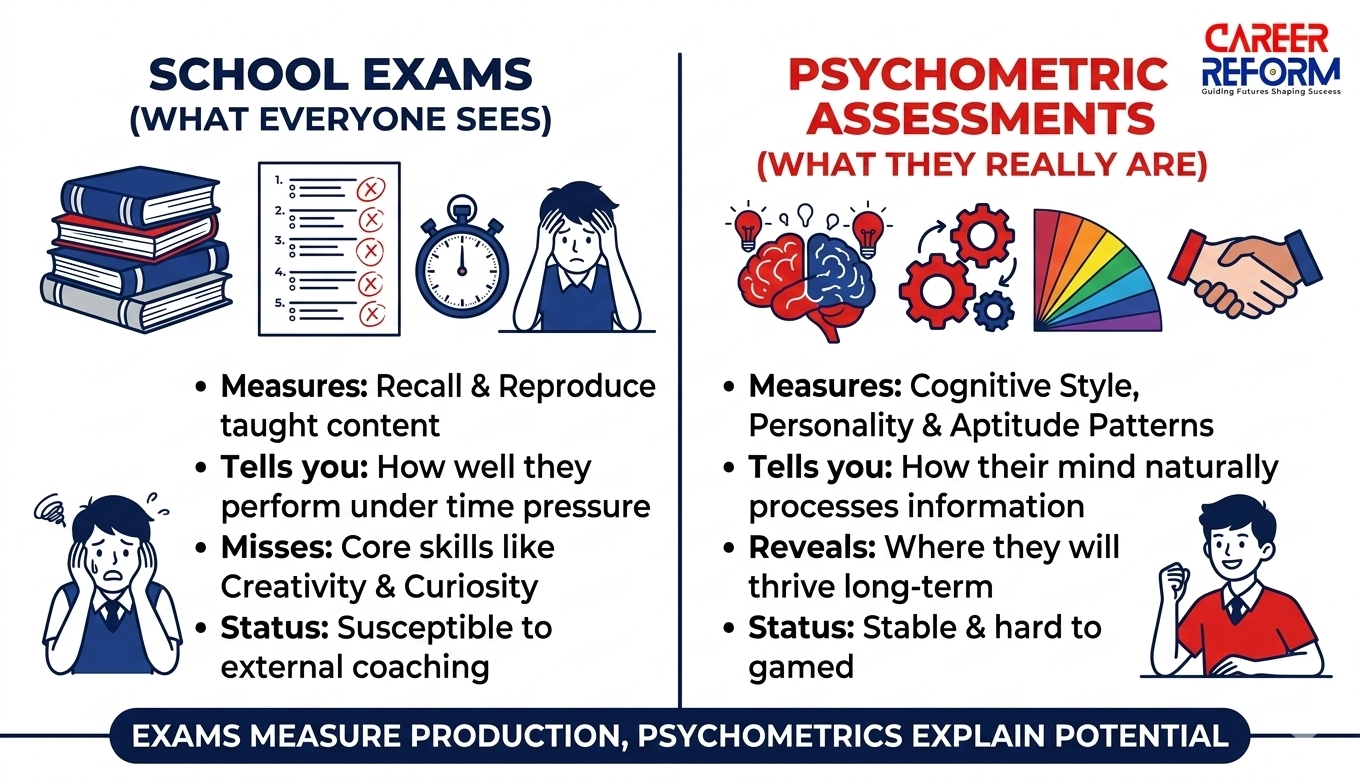
We have built an entire educational system on the assumption that academic performance predicts career fit. It does not. Here is what each actually measures.
School Exam Score:
- What it measures: Ability to recall, reproduce, and apply taught content under time pressure
- What it tells you: How well your child performs within a structured academic system
- What it misses: Creativity, leadership instinct, interpersonal depth, curiosity, adaptability, intrinsic drive
- Career relevance: Determines admission eligibility. Rarely predicts job satisfaction or long-term success.
- Susceptibility to external influence: High. Coaching, tutoring, and test prep can dramatically shift scores.
Psychometric Assessment:
- What it measures: Cognitive style, personality traits, aptitude patterns, motivation, and emotional intelligence
- What it tells you: How your child’s mind naturally processes information and what environments help them thrive
- What it misses: Raw academic output (though it often explains why performance is what it is)
- Career relevance: Maps directly to career environments, work styles, and roles where performance is naturally sustained
- Susceptibility to external influence: Low. Core cognitive and personality patterns are stable and not easily gamed.
A child who scores 92% in mathematics may have a genuinely quantitative mind — or they may have an exceptionally diligent mind that works hard in any subject they are directed toward. You cannot tell from the mark sheet. A psychometric assessment tells you which one is true.
Equally, a child who scores 60% in science may be failing the curriculum but carrying inside them the curiosity, lateral thinking, and pattern-recognition ability of an outstanding researcher. The exam never captures that. A well-designed psychometric tool does.
“A mark sheet tells you what your child produced under test conditions. A psychometric profile tells you what your child is built to produce for the rest of their life.”
The Framework: 4 Steps to Help Your Child Find Genuine Direction
These are not textbook steps. These are things that actually work — drawn from career counseling practice and developmental psychology — that most schools and parents never implement.
Step 01 – Run the “Subtract the Social” Experiment
This is a five-minute conversation that reveals more than months of observation. Ask your child one direct question:
“If you woke up tomorrow and none of your friends were choosing this career — if you had no idea what anyone else was planning — would you still want it?”
- Do not lead the answer. Do not soften the question. Give them time to sit with it. Watch what happens in the silence.
- If the answer is an immediate, slightly indignant “Yes, obviously” — that is a good sign. Authentic interest does not need a social context.
- If they pause and look uncertain, or start justifying based on external factors (salary, prestige, parental approval), you have just discovered that this career choice has a social foundation — not a personal one.
Do this once every six months from Grade 7 through Grade 10. Track how the answers change. The career choices that survive this test consistently are worth taking seriously.
Step 02 – Map the Energy, Not the Grades
For four weeks, track one simple thing. Every day, notice what activity, subject, or type of task made your child lose track of time. Not what they scored highest in. Not what they are praised for. What made them forget to check their phone?
- The child who spends two hours building a game mod “for fun” has told you something about their mind that no school report will.
- The child who voluntarily reads about the psychology of advertising has shown you an aptitude that their commerce grades cannot fully express.
- The child who reorganises the family trip itinerary unprompted may carry planning and systems intelligence that belongs in operations, consulting, or logistics.
Sustained voluntary engagement is the most reliable early signal of natural aptitude. Grade it zero for effort. It was effortless. That is the entire point.
Step 03 – Introduce Psychometric Assessment Before Pressure Peaks
Grade 7 to Grade 9 is the ideal window. Not Grade 11, when the JEE vs. NEET vs. Commerce decision is already being made in a rush. Early psychometric assessment does three things that nothing else can:
- It gives the child a language for themselves. Teenagers who understand their own cognitive style — whether they are analytical-sequential thinkers, creative-associative processors, or people-first intuitive learners — make fundamentally different and better decisions than those who do not.
- It separates performance from potential. Many high-potential students underperform in school because the system is not built for how their brains work. Psychometrics surfaces that gap and allows parents and counselors to address it without shame or blame.
- It creates a stable reference point that resists peer influence. When a child knows, from validated data, that they have strong spatial-visual intelligence and weak sequential memorization, they are far less likely to blindly follow friends into a stream that demands the opposite skill set.
A good psychometric test is not a magic career prescription. It is a map. It shows the terrain honestly. The child still chooses the route.
Step 04 – Conduct a Structured Career Conversation — Not a Lecture
Most career conversations parents have with their children are not conversations. They are broadcasts. The parent transmits a set of beliefs about safety, respectability, and financial stability, and the child either accepts or resists.
A structured career conversation looks different. It starts with questions, not statements.
- “What does the actual day-to-day work in that career look like? What would you be doing at 11 am on a Wednesday?”
- “What is the hardest part of that career path, and how do you think you would handle it specifically?”
- “If you could not have the title, the salary, or the status — just the work itself — would you still want to do it?”
These questions are not traps. They are gifts. They teach a child to think about work as a lived experience, not an identity costume. Most adults wish someone had asked them these questions at 15. You can give your child that advantage today.
What Nobody Tells You About Career Confusion in Teenagers
This is where we stop being polite and start being useful.
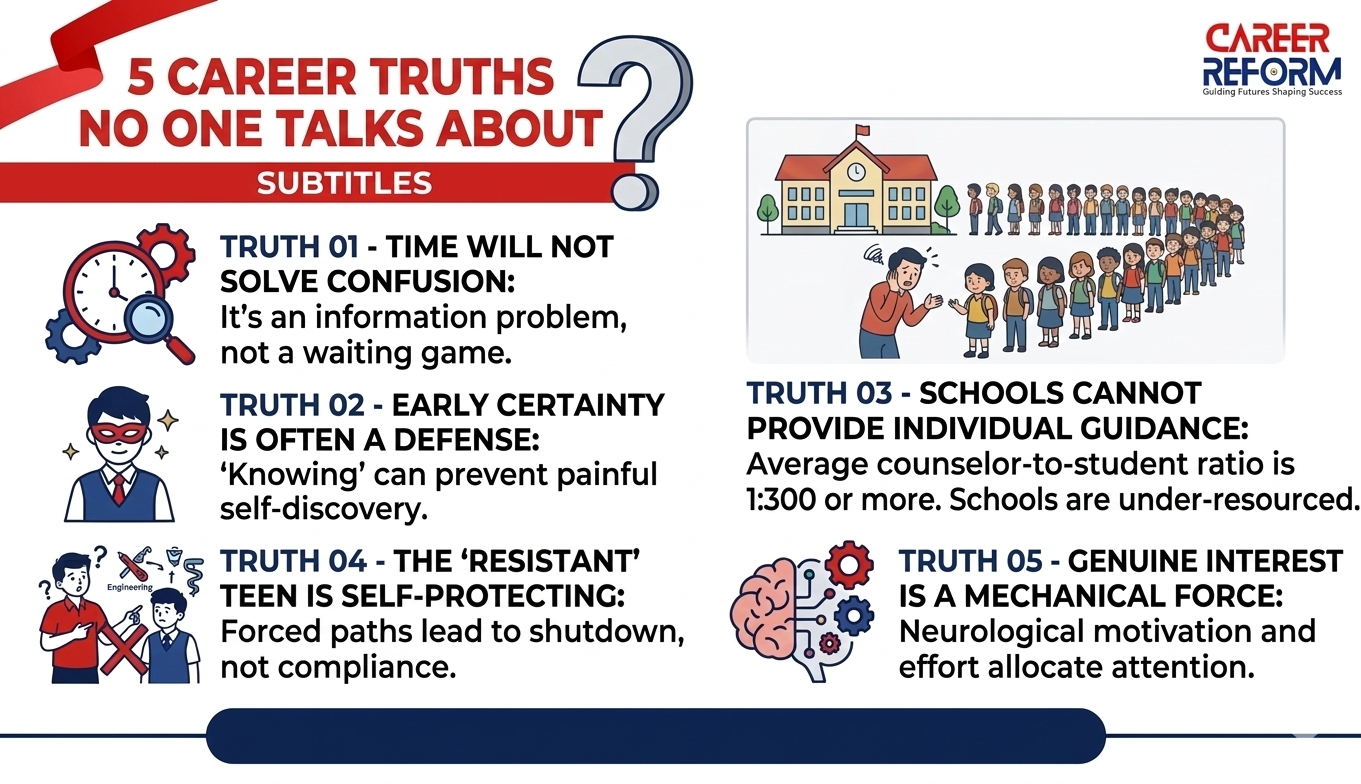
Truth 01 – Career confusion is not a sign of laziness or poor parenting. It is a completely predictable outcome of raising a child in a social environment that has not been designed to help them understand themselves. Schools measure output. Families celebrate achievement. Nobody teaches self-knowledge.
Truth 02 – The children who “know exactly what they want” at 14 are often the most at risk. Premature certainty is frequently a defense mechanism — a way to stop the uncomfortable work of genuine self-exploration. It feels stable. It rarely is.
Truth 03 – School counselors are catastrophically under-resourced. Most school counselors in India manage 300 to 500 students at once. The idea that they can provide meaningful individualized career guidance is a structural myth. It is not their fault. It is a system design failure. Parents who rely entirely on the school for career guidance are hoping for a service the system cannot actually deliver.
Truth 04 – Your child’s resistance to career conversations is not rebellion. It is self-protection. When teenagers feel they are being pushed toward a verdict — choose engineering, choose medicine, choose something respectable — they shut down. The conversation needs to feel like exploration, not cross-examination. If they are shutting down with you, change the format of the conversation before you change the content.
Truth 05 – A child who finds genuine direction at 14 or 15 does not just perform better academically. They perform differently. The effort-to-output ratio changes because they are no longer spending energy forcing interest in something they do not naturally care about. Genuine alignment is not motivational — it is mechanical. It changes how the brain allocates attention and effort at a neurological level.
Truth 06 – A quality psychometric assessment is one of the highest-value investments a parent can make during the secondary school years. It costs less than six months of tuition. The returns are measured in decades. The best assessments measure real, validated constructs — cognitive aptitude, learning style, emotional response patterns, interest clusters, that have strong predictive validity for career performance and satisfaction. It is not a personality label. It is a precision instrument.
A Final Word to Students Reading This
If you are in Grade 7, 8, 9, or 10 and reading this, maybe your parents shared it with you or your counselor pointed you here, I want to say something directly to you.
You do not need to have it figured out. The pressure you feel to sound certain is not about your future. It is about other people’s comfort. Adults feel better when teenagers sound sure. Friends feel safer when everyone shares a plan. That pressure is real, but it is not yours to carry.
What you do need to do, and what very few people will tell you, is pay attention to yourself.
Notice what makes you curious. Notice what makes you angry in a productive way. Notice what you would do with a free Saturday if nobody was watching and nobody would judge you. Notice the kinds of problems you solve in your head when you are supposed to be doing something else. That information is not irrelevant. It is the most relevant data available about who you are and what kind of work will feel meaningful to you. No algorithm, no ranking, and no group chat can generate it for you.
“The career that fits you will not sound impressive to everyone. It will feel right to you. Learn to trust that difference.”
A psychometric assessment does not tell you what to become. It gives you a mirror, clearer than any exam result, cleaner than any family expectation, so you can see yourself accurately and make your own honest choice.
That is a powerful thing to have at 14. Most adults get it at 34, after one career change and a lot of expensive regret.
You have the chance to get it now.
Ready to Give Your Child That Mirror?
Explore our psychometric test packages designed specifically for students in Grades 7–10 — built by career psychologists, interpreted by certified counselors, and delivered in a language your child will actually understand.
[Explore Test Packages → Start with the right assessment for your child:
🔹 Stream Selector Test (Best for Class 9–10)
Find out which stream — Science, Commerce, or Humanities — best matches your aptitude and interests.
👉 https://careerreform.in/stream-selector-test/
🔹 Ideal Career Test
A deep psychometric profile that analyzes aptitude, personality, motivation, and career-fit environments.
👉 https://careerreform.in/ideal-career-test/
🔹 Commerce Career Assessment
Discover careers in finance, business, management, and commerce aligned with your cognitive strengths.
👉 https://careerreform.in/commerce-test/
🔹 Humanities Career Assessment
Identify suitable careers in psychology, law, design, public policy, media, and liberal arts.
👉 https://careerreform.in/humanities-career/
🔹 Engineering Career Assessment
Find out which engineering fields best match your analytical, spatial, and technical abilities.
👉 https://careerreform.in/engineering-test/
Give your child clarity most students discover years too late.
➡️ Start your psychometric assessment today and help your child make a confident career decision.