

|
Getting your Trinity Audio player ready...
|
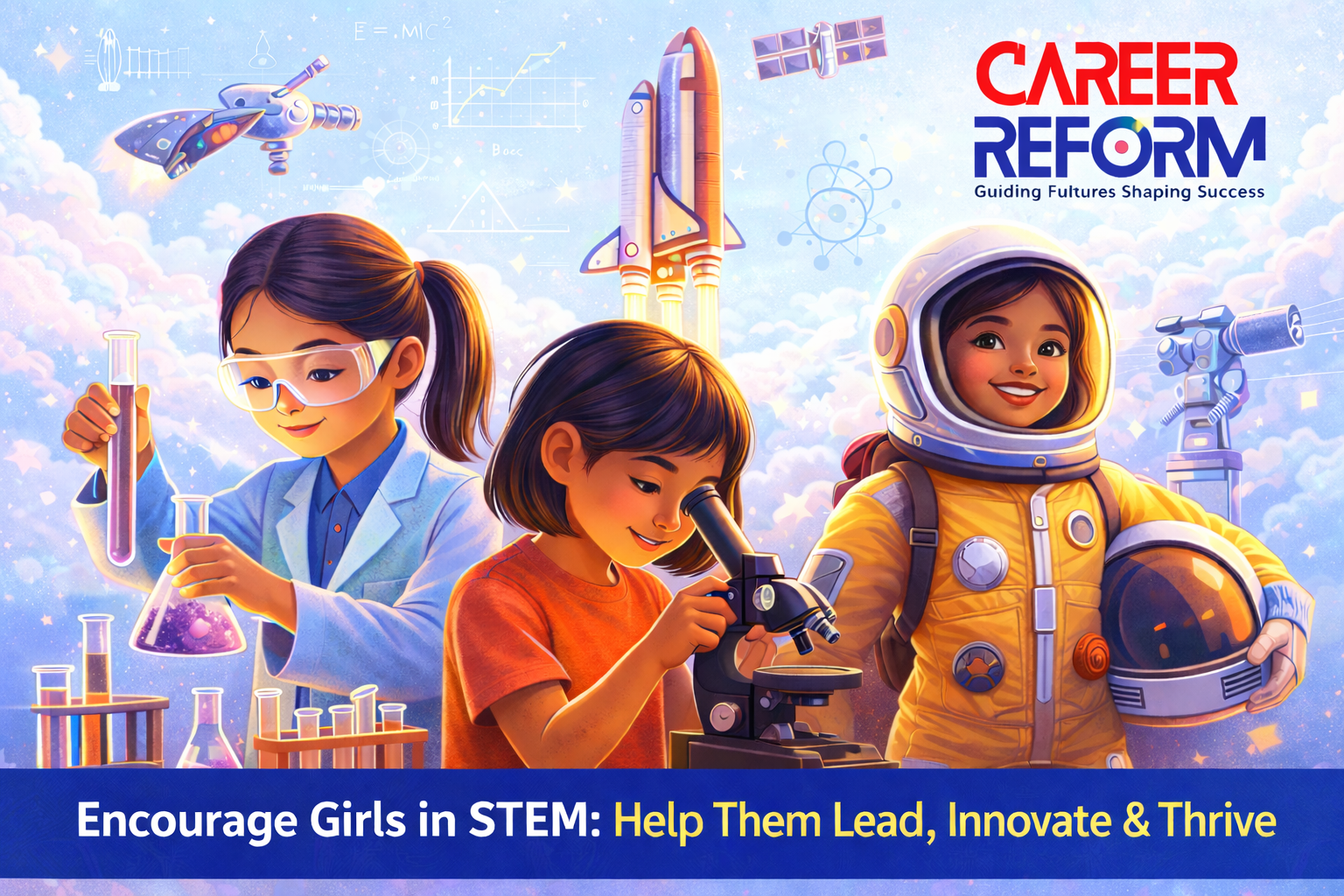
Despite progress in education and awareness, many girls still hesitate to pursue science, technology, engineering, and mathematics (STEM). This hesitation is rarely about ability. More often, it stems from social conditioning, lack of exposure, limited guidance, and self-doubt developed early in life.
Parents are the first and most influential career guides a child has. The way science and math are discussed at home, the expectations set, and the opportunities provided can shape a girl’s confidence for years to come.
This article explores why girls in STEM education is critical, the barriers girls face, and how parents can actively nurture their daughters’ interest in science and math—starting today.
Why Girls In STEM Education Matters More Than Ever
STEM careers are no longer niche or limited to laboratories. They influence nearly every aspect of modern life—healthcare, climate solutions, artificial intelligence, space exploration, finance, and even creative industries.
Yet, women remain significantly underrepresented.
Key facts and trends:
- Women constitute around 30% of the global STEM workforce (UNESCO, WEF – indicative figures).
- In physics, engineering, and computer science, women’s participation often falls below 20–25%.
- Research consistently shows that girls perform as well as boys in math and science at school, but participation drops sharply after secondary education. (Statistics reflect global research trends; exact numbers vary by region.)
Encouraging girls in STEM education is not just about equality—it:
- Expands innovation by bringing diverse perspectives
- Addresses future skill shortages
- Creates economic independence and leadership opportunities for women
- Strengthens national progress in science and technology
Common Barriers Girls Face In Science & Math
Understanding these barriers helps parents respond with empathy rather than pressure.
1. Stereotypes and Social Conditioning
From an early age, girls receive subtle messages about what they are “supposed” to be good at. Toys, advertisements, school dynamics, and even casual comments can reinforce the idea that math or physics is unusual for girls.
Over time, this affects:
- Subject choices
- Self-belief
- Willingness to take academic risks
2. Lack Of Visible Role Models
When textbooks, classrooms, and media mostly highlight male scientists, girls struggle to see a future version of themselves in these fields. The absence of relatable examples can make STEM feel:
- Distant
- Unwelcoming
- “Not meant for me.”
3. Fear Of Failure and Perfectionism
Girls are often socialised to avoid mistakes. STEM subjects, however, thrive on trial, error, and problem-solving.This mismatch can lead to:
- Anxiety around tests and competitions
- Avoidance of advanced math or physics
- Loss of confidence despite strong ability
4. Limited Awareness Of STEM Career Options
Many families associate STEM only with engineering or medicine, overlooking fields like:
- Data science
- Environmental science
- Biomedical research
- UX design
- Climate technology
- Computational social sciences
Without clarity, girls may opt out simply because they don’t see where science can take them.
How Parents Can Encourage Girls In Math and Science
Encouragement doesn’t require technical expertise—it requires mindset, consistency, and openness.
1. Normalize Curiosity and Critical Thinking
Curiosity is the foundation of scientific thinking. When parents encourage questions, they nurture confidence.
What parents can do:
- Take questions seriously, even simple ones
- Explore answers together instead of giving quick solutions
- Connect science to everyday life—cooking, travel, health, technology
This builds a natural relationship with learning.
2. Remove Gendered Expectations From Language and Actions
Children internalize beliefs long before they question them.
Be mindful of:
- Comments about “boys being better at math.”
- Comparing siblings or peers by gender
- Assigning different expectations unconsciously
Instead, emphasize:
- Effort over talent
- Growth over perfection
- Skills over stereotypes
3. Introduce Strong Female Role Models In Science
Representation builds possibility. Parents can:
- Share stories of women scientists, engineers, and innovators
- Highlight Indian women leaders in ISRO, medicine, research, and tech
- Encourage the following women in STEM on social media or YouTube
Role models make abstract careers feel real and achievable.
4. Encourage Hands-On and Experiential Learning
Girls often engage deeply when learning feels meaningful.
Effective approaches include:
- Science kits, puzzles, and experiments at home
- Coding platforms designed for beginners
- Math through games, budgeting, design, or architecture
- Science clubs, exhibitions, and workshops
Hands-on learning builds confidence faster than theory alone.
5. Support Exploration Without Pressure
Interest in STEM doesn’t have to be immediate or linear. Parents should:
- Guide girls to explore arts and humanities alongside science
- Avoid forcing subject choices too early
- Reassure them that changing interests is normal
Confidence grows when girls feel supported, not boxed in.
Girls In Physics and Advanced STEM: Breaking The Myth
Physics and advanced mathematics often see the sharpest drop in female participation—not due to difficulty, but due to perception. Parents can support girls by:
- Encouraging them to continue math and physics beyond compulsory levels
- Treating difficulty as part of learning, not a warning sign
- Showing how physics connects to space science, energy, medicine, and technology
Early encouragement here opens doors to high-impact, future-ready careers.
The Role Of Career Guidance In Supporting Women In Science
Many capable girls leave STEM pathways because of:
- Confusion about subject combinations
- External pressure
- Lack of career clarity
- Fear of limited options
This is where professional career guidance makes a difference.
Confidence Is The Real Formula For Success
Girls don’t need to be “pushed” into STEM—they need to be supported, encouraged, and believed in. Science and math are not about gender. They are about curiosity, persistence, and imagination and girls have all of these in abundance.

CareerReform Picks: STEM Competitions That Empower Girls
With supportive parenting, early career guidance, and platforms like CareerReform.in, more girls can not only enter STEM but also thrive, lead, and transform the future through it. To help girls explore and grow, CareerReform recommends engaging in meaningful competitions and projects such as:
- Technovation Girls – a global technology challenge where girls build mobile apps to solve real-world problems (https://www.steamvisionfoundation.org/technovation-India)
- Future City Competition – an international engineering design challenge focused on building sustainable cities (https://en.wikipedia.org/wiki/Future_City_Competition)
- World Robot Olympiad (WRO) – a global robotics competition encouraging creativity and problem-solving (https://wro-association.org)
- FIRST Global Challenge – an international robotics event promoting STEM careers through Olympic-style competition (https://en.wikipedia.org/wiki/FIRST_Global_Challenge)
- International Greenwich Olympiad – an international STEAM project platform for research and innovation (https://igolondon.co.uk)
Explore the full range of immersion programs here.
Sania Q