

For decades, we’ve been fed a romanticized lie: to “make it” globally, you must pack your life into two suitcases and fly across an ocean. We’re told that the quality of education is directly proportional to the distance traveled.
But here is the unspoken truth for 2026: The most sophisticated players in the global job market aren’t chasing stamps in their passports; they are chasing ROI.
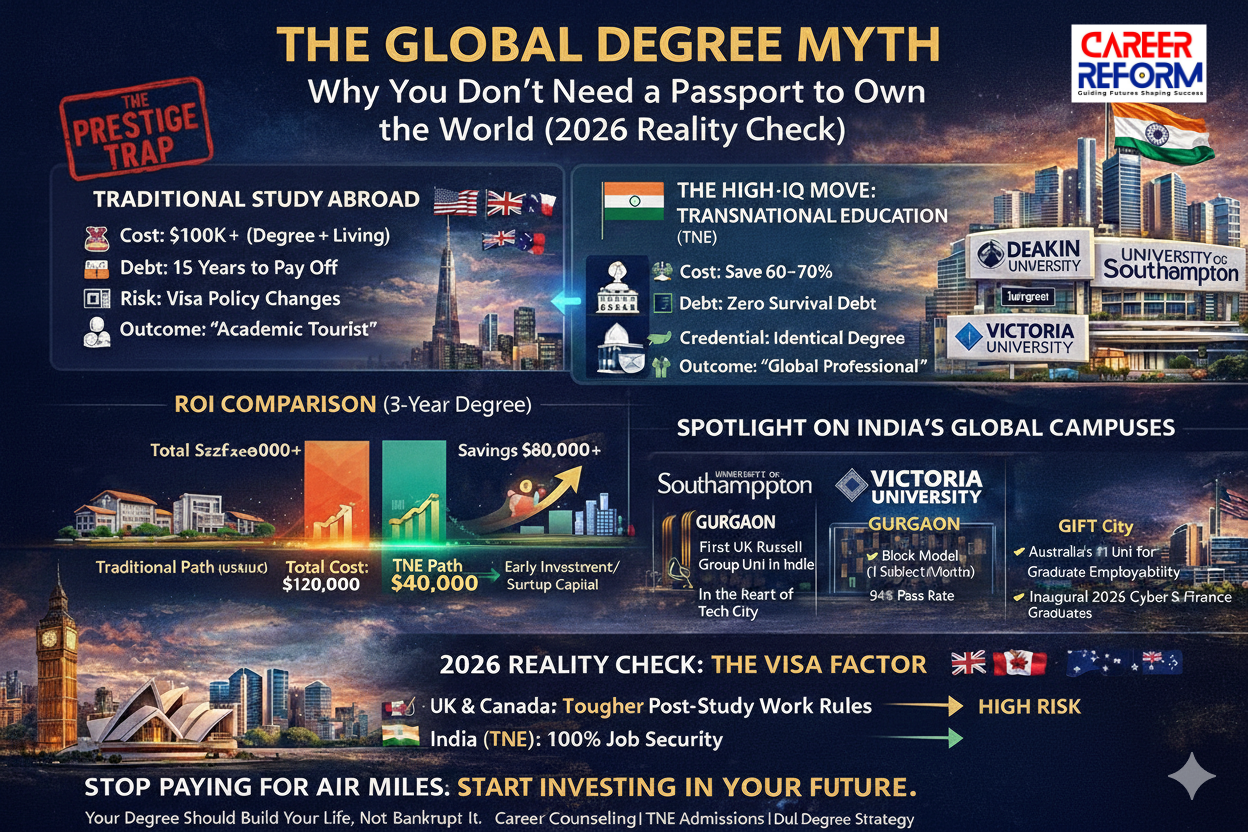
According to recent 2026 data, the cost of a traditional 3-year degree in the “Big Four” (USA, UK, Australia, Canada) has skyrocketed, often exceeding $100,000 when you factor in the “survival tax”—rent, insurance, and the hidden costs of living abroad. Meanwhile, Transnational Education (TNE) is exploding. The UK has officially shifted its 2026 strategy to prioritize “offshore” degrees over physical recruitment.
You can now earn a degree from a top-tier British, American, or Australian university while sitting in a classroom in Dubai, Mauritius, or GIFT City, India. You get the same parchment, the same curriculum, and the same global prestige—without the $80,000 lifestyle debt.

The Problem: The “Prestige Trap” is Bankrupting Your Future
The traditional study-abroad model is failing. It’s built on a 20th-century obsession with “exposure” that often leaves graduates with a world-class degree and a third-world bank balance.
- The Debt Anchor: Most students take 15 years to pay off a foreign degree. That’s 15 years of saying “no” to startups, property, or investments.
- The Policy Lottery: Visa laws in 2026 are volatile. You spend four years studying in a country that might change its “Post-Study Work” rules overnight, effectively deporting your investment.
- The Curriculum Lag: Many on-campus programs are still teaching 2022 theories. TNE programs, by nature, are leaner and more aligned with the digital, borderless economy.
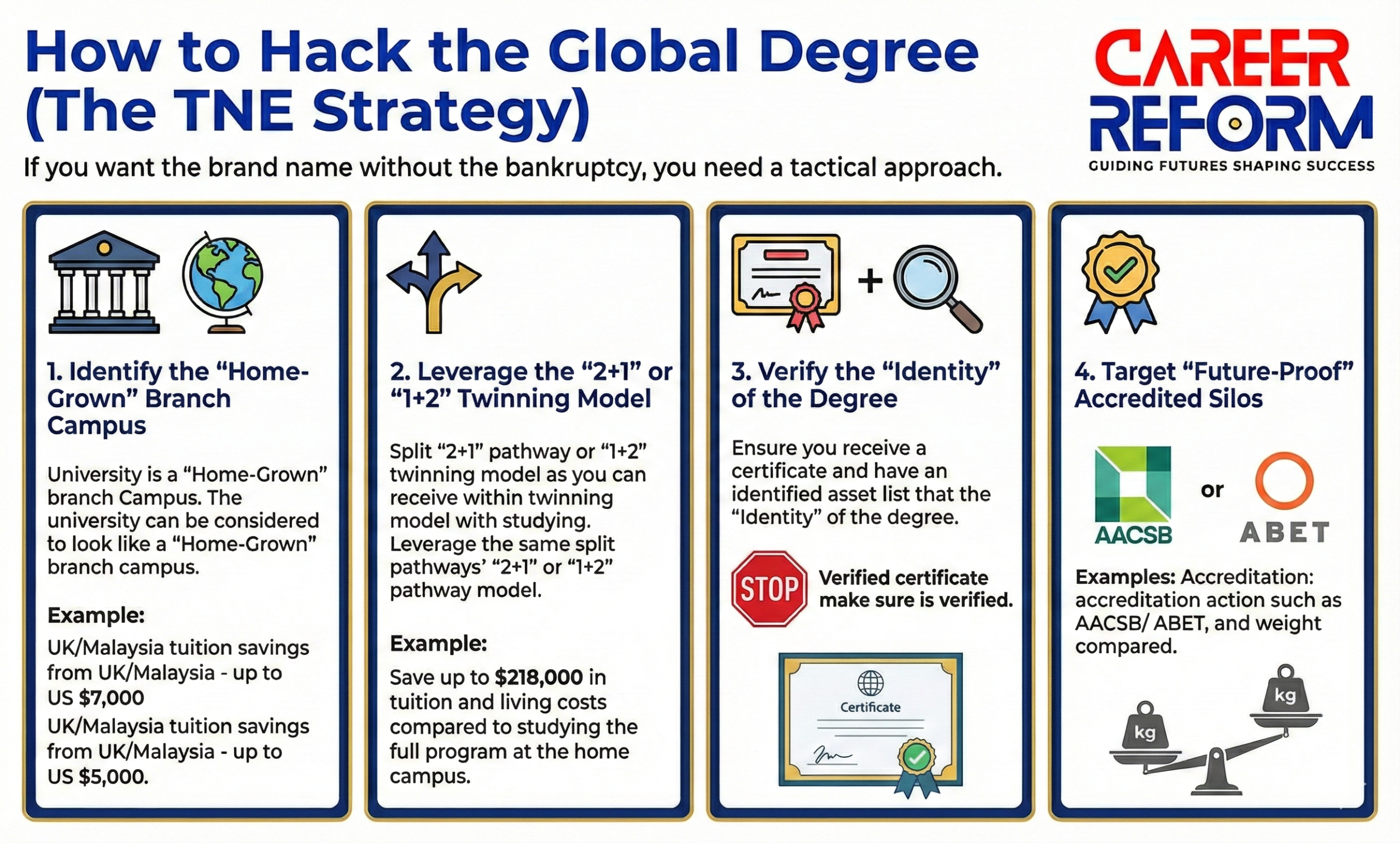
The Framework: How to Hack the Global Degree (The TNE Strategy)
If you want the brand name without the bankruptcy, you need a tactical approach. Here is how to execute a TNE or Dual Degree strategy:
- Identify the “Home-Grown” Branch Campus: Focus on universities that have established physical infrastructure in lower-cost hubs. For example, a student at a UK branch campus in Malaysia pays roughly 30% of the tuition fee of the London campus but receives an identical degree.
- Leverage the “2+1” or “1+2” Twinning Model: Don’t commit to all three years abroad. Look for programs where you spend the first two years at a local partner institution and the final year at the home campus. You save $60,000 in living costs but graduate as an “international” student with full alumni rights.
- Verify the “Identity” of the Degree: Before signing, demand to see a sample certificate. If the degree says “Awarded in [Local City],” walk away. The world-class play is a degree that is digitally and physically indistinguishable from the one issued at the main campus.
- Target “Future-Proof” Accredited Silos: In 2026, employer trust is tied to specific accreditation like AACSB (Business) or ABET (Engineering). A TNE program with these badges carries more weight than a “safe” local degree from a mediocre university.
What nobody tells you about TNE…
Let’s get uncomfortable.
The social capital is different. You aren’t getting the “pub culture” of London or the “frat life” of the US. If your goal is to party in a foreign city for three years, TNE will feel like a compromise.
A Glocal Faculty Mix. The most effective Transnational Education (TNE) models in 2026 discard the “fly-in, fly-out” faculty trope in favour of a Dual-Engine Academic Core. By blending local professors, who possess deep “ground-truth” knowledge of India’s complex supply chains and regulatory nuances, with international faculty from the home campus, students gain a unique hybrid intelligence. The local faculty provides the scaffolding for immediate employability within the Indian ecosystem, while global experts inject the high-level governance, research methodologies, and cross-border standards required for the international stage. This symbiotic relationship ensures that students don’t just learn global theory in a vacuum; they learn how to translate that theory into high-impact local action, facilitating a seamless transition from a regional mindset to a global career trajectory.
The “Global” network is what you make of it. On a main campus, the network happens to you. In a TNE program, you have to hunt for it. You must be the one to email the professors in the home country, join the global alumni webinars, and force your way into the international career fairs.
Employers only care about results. In 2026, over 70% of global hiring managers value the rigor of the institution over the geography of the classroom. If you can prove you mastered a Carnegie Mellon curriculum while navigating a different cultural context locally, you aren’t “lesser”, you are more adaptable.
The Verdict: Own the Brand, Skip the Burden
The era of the “Academic Tourist” is over. The “Global Professional” is here.
By choosing a TNE or Dual Degree path, you are making a high-IQ financial move. You are buying the same intellectual asset at a massive discount. You are keeping your local network intact while building a global credential.
The job market doesn’t reward you for how many air miles you’ve clocked. It rewards you for the skills you possess and the brand that backs them.
The landscape of Indian higher education didn’t just shift; it underwent a tectonic reorganization. If you are still looking at flight tickets to London or Melbourne as your only path to prestige, you are working with an outdated map.
Today, the University of Southampton in Gurgaon and the Deakin and Wollongong campuses in GIFT City aren’t just “foreign outposts.” They are the high-performance engines of a new Indian elite.
The New Power Players: Gurgaon to GIFT City
- University of Southampton (Gurgaon): As the first Russell Group (UK’s “Ivy League”) university to open a comprehensive campus in India, they’ve planted their flag in the heart of the International Tech Park. They aren’t just teaching Computer Science and Business; they are embedding students in an ecosystem of 8 million square feet of premium business space. You graduate with a world-top-100 degree while having interned at the global giants next door.
- Victoria University (Gurgaon – Opening Mid-2026): VU is bringing the “Block Model” to India. Forget juggling five subjects at once. You study one subject intensively for four weeks. It’s a pedagogical revolution designed for high-focus, high-retention learning that has already seen a 94% pass rate in Australia.
- Deakin & Wollongong (GIFT City): These Australian pioneers are the anchors of India’s first smart business district. Deakin’s inaugural 2026 cohort is already graduating into high-finance and cyber roles within the GIFT City SEZ. They offer “In India, for India” education with TEQSA (Australian) accreditation standards.
The “Real Talk” Section: What Nobody Tells You…
The “Visa Trap” is real. In 2026, UK , Australian and Canadian post-study work policies are tighter than ever. If you spend ₹1.5 Cr abroad and are forced to return to India due to visa caps, your ROI timeline stretches from 4 years to 15 years.
By staying in India, you are buying the same asset at 40% of the price. You start your career with zero “survival debt,” allowing you to take risks, join startups, or invest early.
Don’t follow the crowd to the airport. Follow the value to the future.
Ready to build a global career without the debt?
Stop guessing your way through university applications. At CareerReform, we specialize in identifying high-ROI TNE programs and Dual Degree pathways that align with the 2026 economy.
Sania Q