

Every year around this time, I hear the same sentence from parents.
“We love the idea of studying abroad, but scholarships are very rare, right?”
It sounds practical. Sensible, even. And it is also the biggest reason many capable Indian students quietly give up on global education before they even begin.
Here is the uncomfortable truth. Scholarships are not rare. Poor planning is.
Across the United States, Canada, the UK, Europe, Australia, and parts of Asia, universities and governments actively fund Indian students. Not just for Master’s and PhDs, but for undergraduate degrees too. Tuition, living costs, travel, insurance. Often fully funded. Frequently underutilised.
What separates students who receive scholarships from those who do not is not luck or board marks alone. It is timing, clarity, and strategy.
This guide breaks down country-wise scholarships for Indian students at both undergraduate and graduate levels, with practical insights for families planning for 2026–27 admissions.

Why Scholarships Matter More Than Ever
Let’s talk about money without pretending it is not emotional.
Undergraduate degrees abroad last three to four years. That is a long financial commitment for any Indian family.
Graduate degrees are shorter, but the annual cost is often higher. Loans look manageable on paper until currency fluctuations, job uncertainty, and repayment pressure kick in.
Scholarships change this equation in three powerful ways.
- They reduce long-term debt.
- They increase academic credibility.
- They open doors to better visas, jobs, and research opportunities.
Students who begin scholarship planning 12 to 18 months in advance statistically double their chances of securing funding. Late applicants are not rejected because they are weak. They are rejected because the money is already gone.
Undergraduate vs Graduate Scholarships: What Most Families Get Wrong
A common mistake is assuming that scholarships work the same way at all levels. They do not.
Undergraduate Scholarships
Undergraduate funding is usually a mix of merit and financial need.
Many scholarships are linked directly to university admission.
Several require school nominations or counsellor endorsement.
Serious profile building begins as early as Classes 9 to 11.
This is why last-minute applications rarely succeed.
Graduate Scholarships
Graduate scholarships focus less on marks and more on direction.
Leadership, research intent, career clarity, and impact matter deeply.
Many awards are government-funded and applied for separately from admissions.
Work experience, internships, and research exposure add disproportionate value.
In short, undergraduate scholarships reward promise. Graduate scholarships reward purpose.
Country-Wise Scholarships Indian Students Should Track
United States
High Cost, High Funding Potential
The US is expensive, yes. But it also offers some of the most generous need-based and merit-based aid for Indian students.
Undergraduate funding includes university-specific scholarships and large endowment-based awards. A notable example is the Tata Scholarship at Cornell University, which covers full tuition and living expenses for Indian undergraduates admitted to the university.
At the graduate level, the Fulbright-Nehru Fellowships remain one of the strongest fully funded options for Indian Master’s and PhD students, covering tuition, living costs, travel, and insurance.
Many US universities also offer assistantships, departmental funding, and internal merit awards that families often ignore.
Canada
Balanced Costs with Strong Research Funding
Canada attracts students who want affordability without compromising on quality.
For undergraduates, the Lester B. Pearson International Scholarship at the University of Toronto remains one of the most competitive fully funded programs, covering tuition, residence, and books for four years. School nomination is mandatory, which is where early planning matters.
Graduate students benefit from structured research funding. The Vanier Canada Graduate Scholarships provide generous PhD funding, while provincial awards like the Ontario Graduate Scholarship support Master’s and doctoral students.
United Kingdom
Prestige and Impact Driven
UK scholarships often reward leadership and long-term impact rather than financial need alone.
Exceptional undergraduate students can access awards like the Jardine Scholarship at Oxford and Cambridge, along with university-based scholarships such as UCL’s Global Undergraduate Scholarship and Bristol’s Think Big awards.
For postgraduate students, Chevening Scholarships fully fund Master’s degrees for future leaders, while Commonwealth Scholarships support students in development-focused disciplines.
The UK demands clarity. Vague goals do not get funded.
Germany
Low Tuition, High Academic Value
Germany quietly remains one of the most cost-effective destinations for Indian students.
Public universities charge little to no tuition, even for international students. Scholarships like those offered by DAAD cover living expenses, insurance, and travel for eligible undergraduate and postgraduate programs.
Germany is particularly strong for engineering, applied sciences, sustainability, and research-oriented fields.
Europe (Multiple Countries)
Joint Degrees and Mobility Scholarships
Europe rewards students willing to move across borders.
Erasmus+ joint bachelor’s and master’s programs offer tuition support, monthly stipends, travel allowances, and insurance across multiple European universities.
The Erasmus Mundus Joint Master’s remains one of the most generous graduate scholarships globally. Programs are competitive, interdisciplinary, and career-oriented.
Country-specific programs like the Orange Tulip Scholarship in the Netherlands also offer partial tuition support at select universities.
Australia
Merit and Development Focused
Australian universities provide a mix of undergraduate merit scholarships and postgraduate government funding.
Institutions like Macquarie University offer early acceptance scholarships, while Australia Awards Scholarships fully fund postgraduate study for students aligned with public policy, governance, and development goals.
Australia rewards clear intent and academic consistency.
Singapore
High Competition, High Return
Singapore is not forgiving, but it is rewarding.
Top performers in academics and research can access merit-based scholarships at institutions like NUS and NTU. Postgraduate students benefit from research-linked funding and industry collaborations.
This path suits students who are academically strong and mentally prepared for intensity.
South Korea
STEM and Research Powerhouse
South Korea actively funds international talent in science and technology.
Institutions like KAIST offer fully funded undergraduate scholarships, covering tuition, stipends, airfare, and insurance. Graduate students often receive research assistantships and government-supported funding.
Turkey
Fully Funded Government Programs
Turkey’s government scholarship programs provide one of the most comprehensive funding packages for Indian students.
Tuition, accommodation, monthly stipends, health insurance, and airfare are covered for both undergraduate and graduate students. Deadlines usually fall in late winter or early spring, catching many students unprepared.
Scholarship Timelines That Actually Work
Students fail not because they are late, but because they underestimate how early “early” really is.
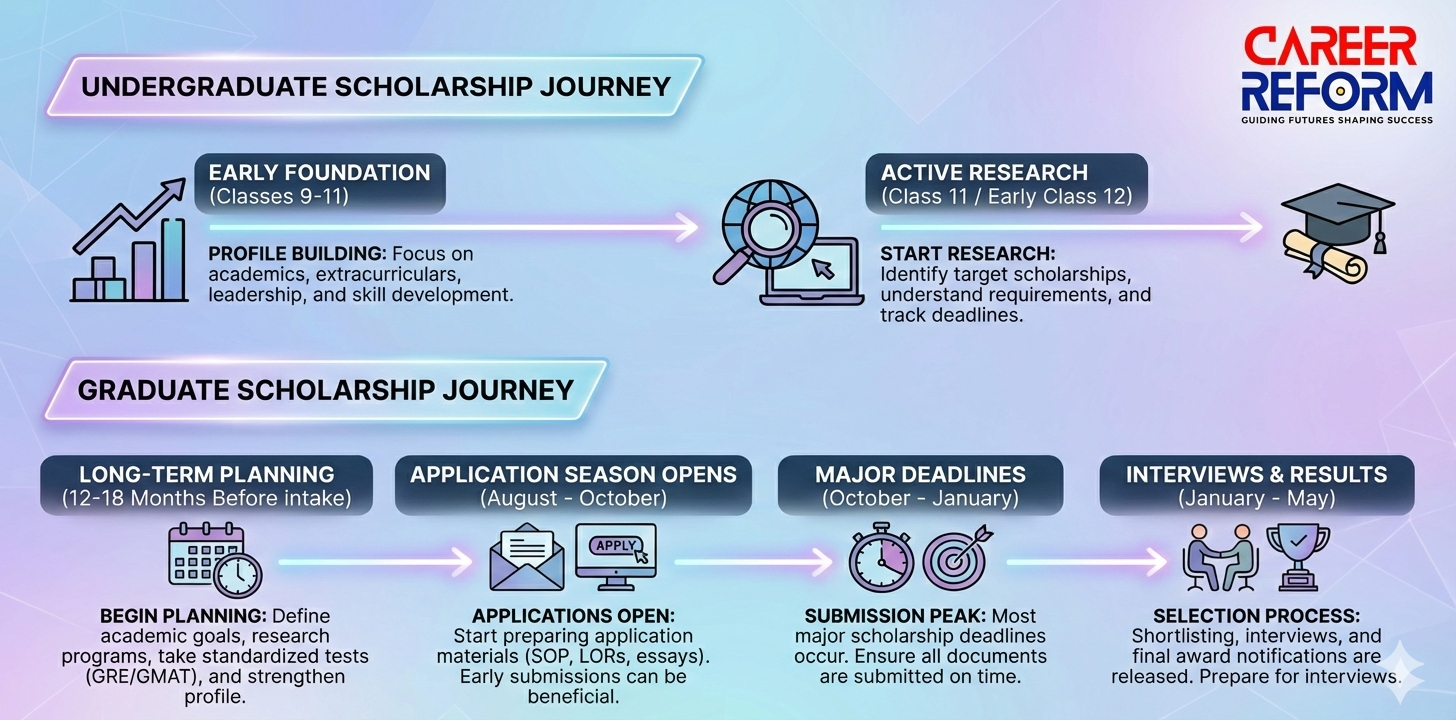
Undergraduates should begin profile building by Classes 9 to 11 and start active scholarship research in Class 11 or early 12.
Graduate students should begin planning 12 to 18 months before intake, with applications opening between August and October and major deadlines running from October to January.
Interviews and results typically follow between January and May.
Mistakes That Cost Students Funding Every Year
Applying randomly without a country strategy.
Assuming scholarships are only for toppers.
Recycling statements of purpose across countries.
Missing early deadlines while waiting for university offers.
Ignoring smaller or partial scholarships that add up significantly.
These are not small errors. They are expensive ones.
How CareerReform Supports Study Abroad Aspirants for 2026
CareerReform works with students and families who want clarity, not confusion.
Support includes career-aligned country and course selection, undergraduate and postgraduate scholarship shortlisting, long-term profile building, structured SOP and essay development, and interview preparation.
The focus is not on shortcuts. It is a sustainable success.
Download our free resource on available scholarships here.
A Note to Parents and Students
Scholarships are not exceptions designed for a lucky few.They are structured systems created for students who plan early and apply intentionally.
Studying abroad becomes affordable when ambition is matched with preparation. If you are aiming for 2026 admissions, now is not too early. It is exactly on time.
Students and parents can begin with a personalised scholarship roadmap to track deadlines, shortlist realistic options, and plan applications calmly rather than reactively.
Global education does not start with an application form. It starts with a conversation.